TLDR
- Non-contact sound wave technology handles corrosive fluids and large pipes without sensor degradation
- Top brands: Siemens, Emerson, Endress+Hauser, ABB, and KROHNE deliver proven accuracy
- Transit-time meters dominate clean fluid applications (80-85% market share)
- Match meter type to your fluid properties, pipe size, and accuracy requirements
- Specialized brands like FLEXIM excel in niche applications beyond major players
Overview of Ultrasonic Flow Meters in Industrial Applications
Accurate flow measurement is critical for industrial facilities managing everything from water billing to custody transfer. Traditional mechanical meters struggle with large pipes, corrosive fluids, and high maintenance demands.
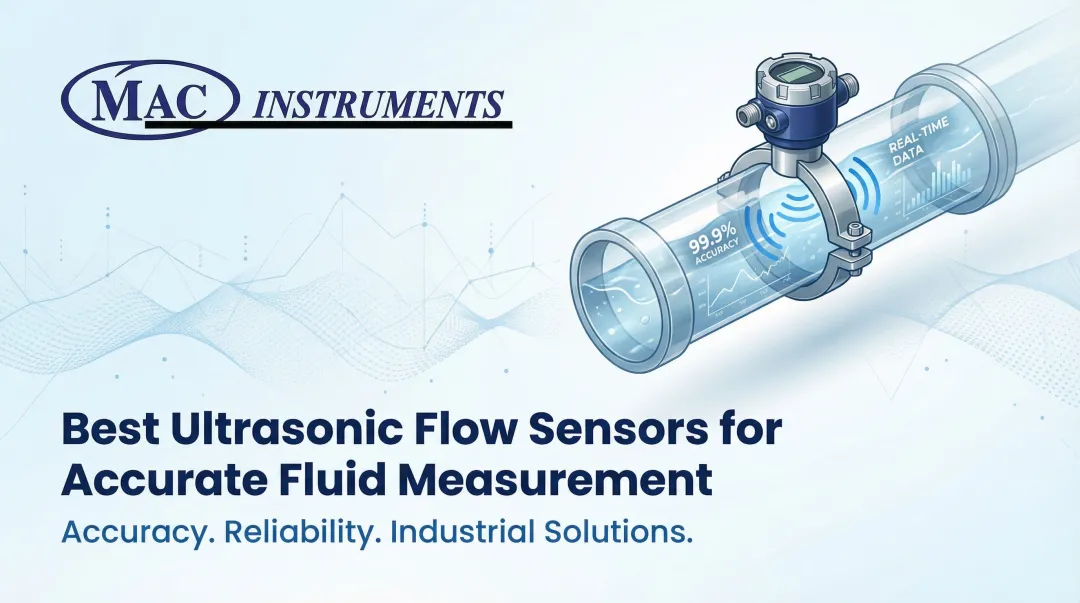
Ultrasonic flow meters measure fluid velocity using two distinct acoustic principles. Transit-time meters measure the time difference between ultrasonic pulses traveling upstream versus downstream through clean, homogeneous liquids. Doppler meters measure the frequency shift of ultrasonic signals reflected off particles or bubbles suspended in the fluid, making them suitable for slurries and aerated liquids.
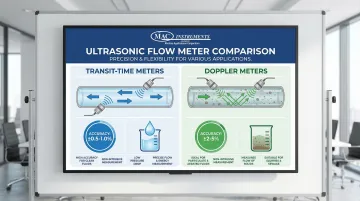
These meters offer key advantages over traditional flow measurement technologies:
- Non-invasive measurement eliminates the need to cut pipes or interrupt processes
- Zero pressure drop reduces energy consumption and pumping costs
- Minimal maintenance with no moving parts to wear or replace
- Large pipe capability handles diameters from 0.5 inches to 160 inches
- Corrosive fluid compatibility since sensors mount externally on clamp-on models
The ultrasonic flow meter market reached $2.1 billion by 2024, growing at a CAGR of 6.5%. Transit-time technology commands 80-85% of global market share due to superior accuracy.
Common applications span water utilities for leak detection and billing, oil and gas custody transfer, chemical plants handling corrosive media, HVAC energy management systems, and food and beverage sanitary processes.
Top Ultrasonic Flow Meter Brands and Manufacturers
These manufacturers were selected based on technological innovation, measurement accuracy, global market presence, and proven customer support.
Siemens (Germany)
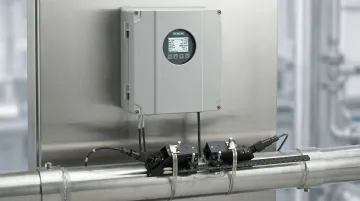
Siemens' SITRANS F ultrasonic portfolio offers both clamp-on and inline configurations for water, oil, gas, and steam applications.
Their WideBeam transit-time technology uses the pipe wall as a waveguide, improving signal-to-noise ratio in challenging measurement conditions.
What makes Siemens stand out:
- Seamless integration with Siemens TIA Portal and SIMATIC control systems
- Robust clamp-on technology for non-invasive retrofits on existing piping
- Advanced diagnostic capabilities for predictive maintenance
- Comprehensive global support network with local service centers
- Hydrocarbon measurement functions including standard volume and interface detection
| Feature | Details |
|---|---|
| Key Product Lines | SITRANS FS220 (clamp-on), SITRANS FST030 (custody transfer), SITRANS FUS380 (inline) |
| Typical Accuracy Range | ±0.5% to ±1.0% of reading depending on application |
| Best Applications | Water utilities, oil & gas custody transfer, large pipe retrofits, plants with existing Siemens automation |
Emerson (Rosemount - USA)
Emerson's Rosemount ultrasonic product line focuses on high-accuracy measurement for critical fiscal metering and custody transfer applications.
Their meters integrate seamlessly with PlantWeb digital architecture and DeltaV control systems for comprehensive process visibility.
Their key differentiators:
- ±0.15% linearity for custody transfer and fiscal metering
- Smart Meter Verification technology for in-situ diagnostics without process interruption
- Proven reliability in harsh upstream oil and gas environments
- ISO 17025 certified calibration laboratories ensuring traceability
- Full compliance with API MPMS Chapter 5.8 and OIML R117 standards
| Feature | Details |
|---|---|
| Key Product Lines | Rosemount 3814 (inline liquid), SeniorSonic (gas) |
| Typical Accuracy Range | ±0.15% to ±0.5% of reading for custody transfer |
| Best Applications | Oil & gas fiscal metering, custody transfer, critical process control, high-accuracy digital integration |
Endress+Hauser (Switzerland)
Endress+Hauser's Proline Prosonic Flow series spans clamp-on, inline, and insertion configurations—offering one of the most comprehensive ultrasonic portfolios from a single manufacturer.
The company is known for complete measurement solutions with strong field service support.
What sets them apart:
- Comprehensive product portfolio covering most ultrasonic applications
- Heartbeat Technology enables in-situ verification without process interruption
- Industry-specific certifications for custody transfer and hygienic applications
- Extensive calibration facilities and field service network
- Pressure Equipment Directive (PED) compliance and hazardous area approvals
| Feature | Details |
|---|---|
| Key Product Lines | Proline Prosonic Flow B 200 (inline), Proline Prosonic Flow E 100 (clamp-on), Proline Prosonic Flow G 300 (gas) |
| Typical Accuracy Range | ±0.3% to ±1.5% depending on model and application |
| Best Applications | Water/wastewater, custody transfer, chemical processing, customers seeking single-source solutions |
ABB (Switzerland)
ABB's ultrasonic offerings focus on smart digital features and integration with the ABB Ability ecosystem for advanced analytics and remote monitoring.
The company specializes in municipal water and wastewater applications, making them a common choice for utility providers.
Their competitive advantages:
- On-site verification technology confirms accuracy without process shutdown
- Strong focus on water and wastewater utility applications
- Integration with ABB control systems and digital platforms
- Practical innovations solving real operational challenges
- Thermal energy measurement approvals for district heating
| Feature | Details |
|---|---|
| Key Product Lines | AquaMaster (water/wastewater), ProcessMaster (industrial process), WaterMaster (utility metering) |
| Typical Accuracy Range | ±0.5% to ±2.0% depending on application and installation |
| Best Applications | Municipal water systems, wastewater treatment, utility billing, plants with ABB automation infrastructure |
KROHNE (Germany)
KROHNE specializes in flow and level measurement as a core focus.
Their OPTISONIC ultrasonic meters are known for custody transfer accuracy and expertise in challenging applications involving aggressive media.
Why they're considered specialists:
- Family-owned company with singular focus on measurement technology
- Large-scale calibration facilities for large-diameter meters
- Strong engineering expertise for custody transfer and corrosive/abrasive media
- Proven track record in oil & gas and chemical industries
- Factory sensor calibration ensuring accuracy without process interruption
| Feature | Details |
|---|---|
| Key Product Lines | OPTISONIC 3400 (clamp-on), OPTISONIC 6300 (custody transfer), OPTISONIC 7300 (biogas/flare gas) |
| Typical Accuracy Range | ±0.5% for custody transfer, ±1.0% for general industrial |
| Best Applications | Oil & gas custody transfer, large pipe installations, corrosive/abrasive media, certified accuracy requirements |
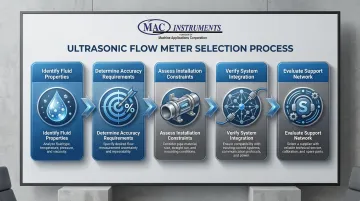
How We Chose the Best Ultrasonic Flow Meter Brands
The evaluation framework considered four critical dimensions:
- Technological capability: Measurement principles, accuracy specifications, and diagnostic features
- Product range breadth: Clamp-on versus inline options, pipe size coverage, and material compatibility
- Global presence and support: Service network density, calibration facilities, and technical expertise availability
- Proven track record: Performance in critical applications like custody transfer and fiscal metering
Common Buyer Mistakes to Avoid
- Choosing based solely on initial purchase price without calculating total cost of ownership
- Selecting a brand without verifying compatibility with existing control systems and communication protocols
- Not matching meter technology (transit-time versus Doppler) to actual fluid characteristics
- Overlooking calibration requirements and long-term support availability
- Underestimating installation requirements like straight pipe runs and proper sensor alignment
Beyond avoiding these pitfalls, successful meter selection requires matching technology to your specific application.
Critical Application-Specific Factors
When selecting an ultrasonic flow meter, prioritize these considerations:
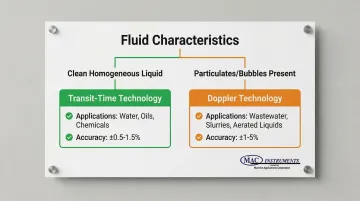
- Clean liquids require transit-time technology; fluids with particles need Doppler
- Pipe material (metal, plastic, lined), size, and wall thickness affect clamp-on performance
- Custody transfer demands ±0.5% or better accuracy; process monitoring may accept ±1-2%
- Determine whether the pipe can be cut for inline installation, or if clamp-on is mandatory
- Verify communication protocols (HART, Modbus, PROFIBUS) match your control system
- Confirm availability of local calibration services and technical support
The Asia Pacific region represents 29% of global market growth, driven by infrastructure investments, making regional service capabilities increasingly important for international operations.
Conclusion
The top ultrasonic flow meter brands—Siemens, Emerson, Endress+Hauser, ABB, and KROHNE—are global leaders in accuracy, reliability, and innovation. Transit-time meters excel with clean liquids and offer superior accuracy, while Doppler technology handles particulate-laden fluids that would block transit-time signals.
The best choice depends on matching technology type, accuracy requirements, and integration needs to your specific application.
When making your final decision, evaluate these critical factors:
- Technical specifications matched to your application requirements
- Manufacturer support capabilities and calibration services
- Compatibility with existing plant infrastructure
- Total cost of ownership (installation, calibration intervals, maintenance)
- Long-term reliability and service availability
Ultrasonic flow meters excel at liquid and gas flow measurement across diverse industrial applications. Yet certain specialized processes require complementary instrumentation for complete process control.
High-temperature steam systems and moisture-critical processes benefit from pairing ultrasonic meters with specialized instruments. MAC Instruments provides steam flow meters and moisture analyzers designed specifically for extreme-temperature environments up to 1200°F, offering NIST-traceable measurement that complements ultrasonic flow measurement for comprehensive process visibility.
Frequently Asked Questions
What is the most commonly used flow meter?
Electromagnetic (mag) flow meters are most common for liquids, accounting for 27.2% of market revenue. Differential pressure meters dominate gas/steam applications, while ultrasonic meters are increasingly popular for non-invasive and large-pipe installations.
What are the two types of ultrasonic flow meters?
Transit-time meters measure signal time differences between upstream and downstream paths (±0.5-1.0% accuracy for clean liquids). Doppler meters measure frequency shifts from particles or bubbles in the fluid (±2-5% accuracy for liquids with suspended solids).
Who makes flowmeters?
Major manufacturers include Emerson, Endress+Hauser, Siemens, ABB, KROHNE, Yokogawa, and Honeywell. FLEXIM specializes in clamp-on ultrasonic applications, while emerging manufacturers offer cost-effective alternatives.
How do I choose between transit-time and Doppler ultrasonic flow meters?
Choose transit-time meters for clean, liquids (water, oils, chemicals) when you need higher accuracy (±0.5-1.5%). Select Doppler meters for fluids containing particulates, bubbles, or suspended solids (wastewater, slurries, aerated liquids), accepting lower accuracy (±1-5%) as a trade-off for measuring otherwise difficult fluids.
What is the typical accuracy of ultrasonic flow meters?
Transit-time ultrasonic flow meters typically offer ±0.5% to ±1.5% accuracy in optimal conditions, with custody transfer models achieving ±0.5% or better when properly installed and calibrated. Doppler meters generally provide ±1% to ±5% accuracy depending on fluid consistency, particle concentration, and installation quality.
Are ultrasonic flow meters suitable for custody transfer applications?
Yes, high-end transit-time meters from Endress+Hauser, KROHNE, and Emerson meet API MPMS Chapter 5.8 standards for oil and gas custody transfer. They require multipath inline installation, ISO 17025 certified calibration, and regular verification.