Ultrasonic flow meters become problematic when the data can’t be trusted during real-world operating upsets. You’re the one dealing with readings that shift with load or temperature, control loops that no longer behave, and questions you’re expected to answer with confidence. When that happens, the risk isn’t theoretical; it’s operational, reputational, and very real.
This article helps you evaluate where ultrasonic flow measurement holds up, where it breaks down, and how to make defensible decisions before those failures land on your desk.
Key Takeaways
Ultrasonic flow meters don’t usually fail outright; they lose reliability when real process conditions violate their assumptions.
Temperature changes, flow distortion, steam quality, and acoustic instability are the root causes behind most “mysterious” issues.
The highest risk comes when ultrasonic data is used for control, energy accounting, or reporting without clear validity boundaries.
In steam and thermal processes, replacing inferred flow with direct, in-situ steam or moisture measurement can reduce uncertainty instead of managing it.
How Ultrasonic Flow Meters Actually Work
Ultrasonic flow meters determine flow by transmitting sound waves through a moving process medium and analyzing how flow alters those signals. The principle is straightforward. The risk comes from how dependent that principle is on the flow profile, temperature, and acoustic stability inside real piping.
How Transit-Time Ultrasonic Flow Measurement Works
Transit-time meters send ultrasonic pulses both upstream and downstream and calculate flow from the difference in signal travel time. When velocity profiles are stable and predictable, the method can produce repeatable results. In operating plants, changes in temperature, turbulence, or pipe geometry directly affect the speed of sound and distort the measurement.
What this means in practice:
Flow readings change with process load or thermal conditions
Installation sensitivity becomes a dominant error source
Long-term drift can appear without obvious device faults
How Doppler Ultrasonic Flow Measurement Works
Doppler meters measure flow by detecting frequency shifts in sound waves reflected off particles or bubbles moving with the fluid. The method assumes those scatterers are present and consistent. When solids loading, entrained gas, or steam quality changes, the measurement basis changes with it.
Operational consequences engineers encounter:
Signal strength tied to process variability, not just flow
Apparent accuracy during one operating mode and failure in another
Limited confidence when validating against mass or energy balances
Why Both Methods Depend on Acoustic Path Stability
Regardless of method, ultrasonic meters rely on a clear, stable acoustic path between transducers. High temperatures, condensation, vibration, and pipe wall condition all interfere with that path. These effects rarely show up during commissioning and tend to surface under upset or transient conditions.
Real-world implications:
Diagnostics may report a healthy instrument while data quality degrades
Problems emerge during startups, shutdowns, or load swings
Engineers are left troubleshooting data, not hardware
What the Ultrasonic Working Principle Does and Does Not Solve
The ultrasonic principle enables non-intrusive flow measurement and fast response. It does not protect against poor installation geometry, unstable process conditions, or changing thermal environments. Understanding this boundary is critical when deciding whether ultrasonic measurement reduces risk or quietly adds to it.
This is where MAC Instruments helps by shifting the measurement focus from inferred flow to direct, in-situ steam and moisture data. Instead of relying on assumptions about acoustic stability or flow profiles, the measurement reflects what’s actually happening in the process. For many steam-driven and thermal applications, that shift improves control confidence and reduces downstream uncertainty.
Common Failure Modes in Real Plants
Ultrasonic flow meters rarely fail catastrophically. They fail quietly, by delivering data that looks plausible but no longer reflects the process. This section focuses on the failure modes that experienced engineers actually encounter after commissioning.
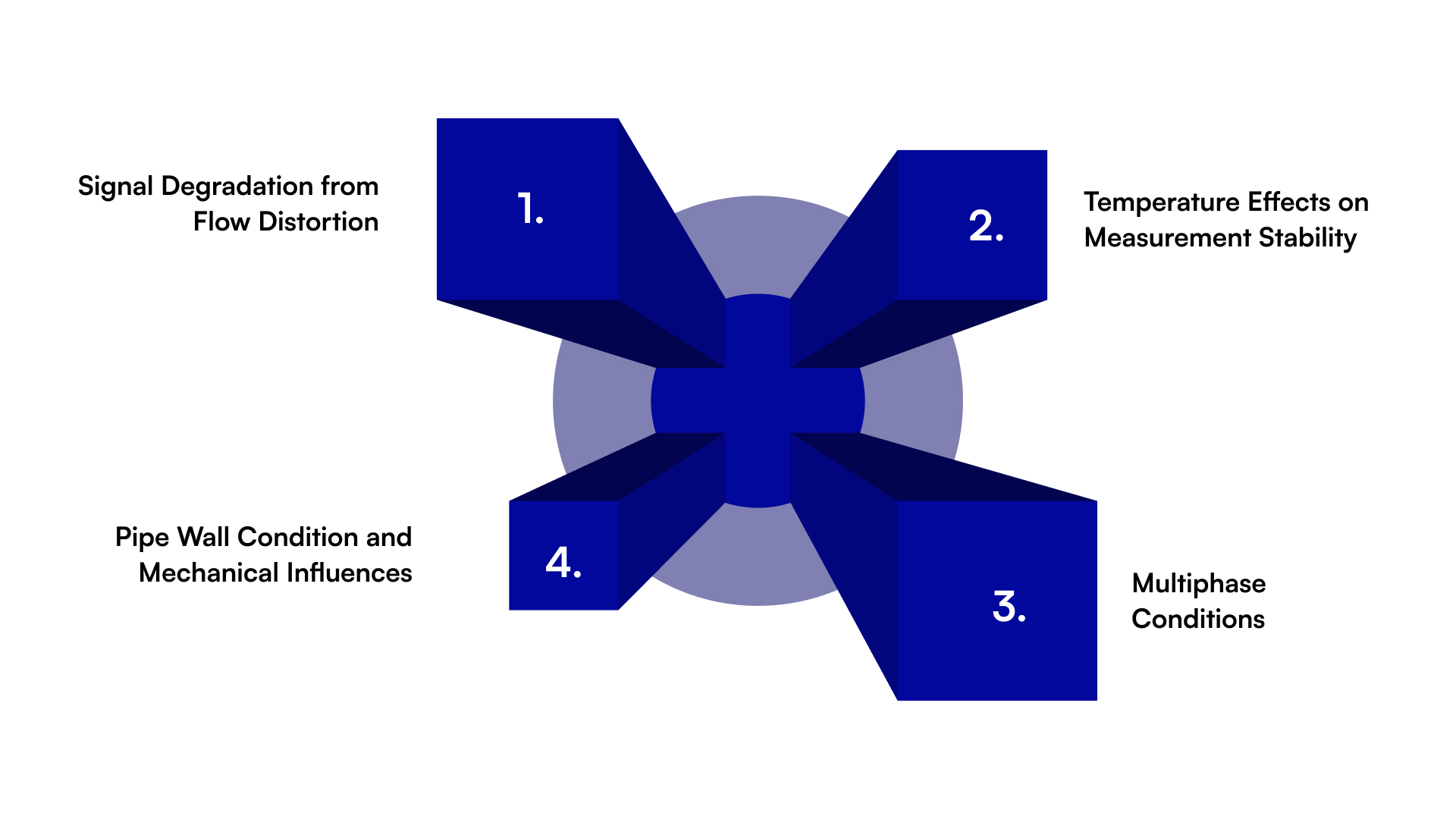
1. Signal Degradation from Flow Distortion
Ultrasonic meters assume a predictable velocity profile across the pipe. Elbows, valves, reducers, and tees upstream distort that profile, even when straight-run guidelines are technically met. The result is a measurement that responds more to piping effects than true flow changes.
What shows up operationally:
Inconsistent readings between similar lines.
Sensitivity to valve position changes upstream.
Difficulty reconciling readings with mass or energy balances.
2. Temperature Effects on Measurement Stability
Ultrasonic measurement depends on the speed of sound in the medium, which varies with temperature. In processes with thermal gradients, cycling loads, or startups and shutdowns, that dependency becomes a liability. Compensation models help, but they assume uniform conditions that rarely exist.
Common consequences:
Flow drift correlated with temperature, not throughput.
Stable readings during steady state, instability during transients.
Increased uncertainty when data is most critical.
3. Multiphase Conditions and Steam Quality Changes
Both transit-time and Doppler methods struggle when phases appear or disappear. Condensation, entrained gas, or changing steam quality alter the acoustic environment. These changes often occur intermittently, making the issue hard to diagnose.
Typical symptoms:
Intermittent signal loss or spikes.
Apparent noise during load changes.
Operators are losing confidence in alarms and trends.
4. Pipe Wall Condition and Mechanical Influences
Scale buildup, erosion, corrosion, or coating changes on the pipe wall affect how ultrasonic signals transmit and reflect. Vibration and thermal expansion further complicate the acoustic path. These effects accumulate slowly and are rarely part of routine maintenance checks.
Why this creates risk:
Gradual degradation that bypasses alarms.
No clear maintenance trigger until the data is questioned.
Increased effort spent validating numbers instead of running the process.
Understanding these failure modes is the first step; the next is knowing what to evaluate up front so they don’t become permanent operating issues.
How to Choose an Ultrasonic Flow Meter: Practical Selection Criteria
Choosing an ultrasonic flow meter is less about the measurement principle and more about how well it tolerates real operating conditions. The objective is to reduce risk up front by identifying where the technology aligns with the process and where it introduces hidden exposure.
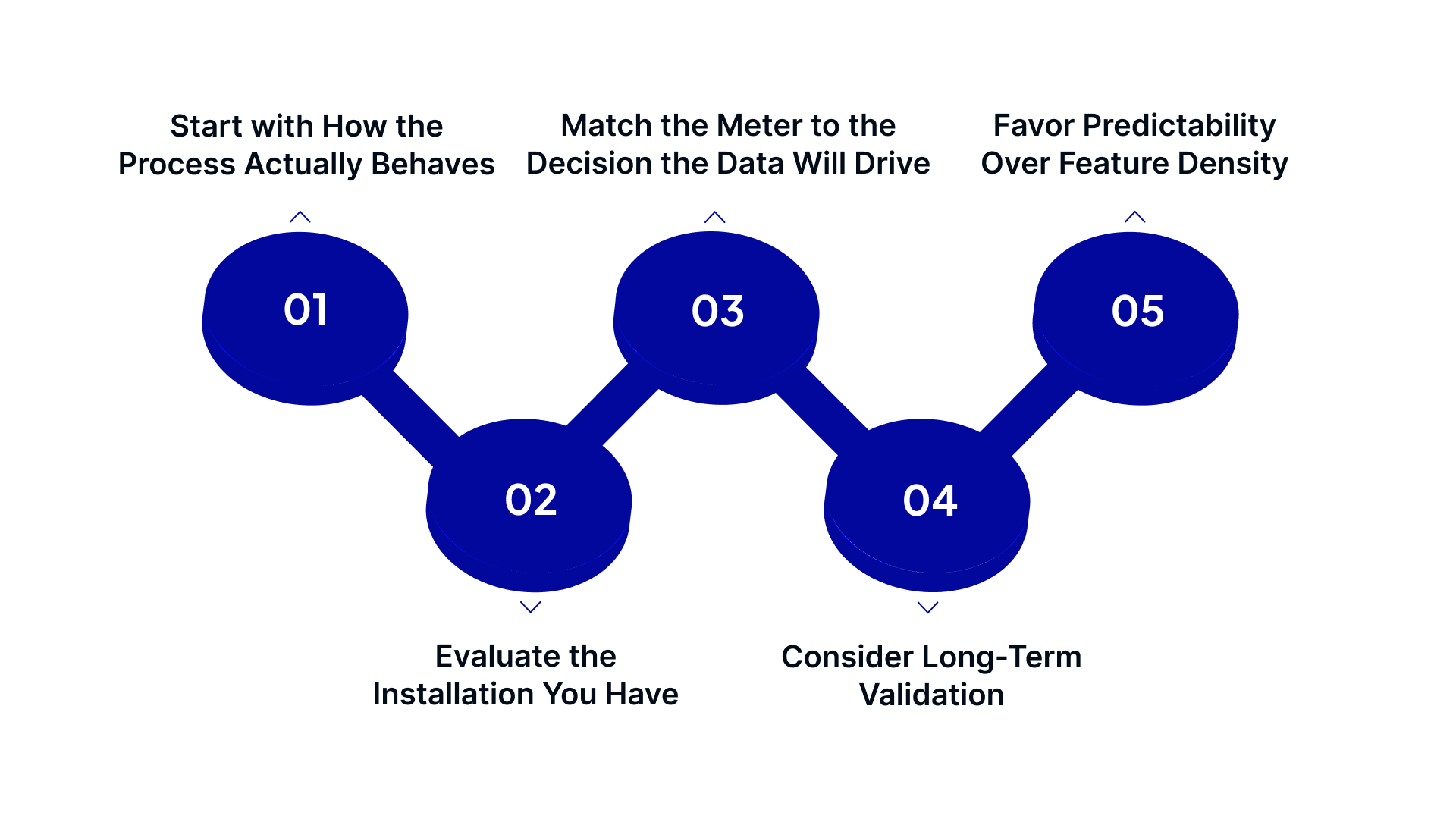
1. Start with How the Process Actually Behaves
Base selection on real operating behavior, not design intent. Temperature swings, startups and shutdowns, load changes, and process upsets will stress the measurement far more than steady-state conditions. Many ultrasonic meters perform acceptably until these conditions dominate.
Engineers should evaluate:
How often flow profiles change with operating mode
Whether thermal gradients or phase changes are routine
When the process is most unstable, not when it is ideal
2. Evaluate the Installation You Have, Not the One in the Manual
Ultrasonic flow meters often assume straight runs and well-developed flow. In existing plants, those conditions are rare. Selection should be grounded in the physical constraints that cannot be engineered away.
Assess realistically:
Fixed upstream disturbances such as elbows, valves, or reducers
Access limitations for installation and future verification
Exposure to vibration, heat, and pipe condition changes over time
3. Match the Meter to the Decision the Data Will Drive
Risk increases as flow data moves closer to control, energy accounting, or reporting. A meter used for indication carries far less exposure than one feeding a control loop or cost allocation model.
Clarify early:
Whether the data is informational, control-critical, or reportable
How much uncertainty is acceptable in each use case
Who is accountable when the number is challenged
4. Consider Long-Term Validation, Not Just Initial Commissioning
Ultrasonic meters are often selected to reduce maintenance, but validation still matters. If confidence in the data requires frequent cross-checks or manual reconciliation, the operational burden hasn’t been eliminated.
Key questions:
How will data quality be verified over time?
What conditions trigger recalibration or investigation?
Can validation be done during normal operation?
5. Favor Predictability Over Feature Density
Advanced diagnostics and signal processing cannot fully compensate for unstable process conditions. Selection should favor measurement behavior that is consistent and explainable over systems that appear sophisticated but are condition-sensitive.
A disciplined selection approach helps ensure ultrasonic flow measurement reduces operational risk instead of introducing it quietly.
Integration and Operations Reality
Ultrasonic flow meters rarely fail at the sensor alone; problems usually surface at the interface between measurement, controls, and operations. This is where otherwise acceptable data becomes difficult to use, trust, or explain.
PLC and DCS Signal Behavior
From a controls perspective, ultrasonic flow signals can look clean while still being misleading. Filtering, averaging, and internal diagnostics may smooth the output, masking short-term instability or slow drift. Once that signal is tied into control logic, small inconsistencies can drive oscillation or overcorrection.
What engineers need to watch for:
Excessive filtering hiding real process changes
Signal latency affecting loop response
Alarms based on values that lag actual conditions
Control Loop Interaction and Process Response
Ultrasonic flow meters respond to acoustic conditions as much as flow. When the process changes quickly, the measurement may respond differently than expected, especially during startups, load swings, or thermal transitions. This mismatch often shows up as loop instability rather than an obvious measurement fault.
Operational symptoms include:
Control loops that hunt despite stable setpoints
Manual mode becoming the “safe” default
Operators compensating for measurement behavior instead of process behavior
Maintenance Visibility and Troubleshooting Burden
When ultrasonic data degrades, the root cause is rarely obvious. Mechanical inspection may show nothing wrong, while diagnostics indicate normal operation. Troubleshooting becomes a data exercise rather than a hardware fix.
Common operational impacts:
Time spent reconciling flow data with secondary indicators
Increased reliance on inferred or calculated values
Maintenance teams involved without clear corrective actions
Long-Term Data Confidence
Integration issues accumulate over time. Small discrepancies that are tolerable early on can become systemic once the data is used for trending, optimization, or reporting. At that point, the challenge isn’t fixing the meter, it’s restoring confidence in the number.
Decision impact:
Engineers hesitate to rely on flow data for optimization
Control strategies are constrained by measurement uncertainty
Flow becomes a reference point rather than a trusted input
Understanding integration and operational behavior is critical before relying on ultrasonic flow data for anything beyond basic indication.
Ultrasonic Flow Meters Compared to Other Industrial Flow Technologies
Ultrasonic flow meters are often evaluated alongside other mature flow technologies. The decision is rarely about which method is “better” in general, but which one introduces the least operational and compliance risk for a specific application.
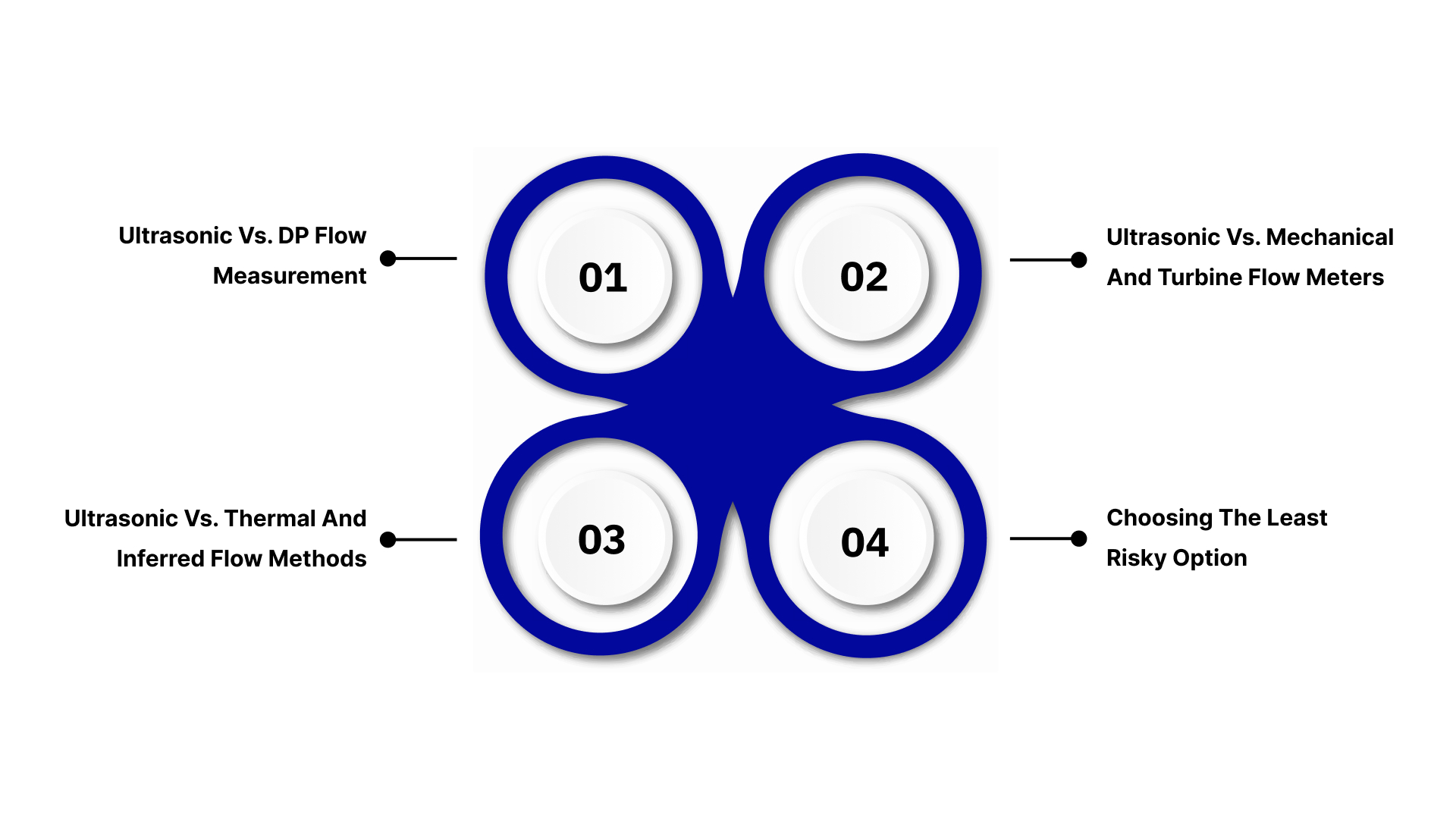
Ultrasonic vs. Differential Pressure (DP) Flow Measurement
Differential pressure flow measurement is mechanically simple but operationally demanding. It introduces pressure loss and requires impulse lines, taps, and ongoing maintenance. Ultrasonic meters avoid pressure drop, but trade mechanical simplicity for sensitivity to process conditions.
Key tradeoffs engineers weigh:
DP meters tolerate distorted flow better, but increase the maintenance burden
Ultrasonic meters reduce hardware complexity but depend on stable acoustics
DP measurement degrades predictably; ultrasonic degradation can be subtle
Ultrasonic vs. Mechanical and Turbine Flow Meters
Mechanical meters offer direct measurement but introduce moving parts into the process. Wear, fouling, and mechanical failure are expected over time. Ultrasonic meters eliminate moving parts but replace mechanical wear with signal-quality dependencies.
Practical differences:
Mechanical meters fail visibly; ultrasonic meters often fail quietly
Turbines require clean, well-conditioned flow
Ultrasonic meters reduce mechanical risk but increase diagnostic complexity
Ultrasonic vs. Thermal and Inferred Flow Methods
Thermal and inferred methods rely on correlations rather than direct velocity measurement. They can work well in tightly controlled conditions but lose reliability when process composition or heat transfer assumptions shift.
Decision considerations:
Correlation-based methods are highly condition-dependent
Ultrasonic meters are less model-driven but still assumption-heavy
Both require a careful definition of valid operating envelopes
Choosing the Least Risky Option, Not the Most Elegant
No flow technology is universally superior. The lowest-risk choice is the one whose failure modes are best understood, most detectable, and easiest to explain when something goes wrong.
For many engineers, the comparison ultimately comes down to whether they prefer managing mechanical maintenance or managing measurement assumptions.
Is Ultrasonic Flow Measurement the Right Choice?
Use this as a pre-selection or re-evaluation checklist.
Process operates mostly within a narrow, stable envelope
The flow profile is predictable and rarely distorted
Temperature gradients are limited or well understood
Multiphase conditions are rare and well-defined
Flow data is not the sole basis for compliance or cost allocation
Installation constraints can be realistically accommodated
Ongoing validation can be performed without disruption
If multiple items above cannot be confidently checked, ultrasonic flow measurement likely introduces more risk than expected.
Conclusion
Ultrasonic flow measurement isn’t risky because the principle is flawed, but because its assumptions are easy to overlook in real operating environments. The long-term impact shows up in data confidence, control behavior, and the defensibility of the numbers when they matter most. What matters in real plants is not elegance, but predictable behavior under changing conditions. Understanding where ultrasonic flow fits, and where it doesn’t, reduces downstream operational risk.
If ultrasonic flow data is creating uncertainty in steam or thermal processes, the next step is to review whether direct, in-situ steam or moisture measurement would provide more reliable process insight.
Before an upgrade, retrofit, or compliance review, it’s worth discussing how steam flow or moisture analyzers would behave in your actual operating conditions. A focused technical conversation with MAC Instruments can help align measurement strategy with process reality.
FAQs
When do ultrasonic flow meters tend to fail quietly?
When acoustic conditions degrade slowly, and diagnostics continue to report healthy operation.
Why do readings change with temperature even after compensation?
Because compensation assumes uniform conditions that rarely exist across the acoustic path.
Are ultrasonic meters suitable for steam flow measurement?
They can be applied, but steam quality changes and condensation significantly increase the
risk.
Why do two ultrasonic meters disagree in similar services?
Small differences in installation, piping, or operating conditions can dominate behavior.
Can filtering fix unstable ultrasonic flow signals?
Filtering smooths outputs but does not correct underlying measurement instability.
What makes ultrasonic data hard to defend during audits?
Dependence on assumptions that are difficult to document and validate over time.
Is clamp-on ultrasonic inherently lower risk than inline?
It reduces mechanical intrusion but increases sensitivity to pipe condition and coupling.
How should engineers define “valid” ultrasonic data?
By clearly documenting operating conditions where assumptions hold and where they do not.