If you’re responsible for flow measurement in a real plant, you already know that most problems don’t show up during commissioning. They show up months or years later, when readings start drifting, when operators stop trusting the signal, or when you’re asked to defend data you didn’t personally install.
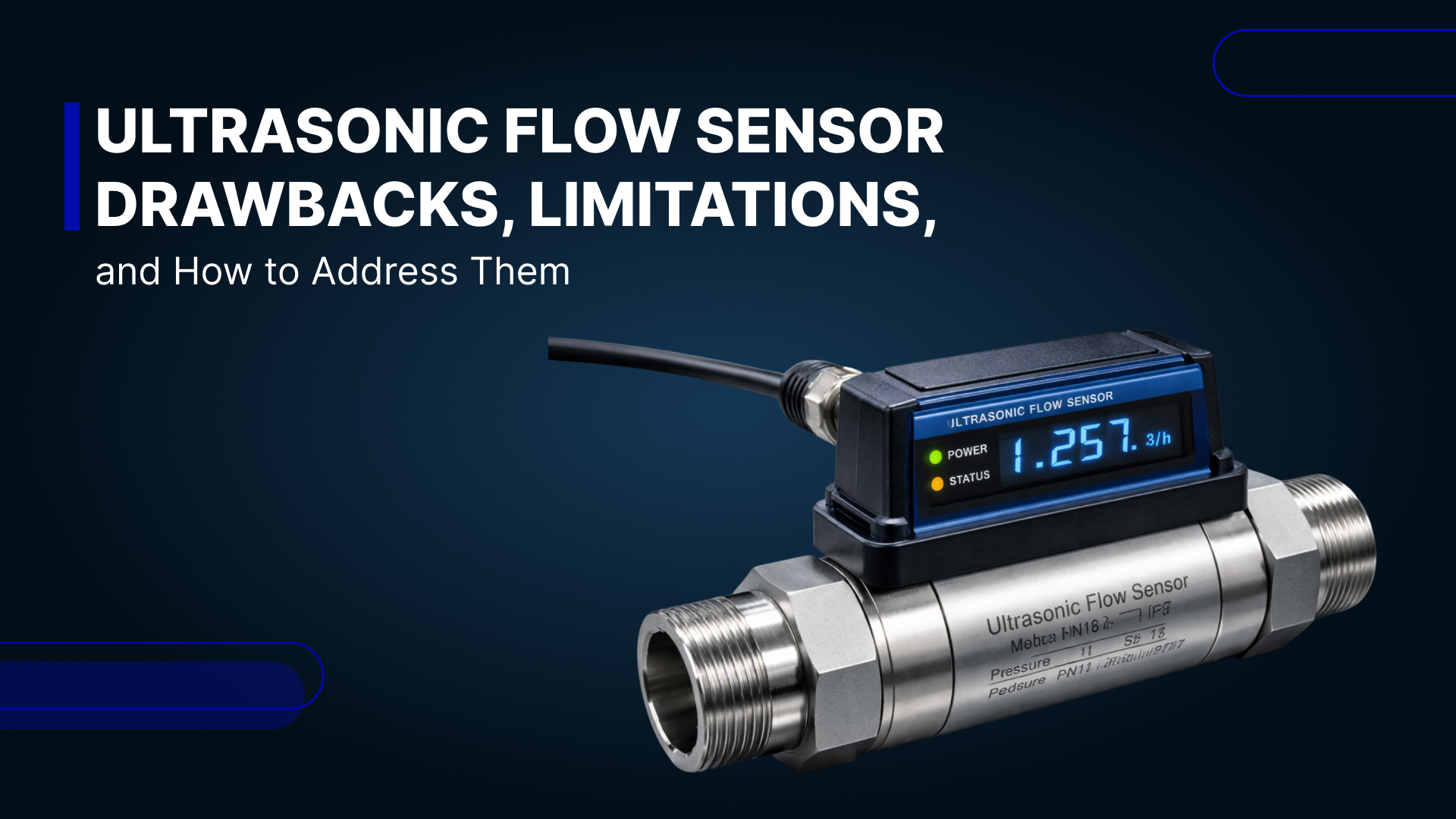
Ultrasonic flow sensors are widely used and often perform well. But when they’re applied outside the conditions they were designed for, their limitations tend to surface quietly, and that’s where risk creeps in.
This article walks through the drawbacks of ultrasonic flow sensors, not to discredit the technology, but to help you recognize where problems typically emerge, how teams mitigate them, and when those mitigations stop being effective.
Key Takeaways
Ultrasonic flow sensors work well in clean, stable, single-phase flows, but their performance degrades quietly when real-world conditions drift from those assumptions.
Common drawbacks, such as sensitivity to fluid properties, installation quality, temperature, and multi-phase flow, often show up as loss of data trust, not outright failure.
Many teams mitigate these issues through calibration and installation discipline, but repeated mitigation is usually a sign of poor fit, not poor maintenance.
Choosing the right flowmeter means evaluating long-term reliability, maintenance burden, and what happens when the data is questioned, not just accuracy on paper.
In steam and high-temperature industrial environments, ultrasonic limitations become structural. This is where MAC Instruments provides a purpose-built solution with in-situ steam flow meters designed for stable, defensible measurement in real plant conditions.
Understanding Ultrasonic Flow Sensor in Practice
An ultrasonic flow sensor measures flow velocity by transmitting high-frequency sound waves through a fluid and analyzing how those waves are affected by flow.
What matters in practice is that the measurement depends on sound propagation. That means performance is directly tied to fluid properties, installation quality, and operating conditions. When those factors stay within assumptions, ultrasonic sensors work well. When they don’t, limitations begin to appear.
Understanding that dependency makes the drawbacks below easier to evaluate in your own process.
Key Advantages of Ultrasonic Flow Sensors
You don’t need convincing that ultrasonic flow sensors have value; you’re likely using them already for a reason.
Their main advantages include:
No moving parts, which reduces mechanical wear.
No pressure drop, which avoids energy penalties.
Applicability to large pipe diameters.
Clamp-on options that allow installation without process interruption.
In clean, stable, single-phase flows, these benefits often outweigh the tradeoffs. Problems tend to arise when process conditions push beyond those assumptions.
The Main Drawbacks of Ultrasonic Flow Sensors
These drawbacks aren’t theoretical. They’re the issues that typically show up once a system has been running long enough for conditions to vary and shortcuts to matter.
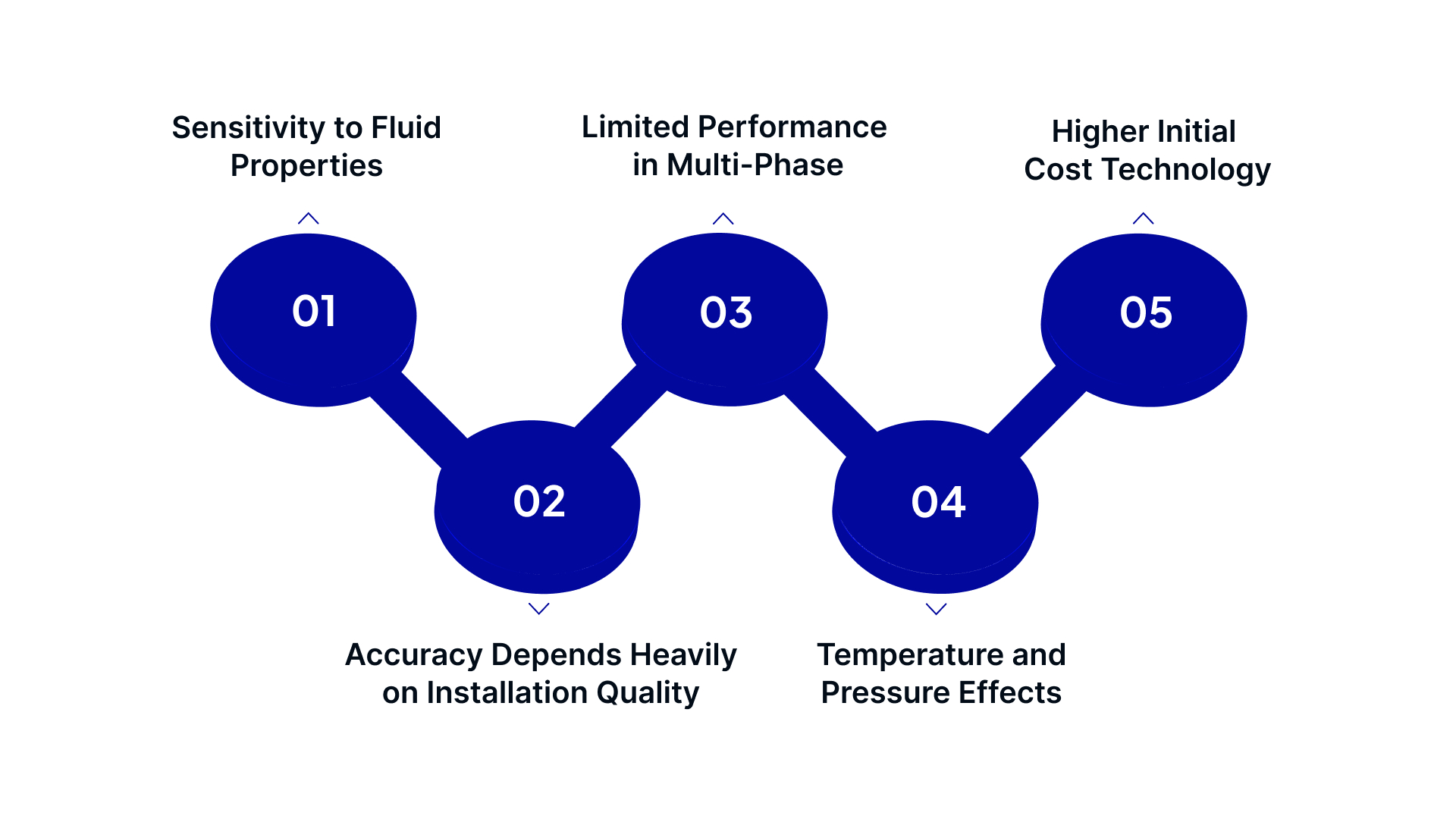
1. Sensitivity to Fluid Properties
Ultrasonic sensors assume relatively stable acoustic behavior in the fluid. When density, composition, or phase changes, signal quality can change with it.
If your process experiences:
Composition swings,
Entrained gas or liquid,
Or poorly defined fluid properties,
You may see a gradual drift or inconsistent readings. The sensor may never “fail,” but confidence in the data slowly erodes, and that’s often worse than an outright fault.
2. Accuracy Depends Heavily on Installation Quality
Ultrasonic flow sensors are unforgiving of poor installation.
If straight-run requirements are compromised, flow profiles are distorted, or transducers are misaligned, accuracy suffers. With clamp-on sensors, pipe condition, wall thickness, and surface finish introduce additional variables.
If you inherit an installation you didn’t design, this is often where problems originate—and where they’re hardest to correct after the fact.
3. Limited Performance in Multi-Phase or Dirty Fluids
Ultrasonic sensors perform best in clean, single-phase fluids. When solids, droplets, bubbles, or fouling are present, acoustic paths become unstable.
In practice, this shows up as:
Noisy signals,
Slower response,
Or readings that only look wrong during the process upsets.
These issues often go unnoticed until someone questions the data or relies on it during a critical event.
4. Temperature and Pressure Effects
The speed of sound in a fluid is not constant. In gases and steam, it changes significantly with temperature and pressure.
Ultrasonic sensors rely on compensation models to account for this. If temperature gradients are uneven, or conditions change faster than compensation can keep up, calculated flow begins to drift—even when the ultrasonic signal itself looks healthy.
This is a common source of “it worked before” complaints.
5. Higher Upfront Cost Compared to Basic Technologies
Ultrasonic sensors typically cost more upfront than basic differential pressure or mechanical meters.
That cost can be justified by lower maintenance and flexibility—but only if the application stays within the technology’s comfort zone. When additional engineering effort or ongoing mitigation is required, the economics can shift quickly.
Drawbacks vs. Solutions: How You Typically Mitigate Them
In many applications, you can manage ultrasonic limitations with good engineering discipline.
That usually means:
Strict installation practices.
Verified straight-run lengths and alignment.
Reliable temperature and pressure compensation.
Ongoing signal quality monitoring.
But there’s an important inflection point. When you find yourself compensating continuously—cleaning, recalibrating, explaining anomalies, you’re no longer mitigating drawbacks. You’re working around them.
At that stage, especially if your application involves steam or sustained high temperatures, it’s worth asking whether ultrasonic technology is the right tool at all. This is often when teams evaluate alternatives like MAC Instruments, whose in-situ steam flow meters are designed specifically for continuous high-temperature service where ultrasonic sensors struggle with stability and maintenance.
When Ultrasonic Flow Sensors Are a Poor Fit (But Still Commonly Used)
You’ll often see ultrasonic sensors applied in:
Steam systems,
Condensing flows,
Severe temperature cycling,
Fouling or corrosive environments.
They’re used not because they’re ideal, but because they’re familiar. Over time, that familiarity can turn into technical debt, especially when data credibility becomes critical.
Choosing the Right Flowmeter for Your Application
Selecting the right flowmeter is less about comparing technologies on paper and more about understanding where risk shows up over time in your process.
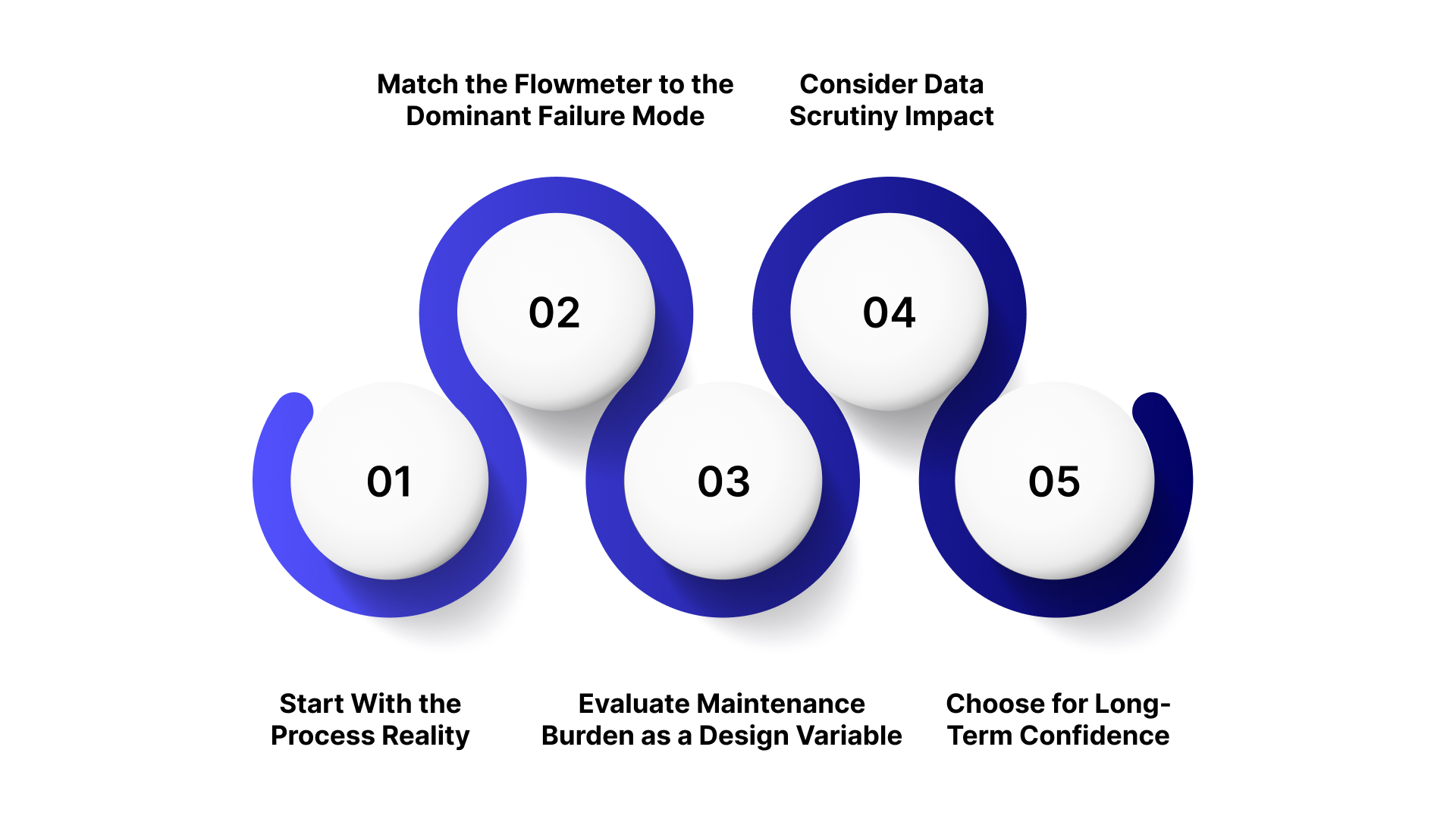
Most flow measurement problems don’t come from choosing a “bad” meter. They come from choosing a meter that performs well under ideal assumptions but degrades quietly when real operating conditions take over.
When you’re evaluating flowmeter options, focus on the following decision lenses.
1. Start With the Process Reality, Not the Technology
Before narrowing in on ultrasonic, DP, Coriolis, or any other technology, step back and look at what your process actually does day to day.
Ask yourself:
Is the fluid always single-phase, or does it occasionally condense, flash, or carry entrained material?
Are temperature and pressure stable, or do they cycle with load changes and startups?
Is the environment clean, or does fouling, vibration, or corrosion develop over time?
Flowmeters fail most often when these questions are glossed over early.
2. Match the Flowmeter to the Dominant Failure Mode
Every flow technology has a dominant way it fails.
Ultrasonic meters struggle when acoustic assumptions break down (steam, condensation, unstable gas properties).
DP meters introduce pressure loss and maintenance through impulse lines and taps.
Mechanical meters wear in dirty or abrasive services.
Some technologies perform well initially but demand increasing attention as conditions drift.
The right choice is the one whose failure mode you can tolerate—or better yet, avoid altogether.
3. Evaluate Maintenance Burden as a Design Variable
Maintenance is not just an operational concern; it’s a design outcome.
If a flowmeter requires:
Frequent recalibration to stay trusted,
Regular removal for inspection,
Or repeated explanation during audits,
Then maintenance has become a proxy for poor fit.
The most reliable flowmeters are not the ones that are easiest to calibrate, but the ones that don’t need frequent intervention to remain credible.
4. Consider What Happens When the Data Is Questioned
This is the question many teams overlook until it matters.
When flow data becomes questionable:
Do operators ignore it?
Do controls become conservative?
Do you fall back on estimates or manual checks?
Does someone have to defend that data during an audit or investigation?
If unreliable data creates downstream stress, rework, or defensiveness, the cost of the wrong flowmeter is far higher than the instrument itself.
5. Choose for Long-Term Confidence, Not Short-Term Convenience
Clamp-on installation, fast commissioning, or familiarity can be compelling—but they don’t guarantee long-term success.
The right flowmeter is the one that:
Matches the harshest conditions it will see, not the average.
Maintains stable output without constant attention.
Lets you focus on running the process instead of managing the instrument.
When you choose with those priorities in mind, many downstream problems never materialize.
How to Decide Whether the Drawbacks Matter for You
The real question isn’t whether ultrasonic flow sensors have drawbacks. It’s whether those drawbacks introduce risk in your role.
Ask yourself:
How much does your process vary from ideal conditions?
What happens operationally when flow data becomes questionable?
Who has to explain the data during audits or investigations?
How much maintenance effort is acceptable just to keep confidence in the number?
If unreliable data creates stress, workarounds, or defensiveness, the drawback already matters.
Conclusion: Fit Determines Risk, Not the Technology
If you’re dealing with recurring uncertainty in flow data due to steam, sustained high temperatures, condensation, or harsh operating conditions, the issue is no longer how well ultrasonic technology is installed or compensated. It's about how well the system is designed and configured. The problem is that ultrasonic flow sensors are being pushed beyond their design limits.
In those environments, continuing to work around drift, instability, and maintenance burden only increases operational and professional risk. What resolves the problem is moving to a measurement approach explicitly engineered for those conditions.
MAC Instruments addresses this exact failure mode with in-situ steam flow meters designed for continuous high-temperature industrial service, eliminating the acoustic, thermal, and dependency-driven limitations that cause ultrasonic sensors to lose reliability over time. Request a quote today.
Frequently Asked Questions
Are ultrasonic flow sensor drawbacks avoidable or inherent?
Some can be mitigated with good installation and compensation. Others are inherent to acoustic measurement.
Why do ultrasonic meters struggle with steam?
Steam introduces extreme temperature variation, density changes, and condensation that destabilize ultrasonic signals.
Are clamp-on ultrasonic sensors less reliable than inline?
They can be, particularly in gas and high-temperature applications, due to weaker acoustic coupling.
How does fluid composition affect accuracy?
Changes in composition alter sound velocity and can cause drift if not properly compensated.
When should you replace an ultrasonic meter instead of correcting it?
When recurring mitigation doesn’t restore long-term confidence and the environment consistently violates the technology’s assumptions.