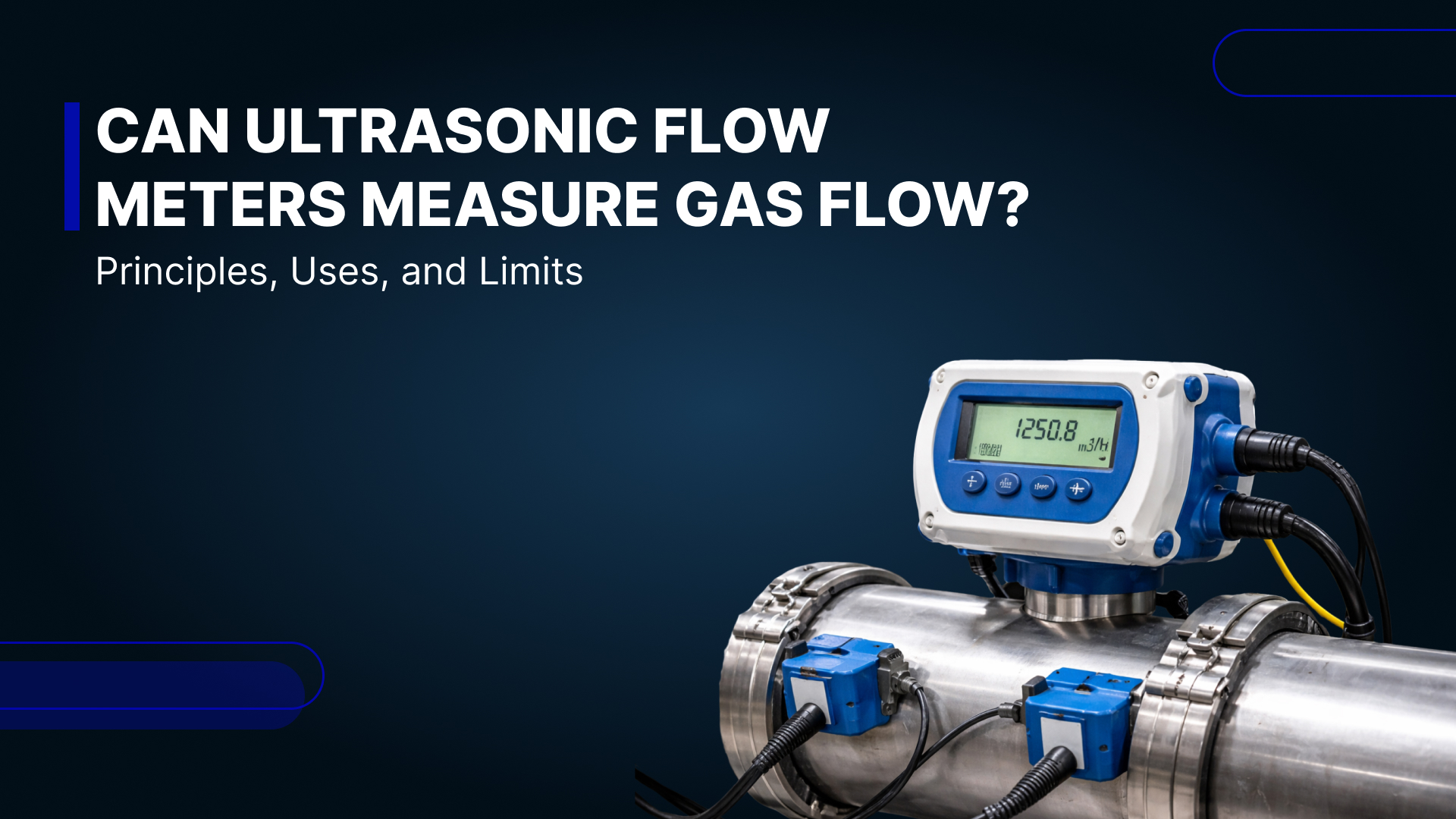
Ultrasonic flow meters are widely used in liquid applications, which naturally leads many engineers to ask a straightforward question: Can ultrasonic flow meters measure gas flow as well?
The short answer is yes, but the longer, more important answer is it depends. Gas flow measurement introduces physical and acoustic challenges that do not exist with liquids, and whether ultrasonic technology works well depends heavily on gas properties, operating conditions, and meter configuration.
This article explains how ultrasonic flow meters measure gas, where they work well, where they struggle, and what engineers need to evaluate before selecting them for gas applications.
Key Takeaways
Yes, ultrasonic flow meters can measure gas flow, but performance depends heavily on gas properties, operating conditions, and meter configuration—not all gas applications are a good fit.
Gas measurement is harder than liquid measurement because gases are compressible, attenuate sound more easily, and have a speed of sound that varies with temperature, pressure, and composition.
Transit-time ultrasonic meters are the primary option for gases, while Doppler methods are rarely suitable due to the lack of particles in most gas streams.
Ultrasonic gas meters work best in clean, dry, single-phase gases with stable conditions and struggle with low pressure, condensation, particulates, or multi-phase flow.
If your application involves steam or sustained high temperatures, ultrasonic gas flow meters may introduce reliability and maintenance challenges. At that point, many engineers evaluate MAC Instruments for in-situ steam flow meters designed specifically for continuous, high-temperature industrial service.
Can Ultrasonic Flow Meters Be Used for Gas Flow Measurement?
Yes, ultrasonic flow meters can measure gas flow, and they are widely used in applications such as natural gas pipelines, flare gas monitoring, and certain industrial gas processes.
However, ultrasonic meters do not behave identically in gases and liquids. Gases have lower density, higher compressibility, and greater sensitivity to temperature and pressure changes. These characteristics directly affect how ultrasonic signals propagate and how reliably flow velocity can be calculated.
Because of this, ultrasonic flow meters for gas measurement must be designed, installed, and compensated differently than those used for liquids. Understanding why starts with how the technology works at a fundamental level.
To see where the limitations come from, it helps to first understand the basic measurement principle.
How Ultrasonic Flow Meters Work: Basic Principles
Ultrasonic flow meters determine flow velocity by transmitting high-frequency sound waves through a flowing medium and analyzing how those waves are affected by the movement of the fluid.

The meter does not measure flow directly. Instead, it measures time or frequency changes in ultrasonic signals and converts those into velocity and volumetric flow.
While several ultrasonic techniques exist, only some are practical for gas applications.
Understanding these methods clarifies why some ultrasonic meters perform well in gases while others do not.
1. Transit-Time Differential Method
The most common ultrasonic method for gas flow measurement is the transit-time differential method.
In this approach, ultrasonic transducers send sound pulses both upstream and downstream across the pipe. When gas is flowing, the downstream signal travels slightly faster than the upstream signal. The difference in transit time is proportional to the gas velocity.
This method works well for gases because:
It does not require particles or droplets in the gas.
It can achieve high accuracy when acoustic paths are stable.
It introduces no pressure drop.
However, the accuracy depends on knowing the speed of sound in the gas, which varies with temperature, pressure, and composition, a vital consideration addressed later.
Not all ultrasonic methods rely on transit time, which leads to different strengths and limitations.
2. Doppler and Other Ultrasonic Methods
Doppler ultrasonic flow meters measure flow by detecting frequency shifts caused by sound reflecting off particles or bubbles in the fluid.
In gas applications, Doppler methods are generally less suitable because:
Many gases are clean and lack reflective particles.
Signal strength can be inconsistent.
Accuracy depends on particle concentration rather than bulk flow.
As a result, Doppler ultrasonic meters are rarely used for gas flow compared to transit-time designs.
With the measurement principles established, the next question is why gas presents more challenges than liquids.
Why Gas Flow Measurement Is More Challenging Than Liquids
The fundamental difference between liquid and gas measurement lies in acoustic behavior.
Liquids are dense, acoustically uniform, and relatively insensitive to small temperature changes. Gases, by contrast, are compressible and highly sensitive to operating conditions.
Key challenges in gas measurement include:
Lower acoustic energy transmission, which weakens ultrasonic signals.
Greater attenuation, especially at low pressures or low flow velocities.
Variable speed of sound, which changes with temperature, pressure, and composition.
These factors mean that ultrasonic gas meters must rely on compensation algorithms and stable operating conditions to maintain accuracy.
Because of these challenges, meter configuration becomes critically important.
Typical Ultrasonic Gas Flow Meter Configurations
Ultrasonic gas flow meters are commonly deployed in two main configurations: inline and clamp-on. Each has advantages and tradeoffs depending on the application.
Choosing the right configuration is often more important than choosing the technology itself.
1. Inline (Wetted) Ultrasonic Gas Flow Meters
Inline ultrasonic gas flow meters mount transducers directly inside the pipe wall or within a spool piece.
This configuration offers:
Stronger acoustic coupling.
Higher signal-to-noise ratio.
Better performance at lower flow velocities.
Because the transducers are in direct contact with the gas, inline meters are commonly used in custody transfer, pipeline transmission, and critical process measurements.
The tradeoff is installation complexity, as inline meters require pipe modification or shutdown.
For applications where intrusion is not acceptable, clamp-on options are often considered.
2. Clamp-On Ultrasonic Gas Flow Meters
Clamp-on ultrasonic meters mount transducers on the outside of the pipe, sending sound through the pipe wall into the gas.
Their primary advantages are:
Non-intrusive installation.
No process interruption.
No pressure loss.
However, clamp-on meters face additional challenges in gas service, including weaker signals and sensitivity to pipe material, wall thickness, and surface condition.
As a result, clamp-on ultrasonic meters are typically better suited for temporary measurements, diagnostics, or stable gas systems, rather than high-accuracy custody transfer.
Knowing the configuration options helps explain where ultrasonic meters perform best.
Conditions Where Ultrasonic Flow Meters Measure Gas Well
Ultrasonic gas flow meters perform best under stable, predictable conditions where acoustic properties remain consistent.
Common favorable conditions include:
Clean, dry, single-phase gases.
Steady flow profiles with minimal turbulence.
Known and stable gas composition.
Adequate pressure to support signal strength.
These conditions are frequently found in natural gas transmission systems and certain industrial gas applications.
Unfortunately, not all gas systems behave this well in practice, which leads to important limitations.
Limitations and Failure Modes in Gas Applications
While ultrasonic meters can measure gas flow effectively, they are not universal solutions. Several failure modes can degrade performance if not properly addressed.
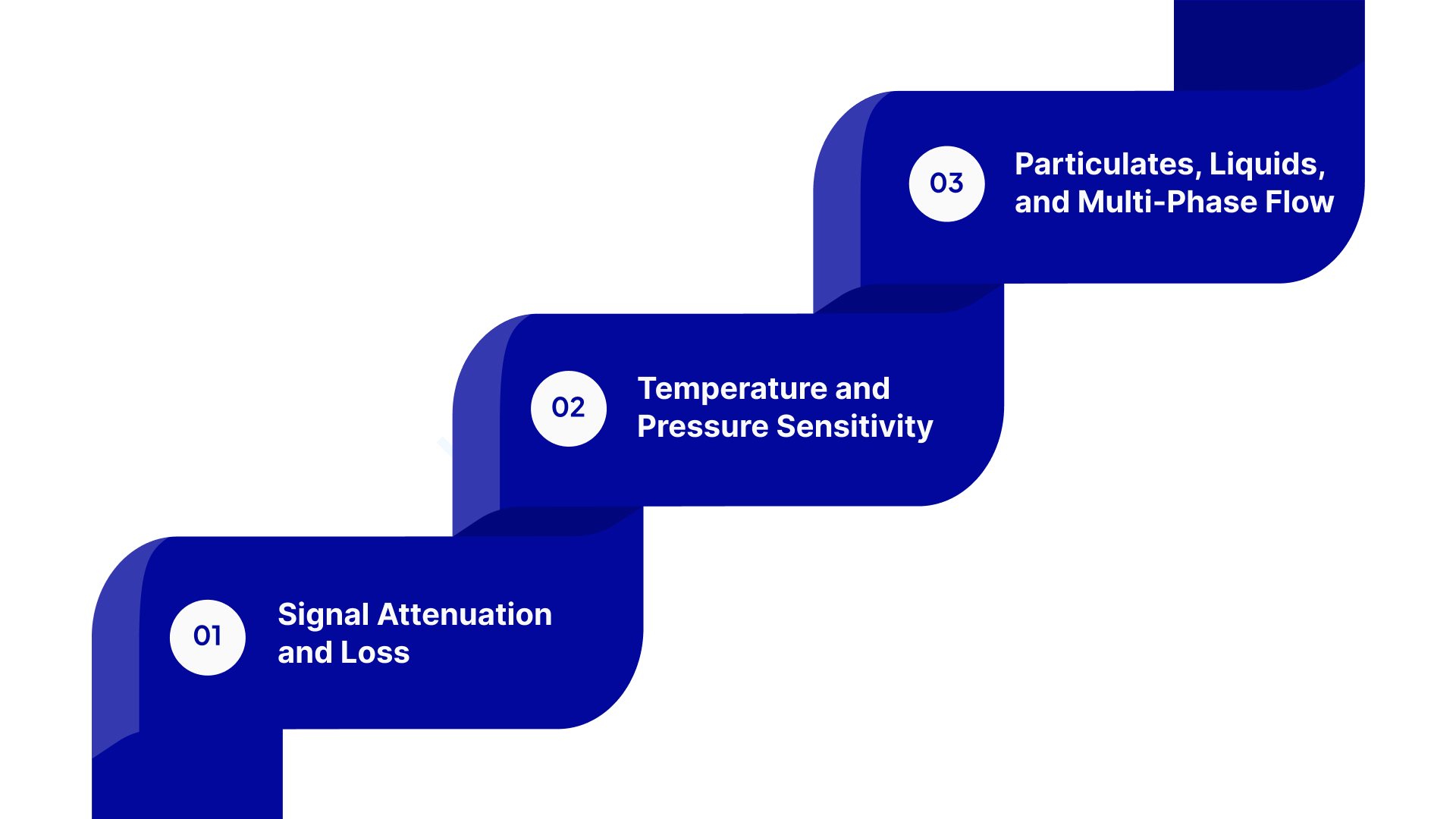
Understanding these limitations helps prevent unrealistic expectations.
Signal Attenuation and Loss
Low gas density, low pressure, or long acoustic paths can weaken ultrasonic signals to the point where reliable detection becomes difficult.
This can lead to:
Intermittent readings.
Increased noise.
Reduced accuracy at low flow rates.
Design choices such as transducer spacing and frequency selection are critical in mitigating attenuation.
Even when signals are strong, environmental variables still matter.
Temperature and Pressure Sensitivity
The speed of sound in gas is directly influenced by temperature and pressure. If these variables are not measured and compensated accurately, flow calculations can drift.
Most ultrasonic gas meters rely on:
Integrated temperature sensors.
Pressure compensation inputs.
Gas property models.
In rapidly changing conditions, compensation accuracy becomes just as important as the ultrasonic measurement itself.
Another major challenge arises when the gas is not truly single-phase.
Particulates, Liquids, and Multi-Phase Flow
Condensed liquids, entrained droplets, or solids can disrupt ultrasonic paths, scatter sound waves, or introduce measurement bias.
In flare gas and wet gas applications, special meter designs and signal processing techniques are often required to maintain usable data.
Because of these factors, engineers often compare ultrasonic meters to alternative technologies.
Ultrasonic vs. Traditional Gas Flow Measurement Technologies
Ultrasonic meters offer distinct advantages, but they are not always the best choice.
Compared to differential pressure (DP) meters, ultrasonic meters:
Introduce no pressure drop.
Have no moving parts.
Require less routine mechanical maintenance.
Compared to thermal or Coriolis meters, ultrasonic meters:
Handle larger pipe diameters more easily.
Avoid direct mass measurement complexities.
May be less sensitive to composition changes, depending on design.
However, no single technology is optimal for every gas application, making proper evaluation essential.
If your application involves steam or sustained high temperatures, ultrasonic gas flow meters may not be the right fit. In those cases, you may want to evaluate MAC Instruments, which designs in-situ steam flow meters specifically for continuous, high-temperature industrial service where reliability matters more than theoretical accuracy.
Final Takeaway
Ultrasonic flow meters can measure gas flow, and in the right conditions, they do so effectively and reliably. However, gas measurement places higher demands on acoustic stability, compensation accuracy, and installation quality than liquid applications.
For engineers, the key is not whether ultrasonic technology works for gas, but whether it fits the specific gas properties, operating conditions, and performance expectations of the application.
If ultrasonic gas flow meters are forcing you to work around condensation, temperature limits, or unstable data, and your application is actually steam or high-temperature service, it’s time to evaluate a measurement approach built for that reality.
Talk with MAC Instruments about your process conditions to determine whether our in-situ steam flow meters can reduce maintenance burden, stabilize your data, and eliminate recurring measurement issues. You can also request for a quote for the flow meters specific to your industry,
Frequently Asked Questions
Does gas composition affect ultrasonic flow measurement?
Yes. Changes in composition alter the speed of sound and must be accounted for through compensation or gas modeling.
Can ultrasonic flow meters measure low-pressure gases?
They can, but signal attenuation increases as pressure decreases, which may limit accuracy at very low pressures.
Are clamp-on ultrasonic meters reliable for gas pipelines?
They can be reliable in stable, clean gas systems, but they are generally less accurate than inline designs.
How does temperature variation impact ultrasonic gas measurement?
Temperature directly affects acoustic velocity and must be measured accurately to maintain reliable flow calculations.
What maintenance challenges do ultrasonic gas meters face?
While they have no moving parts, issues such as transducer coupling, signal degradation, and environmental exposure still require attention.
With these questions answered, the final takeaway becomes clear.