Primary Keyword: advantages of ultrasonic flow meter
Meta Description: Learn the key advantages of ultrasonic flow meters, including non-intrusive installation and reliable performance across industrial applications.
Accurate flow measurement is essential for industrial efficiency, precise process control, and operational safety. Many facilities struggle with selecting the right technology, which can lead to inaccurate readings, downtime, and higher maintenance costs.
Ultrasonic flow meters address these challenges by offering non-intrusive, highly accurate measurement across a wide range of fluids and pipe types. Their advanced design ensures reliable performance, minimal maintenance, and safe operation, making them ideal for industries where process integrity is critical.
This article highlights the advantages of ultrasonic flow meters, exploring their technical benefits, practical applications, and why they are increasingly relied upon in modern industrial systems
Key Takeaways:
Ultrasonic meters can be installed externally, avoiding pipe modifications or process interruption. This ensures continuous operation and reduces contamination risk.
Provides precise flow readings with ±0.5–2% accuracy. Advanced models compensate for turbulence, temperature changes, and velocity variations.
With no moving parts, ultrasonic flow meters experience low mechanical wear, reducing downtime and long-term maintenance costs.
Suitable for clean liquids, water, steam, gasses, and some chemical solutions across a variety of pipe materials and diameters.
Enables reliable, accurate monitoring for HVAC systems, water treatment, chemical processing, and industrial pipelines, improving overall operational efficiency.
Ultrasonic Flow Meters: Overview and Technical Advantages
Ultrasonic flow meters measure the velocity of fluids or gasses using high-frequency acoustic waves, offering precise, non-intrusive flow monitoring. They operate based on transit-time differences or the Doppler effect, calculating flow rates by analyzing how ultrasonic signals are altered as they travel with or against the fluid flow.
This non-intrusive design ensures no pressure drop, no moving parts, and minimal maintenance, making them suitable for sensitive, hazardous, or hygienic processes. Advanced ultrasonic meters also incorporate signal processing algorithms, automatic temperature and velocity compensation, and digital outputs compatible with industrial control systems for real-time monitoring and integration.
Key technical advantages:
High Measurement Accuracy: ±1–2% of reading, with corrections for turbulence, pipe diameter, and temperature variations.
Non-Intrusive, Clamp-On Options: Enables retrofit applications without modifying existing pipelines or halting operations.
Wide Pipe and Flow Range: Effective for large-diameter pipelines, variable flow rates, and long-distance monitoring.
Advanced Signal Processing: Reduces errors from air bubbles, minor solids, or acoustic noise.
Digital Integration: Provides 4–20 mA, pulse, Modbus, and HART outputs for seamless process control and data logging.
Robust Performance: Maintains accuracy in varying operating conditions, including moderate temperatures and pressures.
Ultrasonic flow meters combine precision, safety, and flexibility, making them ideal for clean water monitoring, HVAC systems, process water treatment, chemical solutions, and retrofit pipelines.
Understanding these technical capabilities and limitations is crucial to maximize performance.
Key Technical Advantages of Ultrasonic Flow Meters
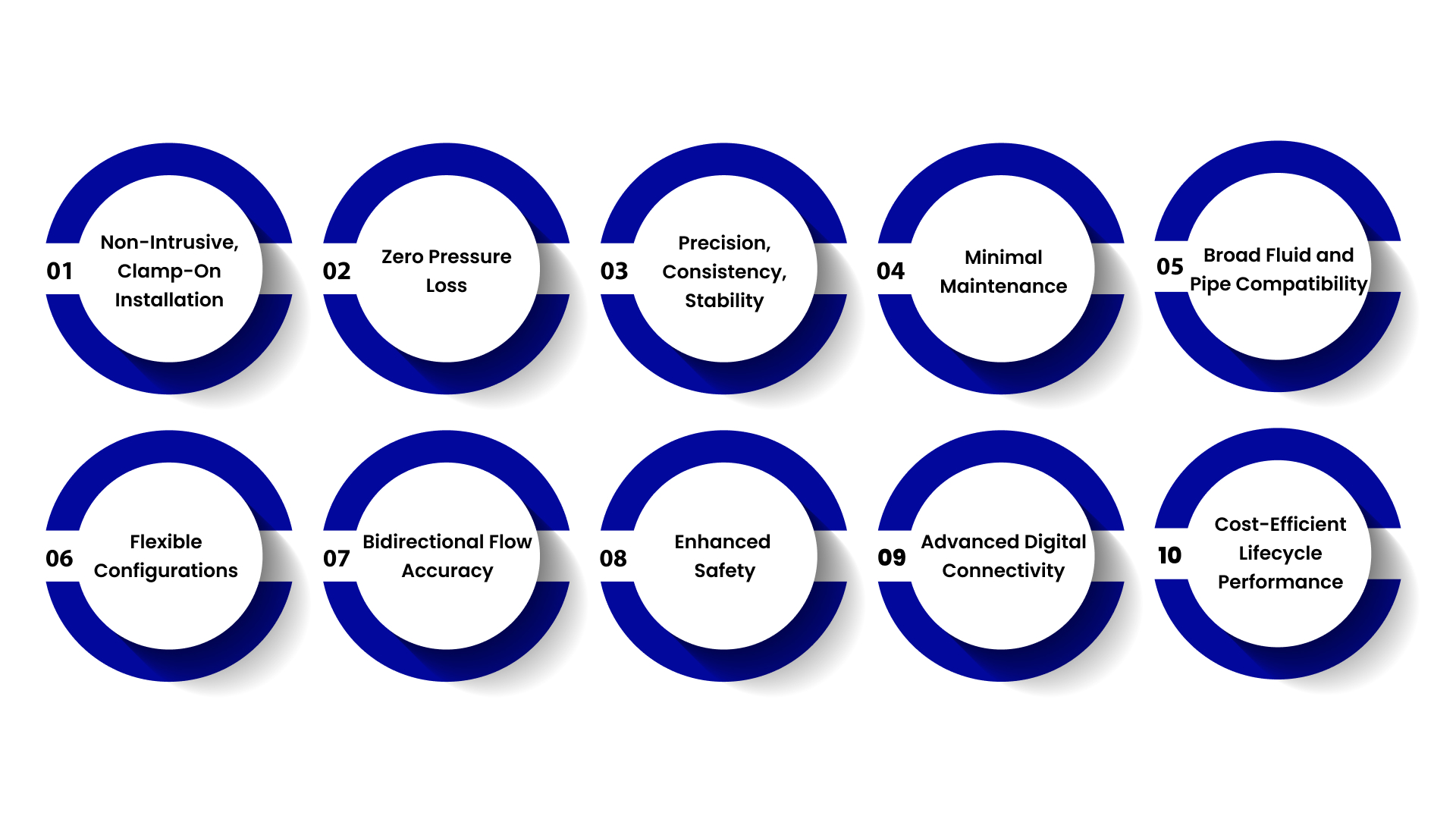
Ultrasonic flow meters combine precision measurement with non-intrusive design, delivering reliable performance across industrial applications. Below are the key technical advantages, explained with examples for context:
1. Non-Intrusive, Clamp-On Installation
Ultrasonic meters can be installed externally on the pipeline without cutting or modifying the system. This allows live monitoring while the system remains operational.
Example: Water treatment facilities retrofit old pipelines with clamp-on ultrasonic meters to track flow in real time, while hospitals monitor sterilization water lines without interruptions.
2. Zero Pressure Loss and Flow Obstruction
Since sensors do not extend into the flow path, there is no added resistance or pressure drop. This ensures consistent flow and energy efficiency.
Example: In chemical dosing systems, pump efficiency is preserved and precise chemical reactions are maintained without fluctuations.
3. High Accuracy, Repeatability, and Measurement Stability
Modern ultrasonic meters deliver accuracy within plus or minus 0.5 to 1 percent. Advanced models include temperature, density, and velocity compensation to maintain reliable readings in turbulent or pulsating flows.
Example: Pharmaceutical plants measure purified water flow for drug production, where small deviations could affect product quality.
4. Minimal Maintenance and Long Operational Life
Ultrasonic meters have no moving parts. This reduces mechanical wear, lowers maintenance requirements, and extends operational life.
Example: HVAC and chilled water systems in commercial buildings operate for years without replacing meters, saving maintenance labor and costs.
5. Broad Fluid and Pipe Compatibility
Ultrasonic meters are suitable for liquids and gasses including water, chemicals, steam, and natural gas across steel, PVC, and copper pipelines.
Example: Municipal water networks and chemical pipelines can use the same ultrasonic meter model for different pipe materials.
6. Flexible Configurations: Clamp-On, In-Line, and Open Channel
Different configurations allow adaptation to specific process needs.
Clamp-on meters are suitable for temporary or retrofit monitoring
In-line meters for permanent integration
Open-channel meters for rivers, canals, or wastewater monitoring.
7. Bidirectional Flow Measurement with High Turndown Ratio
Ultrasonic meters measure flow in both directions and maintain accuracy across wide flow ranges.
Example: Mining operations monitor slurry pipelines with bidirectional measurement to optimize pumping efficiency and reduce energy consumption.
8. Enhanced Safety and Environmental Protection
Non-intrusive installation minimizes the risk of leaks, spills, or operator exposure. This supports safe operations and regulatory compliance.
Example: Chemical plants monitor corrosive liquids externally, eliminating pipeline access and reducing environmental hazards.
9. Advanced Digital Connectivity and Integration
Ultrasonic meters provide outputs compatible with PLCs, SCADA, and monitoring systems including 4–20 mA, pulse, Modbus, and HART. Real-time diagnostics enable early detection of anomalies or leaks.
Example: Industrial water networks integrate ultrasonic meters into SCADA systems for automated leak detection and process optimization.
10. Cost-Efficient Lifecycle Performance
While the initial investment is higher than basic mechanical meters, no pressure loss, low maintenance, and long service life reduce total cost of ownership over time.
Example: Municipal water distribution networks save operational and energy costs over decades, justifying the initial investment.
Ultrasonic Flow Meters: Key Challenges and Best Practices
While ultrasonic flow meters offer precise, non-intrusive measurement, certain technical factors must be managed to ensure optimal performance. The table below summarizes key challenges and practical best practices for reliable operation:
Technical Aspect | Challenge | Best Practice |
Fluid Characteristics | Air bubbles, heavy solids, or unstable flow profiles can distort the ultrasonic signal. | Confirm fluid compatibility and ensure minimal suspended solids for accurate readings. |
Transducer Installation | Incorrect placement or insufficient straight pipe lengths can reduce measurement accuracy. | Install transducers according to manufacturer guidelines with recommended upstream and downstream straight runs. |
Pipe Surface Condition | Rough, corroded, or coated surfaces can weaken signal coupling. | Clean and smooth pipe surfaces before installation to maintain strong signal transmission. |
Temperature & Pressure Limits | Extreme temperatures or pressures may affect meter performance. | Verify meter specifications for operating ranges and select materials compatible with process conditions. |
Calibration & Monitoring | Signal drift or minor process changes can impact accuracy over time. | Perform periodic calibration and monitor signal strength to maintain consistent measurement performance. |
This concise technical overview helps engineers and operators anticipate challenges and implement effective practices, ensuring ultrasonic flow meters deliver precise, reliable, and long-term performance.
Maximizing Ultrasonic Flow Meter Performance with MAC Instruments
Ultrasonic flow meters offer precise, non-intrusive measurement, but their full potential is realized when combined with expert guidance and advanced instrumentation. MAC Instruments helps industries use these meters to achieve accurate, efficient, and reliable flow monitoring across diverse applications.
Here’s how MAC Instruments ensures you get the most out of ultrasonic flow meters:
Simplified Installation & Operation: Designed for quick clamp-on or inline setup, reducing downtime and enabling seamless deployment.
Enhanced Measurement Accuracy: High-frequency ultrasonic technology delivers precise flow readings, even for clean fluids in retrofit projects or large pipelines.
Low Maintenance Requirements: With no moving parts, ultrasonic meters are easy to maintain, and MAC Instruments provides calibration support to ensure long-term reliability.
Intuitive User Interface: Clear, easy-to-read displays make data interpretation simple and support timely decision-making.
Application Flexibility: MAC Instruments guides you in selecting the right solution for HVAC systems, water treatment, process water monitoring, and industrial pipelines.
Expert Technical Support: Assistance in choosing the optimal meter based on pipe size, fluid type, and operational conditions ensures peak performance.
By combining MAC Instruments’ expertise with ultrasonic flow meter technology, industries can maximize efficiency, minimize maintenance, and achieve consistent, dependable flow measurement across all processes.
Conclusion
The advantages of ultrasonic flow meters make them an ideal choice for applications where non-intrusive measurement, quick installation, and low maintenance are priorities. These meters provide accurate flow readings without direct contact with the fluid, making them especially suited for clean liquids, retrofit projects, and large-diameter pipelines.
By using ultrasonic technology, industries can achieve reliable measurements, minimal downtime, and reduced contamination risk, ensuring smooth and efficient process control.
With MAC Instruments, you gain expert guidance, precise instrumentation, and process integration support, helping you maximize the benefits of ultrasonic flow meters in your operations. Connect with us today to explore the full potential of ultrasonic flow measurement solutions.
FAQs
1. What are the main advantages of an ultrasonic flow meter?
Ultrasonic flow meters provide non-intrusive measurement, high accuracy for clean fluids, and minimal maintenance due to the absence of moving parts. They are ideal for retrofit projects and applications where pipeline disruption must be avoided.
2. Are ultrasonic flow meters suitable for all types of fluids?
They work best with clean liquids, water, and certain chemical solutions. Some versions using the Doppler principle can handle fluids with small amounts of suspended solids, but they are not suitable for highly conductive or very dirty fluids.
3. Is installation easier compared to other flow meters?
Yes. Clamp-on ultrasonic flow meters can be attached externally, eliminating the need to cut into pipes or stop the process, which reduces installation time and operational disruption.
4. How does maintenance compare to other flow meter types?
Maintenance is minimal. With no moving parts, ultrasonic meters rarely require servicing, and periodic calibration is typically sufficient to maintain accuracy.
5. Why are ultrasonic flow meters cost-effective?
They reduce downtime and maintenance costs, especially in applications where non-intrusive measurement is important. Their flexibility for large-diameter and retrofit pipelines makes them a practical and economical solution.