Introduction
When an industrial flow meter fails, the costs hit hard: $10,000+ per hour in downtime, wasted materials, and potentially dangerous safety incidents. As facilities push efficiency targets and tighten margins, reliability becomes non-negotiable.
Selecting the most reliable flow meter isn't about comparing accuracy specs on a data sheet. It's about choosing technology that performs consistently in harsh industrial realities: extreme temperatures, corrosive fluids, high pressures, and vibration.
The right flow meter delivers years of accurate measurement with minimal maintenance. The wrong choice leads to frequent recalibration, unexpected failures, and mounting costs.
This guide examines the most reliable flow meter technologies that excel in demanding industrial applications and the factors separating robust performers from frequent failures.
TLDR
- Flow meter reliability depends on technology type, build quality, environmental suitability, and proven field performance
- Magnetic, Coriolis, ultrasonic, vortex, and thermal mass flow meters lead in reliability—each excels in specific applications
- Look for high mean time between failures (MTBF), material compatibility, and low maintenance requirements
- Top manufacturers offer decades of proven reliability with advanced diagnostics and field support
- IoT-enabled predictive maintenance extends calibration intervals to 3-5 years while cutting unplanned downtime significantly
What Makes a Flow Meter Reliable for Industrial Use?
Industrial reliability extends far beyond measurement accuracy. A reliable flow meter delivers consistent performance over time, minimizes downtime, resists harsh conditions, and requires minimal maintenance.
The relationship between reliability and total cost of ownership is direct: flow meter failures drive downtime costs, emergency maintenance, and premature replacement—expenses that dwarf the initial purchase price.
Critical Reliability Metrics
Engineers evaluating flow meters examine several key indicators:
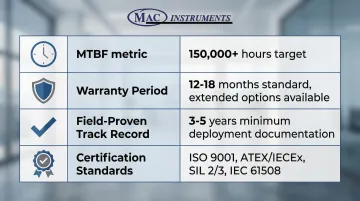
| Reliability Metric | Industry Standard | What to Look For |
|---|---|---|
| MTBF (Mean Time Between Failures) | 150,000+ hours | Higher ratings for safety-critical applications |
| Warranty Period | 12-18 months standard | Extended options from premium manufacturers |
| Field-Proven Track Record | 3-5 years minimum | Documentation of successful deployments in similar applications |
| Certification Standards | ISO 9001, ATEX/IECEx | SIL 2/3 ratings for safety systems, IEC 61508 for functional safety |
2026 Reliability Innovations
These evaluation criteria help identify quality meters, but new technologies are changing how reliability is maintained. The industry has shifted from reactive repairs to predictive health monitoring.
Advanced diagnostic systems now allow operators to verify meter health without process interruption:
- Smart Meter Verification: Emerson's technology checks tube health, electronics, and calibration in under 90 seconds without stopping the process
- Heartbeat Technology: Endress+Hauser's TÜV-certified solution provides traceable device verification during operation, extending proof test intervals
- In-situ verification: ABB's tools generate compliance certificates on-site without removing devices from service
These innovations have reduced unplanned shutdowns by about 30% and extended calibration intervals from annual requirements to 3-5 years for many applications.
Environmental Factors Affecting Reliability
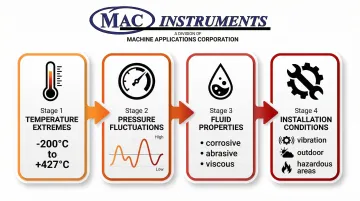
Beyond diagnostic capabilities, reliability depends heavily on matching technology to environmental conditions:
- Temperature extremes: Some applications require measurement from -200°C to +427°C
- Pressure fluctuations: Meters must maintain accuracy despite varying line pressures
- Fluid properties: Corrosive, abrasive, or viscous fluids demand specific materials and designs
- Installation conditions: Vibration, outdoor exposure, and hazardous area classifications all impact reliability
Top 5 Most Reliable Flow Meter Types for Industrial Applications 2026
Different flow meter technologies offer varying reliability profiles depending on the application. The following five types are proven performers in demanding industrial environments, each excelling where their design strengths align with process requirements.
Electromagnetic (Magnetic) Flow Meters
Magnetic flow meters use Faraday's law of electromagnetic induction to measure conductive fluid flow, making them highly reliable for water and wastewater applications. With no moving parts and proven track records spanning decades, they represent one of the most dependable technologies available.
Reliability advantages include:
- No mechanical wear components for exceptional longevity (10+ year service life)
- Minimal maintenance requirements with conductive fluids
- Self-diagnostic capabilities detect electrode fouling, gas bubbles, and conductivity changes in 2 minutes
- High-end models achieve ±0.2% accuracy with long-term stability
- IP68-rated designs allow continuous submergence up to 10 meters for wastewater installations
| Category | Details |
|---|---|
| Best Applications | Water/wastewater treatment, chemical processing, pulp and paper, mining slurries |
| Reliability Strengths | No moving parts, corrosion-resistant liners, self-diagnostic capabilities, typical MTBF of 10+ years, IP68 submergence ratings |
| Limitations | Requires conductive fluids (minimum 5-20 μS/cm depending on model), not suitable for gases or hydrocarbons |
KROHNE's OPTIFLUX series has been deployed in facilities like Heineken, where 250 flowmeters monitor energy and water consumption with proven reliability in food processing environments.
Coriolis Mass Flow Meters
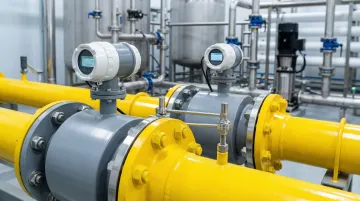
Coriolis technology measures mass flow directly by detecting the Coriolis force effect on vibrating tubes, making it the gold standard for high-accuracy, high-reliability applications in custody transfer and batch processing. These meters provide multi-variable measurement including flow, density, and temperature from a single device.
Reliability advantages include:
- Direct mass measurement eliminates separate density and temperature compensation, reducing failure points
- Minimal drift over time with calibration intervals extending to 3-5 years
- Self-validation features (Emerson's Smart Meter Verification, Yokogawa's Tube Health Check) detect issues before they impact measurement
- High-performance models achieve ±0.05% repeatability
- MTBF ratings exceeding 150,000 hours for safety-critical loops
| Category | Details |
|---|---|
| Best Applications | Custody transfer, chemical dosing, pharmaceutical manufacturing, food and beverage processing |
| Reliability Strengths | High accuracy (±0.1% standard, ±0.05% high-end), self-checking capabilities, no flow profile sensitivity, long calibration intervals (3-5 years), SIL 2/3 certification available |
| Limitations | Higher initial cost, sensitive to vibration, pressure drop considerations |
The integration of zero verification tools addresses the most common Coriolis failure mode—zero drift caused by product buildup or corrosion—allowing operators to diagnose and correct issues in under 90 seconds without process shutdown.
Ultrasonic Flow Meters
Ultrasonic technology measures flow by analyzing acoustic signals through the fluid, offering non-invasive reliability particularly valued for large pipe applications. Both transit-time (for clean liquids) and Doppler (for liquids with particles) types provide versatile solutions.
Reliability advantages include:
- Clamp-on meters eliminate process penetration entirely, removing potential leak points
- Installation without pipe cutting or shutdown
- No pressure drop and no moving parts for long service life
- Suitable for extreme pipe sizes (0.5 inch to over 80 inches)
- Transit-time models achieve ±1% accuracy; Doppler versions handle slurries with ±2% accuracy
| Category | Details |
|---|---|
| Best Applications | Clean liquids, water distribution, oil and gas pipelines, HVAC systems, large-diameter pipes |
| Reliability Strengths | Clamp-on options eliminate process penetration, no flow obstruction, minimal maintenance, suitable for extreme pipe sizes, no pressure drop |
| Limitations | Transit-time requires clean fluids, installation sensitivity affects accuracy, potential acoustic interference |
The non-intrusive nature of clamp-on ultrasonic meters makes them ideal for retrofits and temporary measurements, though inline versions offer higher long-term accuracy for permanent installations.
Vortex Flow Meters
Vortex meters measure flow by detecting the frequency of vortices shed by a bluff body placed in the flow stream. This simple yet robust technology has proven itself as a reliable workhorse for steam, gas, and liquid measurement in power generation and process industries.
Reliability advantages include:
- Minimal moving parts (typically just the sensor) for long service life
- Wide turndown ratios and exceptional temperature capability (-200°C to +427°C)
- Self-cleaning bluff body design resists fouling
- Multivariable versions integrate pressure and temperature compensation
- Gasket-free, non-clog design eliminates impulse lines and associated maintenance
| Category | Details |
|---|---|
| Best Applications | Steam flow, natural gas, compressed air, clean process liquids |
| Reliability Strengths | Minimal moving parts, wide temperature range (-200°C to +427°C), self-cleaning design, multivariable versions available, ASME B31.3 compliance |
| Limitations | Requires minimum flow velocity (typically >0.2 m/s liquids, >2 m/s gas), sensitive to vibration, not suitable for high-viscosity fluids |
KROHNE's OPTISWIRL 4200 has demonstrated reliability in food processing applications, measuring steam for yogurt pot sterilization with integrated pressure, temperature, and volume flow measurement in a single device.
Thermal Mass Flow Meters
Thermal mass flow meters measure gas flow by detecting heat transfer from a heated sensor, providing direct mass measurement without requiring separate pressure and temperature compensation. This technology excels for gases and high-temperature steam applications in extreme industrial conditions.
Reliability advantages include:
- No moving parts and direct mass flow measurement eliminate common failure modes
- High-temperature capability up to 400°C (750°F) standard
- Weatherproof construction suits outdoor installations
- Self-diagnostic features alert operators to potential issues
- Insertion-style designs offer negligible pressure drop for energy efficiency
For extreme steam applications, MAC Instruments has established a proven track record in power generation and cement industries with thermal mass flow meters capable of measuring high-temperature steam up to 1200°F (650°C), with specialized versions reaching 2400°F (1300°C). Their NIST-traceable accuracy and weatherproof construction have made them reliable solutions for demanding steam flow measurement in hundreds of installations worldwide.
| Category | Details |
|---|---|
| Best Applications | Compressed air, natural gas, biogas, flare gas, high-temperature steam in power plants and industrial processes |
| Reliability Strengths | No moving parts, wide temperature range (up to 400°C standard, 1200°F/650°C for specialized steam applications), direct mass measurement, weatherproof construction, self-diagnostic features |
| Limitations | Gas-specific calibration required, sensitivity to gas composition changes, not suitable for liquids |
Thermal mass meters are particularly valuable for boiler efficiency applications, where accurate fuel-to-air ratio measurement directly impacts operational costs and emissions compliance.
Leading Brands Known for Flow Meter Reliability
While technology type matters, manufacturer reputation proves equally critical for long-term reliability. The brands below have earned their reputations through decades of proven performance across demanding industrial applications.
Endress+Hauser
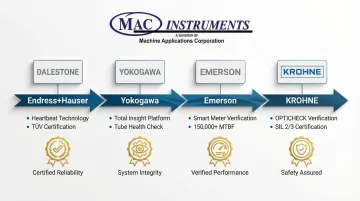
Endress+Hauser's Proline family (Promag, Promass, Prowirl) represents decades of German engineering focused on reliability. Their Heartbeat Technology provides TÜV-certified traceable verification during operation, allowing facilities to extend calibration intervals while maintaining compliance.
Key reliability features include:
- Global calibration network accredited to ISO/IEC 17025 standards for custody transfer applications
- IEC 61508 compliance with comprehensive safety documentation
- SIL 2/3 ratings ideal for safety-instrumented systems
Yokogawa
Yokogawa's ROTAMASS Coriolis and ADMAG magnetic flow meters deliver high-precision digital measurement with advanced diagnostics. Their Total Insight platform detects potential issues before they cause failures.
Standout capabilities:
- Tube Health Check and Entrained Gas Management for predictive maintenance
- SIL 2/3 capability with designs handling high pressure and viscosity
- Strong track record in oil & gas and chemical processing applications
Emerson (Rosemount and Micro Motion)
Emerson's market leadership comes from innovative self-diagnostic features and predictive maintenance capabilities. Their Smart Meter Verification checks Coriolis meter health in under 90 seconds without process interruption, verifying tube integrity, electronics, and calibration.
Performance highlights:
- PlantWeb digital ecosystem for integrated plant reliability monitoring
- MTBF ratings exceeding 150,000 hours
- Premium Coriolis models achieve ±0.05% accuracy
- Frost & Sullivan recognition for technology leadership in clean energy applications
KROHNE
KROHNE's OPTIFLUX, OPTIMASS, and OPTISWIRL series provide versatile solutions across diverse industrial environments.
Notable features:
- SIL 2/3 certification with ATEX/IECEx approvals for hazardous areas
- OPTICHECK in-situ verification allows field validation without service interruption
- Integrated pressure and temperature compensation reduces system complexity
- Proven installations across food processing, chemical manufacturing, and water treatment
How to Evaluate Flow Meter Reliability Before Purchase
Review Certifications and Documentation
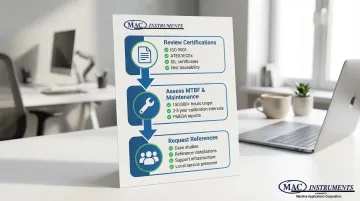
Request comprehensive documentation including ISO 9001 quality management certificates, ATEX/IECEx hazardous area approvals, and SIL certificates for safety-critical applications. For custody transfer, verify compliance with OIML R117 or API standards.
Calibration certificates should demonstrate traceability to national standards like NIST or ISO/IEC 17025. Manufacturers such as MAC Instruments provide NIST-traceable calibration capabilities, ensuring measurement accuracy you can verify.
Assess MTBF and Maintenance Requirements
Compare MTBF ratings across technologies—modern high-reliability units target 150,000+ hours for critical applications. Review calibration intervals: advanced diagnostics now support 3-5 year intervals versus traditional annual requirements.
Request FMEDA reports to understand how devices detect and respond to potential failures. These Failure Modes, Effects, and Diagnostic Analysis documents reveal the meter's self-monitoring capabilities.
Request Reference Installations
Ask manufacturers for case studies or reference installations in applications similar to yours. Contact references directly to learn about actual field performance, maintenance requirements, and total cost of ownership.
Assess the manufacturer's support infrastructure:
- Technical support responsiveness and availability
- Spare parts inventory and delivery times
- Training programs for operators and maintenance staff
- Local service presence in your region
Conclusion
The most reliable flow meter for your application depends on matching technology strengths to your specific process conditions—reliability isn't one-size-fits-all.
Match your needs to the right technology:
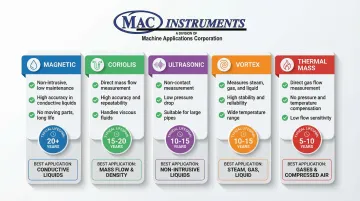
- Magnetic meters excel for conductive liquids
- Coriolis for high-accuracy custody transfer
- Ultrasonic for large pipes
- Vortex for steam applications
- Thermal mass for gas measurement
When evaluating options, prioritize long-term reliability and total cost of ownership over initial purchase price. A meter costing twice as much but lasting three times longer with half the maintenance delivers superior value.
Work with experienced manufacturers who provide application-specific guidance, comprehensive diagnostics, and ongoing support. For specialized applications like high-temperature steam flow measurement, consider niche expertise. MAC Instruments specializes in extreme industrial conditions, offering steam flow solutions designed for demanding environments where general-purpose meters struggle to maintain reliable performance.
Frequently Asked Questions
What makes a flow meter reliable for industrial applications?
Reliable flow meters combine robust construction, proper technology selection, and minimal maintenance needs. Look for MTBF ratings above 150,000 hours, material compatibility with your process fluids, and self-diagnostic capabilities.
Which flow meter type has the longest lifespan in harsh environments?
Magnetic and ultrasonic flow meters typically last 10-20+ years due to having no moving parts. The best choice depends on your specific fluid properties and environmental conditions.
How do you calculate total cost of ownership for industrial flow meters?
TCO includes purchase price, installation, calibration, maintenance, energy costs, and downtime from failures. Higher-quality meters typically cost less over time by extending calibration intervals and preventing unplanned shutdowns.
What are the most common causes of flow meter failure in industrial settings?
Top causes include sensor fouling, mechanical wear in moving parts, and corrosion from incompatible materials. Proper technology selection and correct installation prevent most failures.
Do wireless/IoT flow meters compromise reliability compared to wired systems?
Modern wireless flow meters offer comparable reliability to wired systems for monitoring applications. However, wired systems remain preferred for critical control loops due to their deterministic performance and power stability.
What certifications should I look for when selecting a reliable flow meter?
Essential certifications include ISO 9001, ATEX/IECEx for hazardous areas, and SIL 2/3 ratings for safety-critical applications. Look for NIST-traceable calibration certificates and industry-specific approvals relevant to your application.