Introduction
Flow meter reliability directly impacts plant uptime, process efficiency, and operational costs in industrial facilities. When a critical flow meter fails unexpectedly, production lines halt, quality control suffers, and maintenance teams scramble to restore operations.
The stakes are high: U.S. manufacturers lose up to $207 million weekly due to unplanned downtime, with equipment failures accounting for approximately 42% of these incidents.
The mechanical versus electronic reliability debate matters because choosing the wrong meter can lead to unexpected downtime, inaccurate measurements affecting product quality, and significantly higher total cost of ownership. A single hour of unplanned downtime can cost between $400,000 and $1.7 million depending on facility scale.
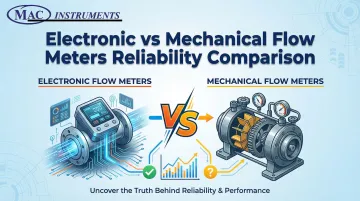
Understanding the reliability differences between mechanical meters (turbines, positive displacement, variable area) and electronic meters (electromagnetic, ultrasonic, Coriolis) is essential for making informed decisions that protect your bottom line.
TLDR
- Mechanical meters require maintenance every 1-2 years and replacement every 3-7 years due to moving parts
- Electronic designs deliver 10-15+ year service life with minimal upkeep
- Accuracy drift: electronic meters hold ±0.5-1% over years vs. 2-5% annual drift for mechanical in harsh conditions
- Mechanical meters suit clean fluids, simple monitoring, and limited upfront budgets
- Electronic meters win for harsh environments, remote monitoring, and long-term cost savings
Electronic vs Mechanical Flow Meters: Quick Comparison
Initial Cost
Mechanical meters offer lower upfront investment, typically 30-60% less expensive than electronic alternatives. A 2-inch stainless steel turbine meter costs between $892 and $2,057, making it attractive for budget-conscious projects.
Electronic meters require higher initial capital—Coriolis meters range from $3,000 to over $25,000 depending on size and features. However, this investment is often justified by dramatically lower total cost of ownership over the equipment's lifespan.
Reliability & MTBF
Mechanical meters:
- Contain moving parts subject to wear, corrosion, and fouling
- Turbine meters typically deliver 3-7 years of service before major component replacement
- Bearing wear is the primary limiting factor
Electronic meters:
- Remove moving parts in most designs
- Achieve typical service life of 10-15+ years with minimal performance degradation
- Specific mass flow controllers have demonstrated Mean Time Between Failures ranging from 59 to 118 years in controlled applications
Maintenance Requirements
Mechanical meters demand regular maintenance including bearing replacement, seal inspection, and moving component servicing. Annual or bi-annual calibration is standard, with more frequent intervals required in harsh conditions.
Electronic meters require minimal maintenance—primarily sensor cleaning. Calibration verification extends to 2-5 years, and many models offer self-diagnostics that enable condition-based maintenance rather than time-based schedules.
Accuracy Over Time
Mechanical meters experience accuracy degradation as components wear. Turbine meters tend to read low as they age, with drift reaching 2-5% annually in harsh conditions with particulates or abrasive fluids.
Electronic meters maintain accuracy within ±0.5-1% over years because they lack wearing components. Coriolis meters have demonstrated calibration stability exceeding 13 years in some industrial applications.
Environmental Tolerance
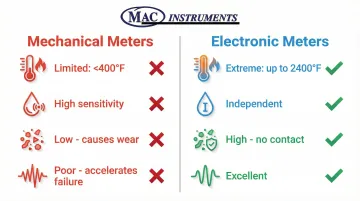
Mechanical meters are sensitive to viscosity changes, temperature extremes, particulates, and vibration. These conditions accelerate wear and reduce service life significantly.
Electronic meters deliver superior performance across extreme temperatures, corrosive environments, and variable process conditions. Industrial electronic instruments can operate reliably at temperatures up to 1200°F standard, with specialized models reaching 2400°F—conditions that would destroy mechanical alternatives.
What is a Mechanical Flow Meter?
Mechanical flow meters use physical, moving components—turbines, positive displacement gears, paddle wheels, or variable area floats—to measure fluid flow rate.
The basic operating principle is straightforward: fluid motion causes mechanical components to move, and this movement translates into flow measurement through direct mechanical linkage or magnetic sensing of the rotating element.
Reliability-related benefits include simple design that's easy to understand and troubleshoot, proven technology with decades of field history, and lower initial capital investment. These meters work well when conditions are favorable and maintenance resources are available.
However, mechanical designs face reliability challenges from component wear:
- Moving parts deteriorate over time, especially with abrasive fluids
- Bearings and seals require periodic replacement
- Fouling from particulates and corrosion from aggressive chemicals
- Accuracy degrades predictably as components wear, requiring frequent calibration and eventual replacement
Reliability considerations by type:
- Turbine meters: Bearing wear is the primary failure mode, with blade damage from debris being a close second
- Positive displacement: Seal leakage and gear wear limit service life, particularly in non-lubricating fluids
- Variable area (rotameters): Float sticking from deposits and tube scratching reduce accuracy over time
Use Cases of Mechanical Flow Meters
Mechanical meters fit reliably in applications with clean water, low-pressure systems, stable fluid properties, and facilities with on-site maintenance capabilities. They remain common in:
- Municipal water distribution systems
- Simple chemical batching operations
- HVAC chilled water circuits
- Agricultural irrigation monitoring
A typical turbine meter in clean water service lasts 5-7 years between overhauls. In lubricating oil applications, positive displacement meters can perform reliably for 10-20 years if properly selected.
These favorable conditions represent a minority of industrial applications—most process environments are far more demanding.
What is an Electronic Flow Meter?
Electronic flow meters measure flow without moving parts in the fluid stream. They use electromagnetic, ultrasonic, or Coriolis sensing principles, each with distinct operating methods:
- Electromagnetic meters: Apply Faraday's Law of electromagnetic induction—conductive fluid moving through a magnetic field generates voltage proportional to flow velocity
- Ultrasonic meters: Measure transit time difference of ultrasonic signals traveling with and against flow, or use Doppler shift from particles in the fluid
- Coriolis meters: Measure mass flow directly by detecting the Coriolis force effect on vibrating tubes carrying the fluid
Reliability Advantages
Electronic meters eliminate moving parts to wear out, maintain accuracy over time, and enable predictive maintenance. The result: less downtime and lower maintenance costs.
These meters resist to corrosion and abrasion since there's no mechanical contact with the fluid. Calibration remains stable over years, and they handle wide temperature ranges. MAC Instruments' high-temperature electronic moisture analyzers demonstrate these advantages, operating reliably up to 2400°F in extreme industrial environments where mechanical alternatives would fail within days.
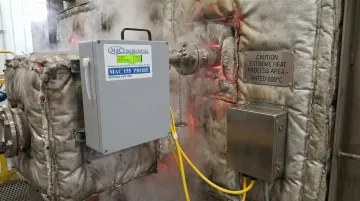
While electronic meters face some challenges—component failure risk, power dependency, and higher replacement costs—field experience shows the operational benefits outweigh these concerns.
Modern designs have made electronic component failures rare, and the extended operational life typically offsets the initial cost premium.
Use Cases of Electronic Flow Meters
Electronic meters provide superior reliability in harsh industrial environments with high temperature, high pressure, or corrosive media. They excel in critical processes where downtime is costly, applications requiring high accuracy over long periods, and remote locations where maintenance access is limited.
Industries preferring electronic meters for reliability:
- Power generation (boiler feed water, steam measurement, flue gas monitoring)
- Chemical processing (corrosive chemicals, batch control, custody transfer)
- Oil and gas refineries (hydrocarbon measurement, catalyst injection)
- Pharmaceutical manufacturing (sterile processes, precise batching)
- Pulp and paper production (pulp consistency, chemical additives)
A petrochemical facility documented significant reliability improvements after replacing mechanical meters with 100 Coriolis meters featuring Smart Meter Verification technology.
The switch enabled extended calibration intervals, avoiding $500,000 in calibration costs and $300,000 in unplanned downtime. This demonstrates the quantifiable reliability advantage of electronic measurement in demanding applications.
Electronic vs Mechanical: Reliability Comparison
Failure Modes and Root Causes
Mechanical meters typically fail from:
- Bearing wear causing increased friction and eventual seizure
- Seal degradation leading to leakage and contamination
- Component fouling from particulates, scale, or biological growth
- Blade or gear damage from debris impact
- Corrosion of metal components in aggressive media
Electronic meters typically fail from:
- Sensor fouling (electrode coating in magnetic meters, buildup on ultrasonic transducers)—usually cleanable without replacement
- Electronic component failure (rare, often from moisture ingress or power surges)
- Power supply issues or wiring problems
- Process conditions exceeding design limits
The critical difference: mechanical failures are progressive and inevitable due to wear, while electronic failures are often preventable through proper installation and protection.
Maintenance and Calibration Requirements
Research shows distinct maintenance patterns. Mechanical turbine meters require annual calibration in custody transfer applications, with bearing replacement every 2-4 years depending on service conditions.
Total maintenance costs can reach 40-60% of the initial purchase price over a 10-year period.
Electronic meters extend calibration intervals to 2-5 years, with some ultrasonic meters reaching 6 years when equipped with diagnostic systems.
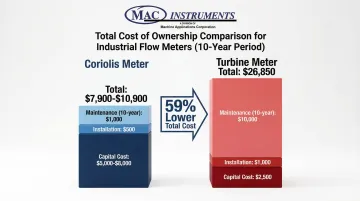
A 10-year Total Cost of Ownership analysis comparing a small Coriolis meter to a turbine meter in natural gas service demonstrates the long-term value:
| Cost Category | Coriolis Meter | Turbine Meter |
|---|---|---|
| Capital Cost | $5,000-$8,000 | $2,500 |
| Installation | ~$500 | ~$1,000 |
| Maintenance (10-year) | $1,000 | $10,000 |
| Total 10-Year Cost | $7,900-$10,900 | $26,850 |
The Coriolis meter delivered 59% lower total cost despite being 2-3 times more expensive initially.
Accuracy Retention as a Reliability Metric
Mechanical meter accuracy degrades predictably with wear. Turbine meters read progressively lower as bearing friction increases, requiring more frequent calibration to maintain process control.
In harsh conditions with particulates, accuracy drifts 2-5% annually.
Electronic meters maintain accuracy significantly longer. Coriolis meters have demonstrated calibration stability exceeding 13 years in some applications, with accuracy remaining within ±0.5-1% of full scale.
This stability reduces calibration-related downtime and ensures consistent process control and product quality.
Environmental Stress Factors
Temperature extremes affect mechanical meters severely—thermal expansion causes binding, lubricants break down, and seals fail. Electronic meters handle wider ranges, with specialized designs operating reliably above 1000°F in industrial applications.
Mechanical seals and bearings suffer damage from pressure fluctuations. Electronic meters tolerate pressure variations better, though sudden pressure changes can affect measurement temporarily in some technologies.
Turbine meter accuracy suffers when fluid viscosity changes, requiring recalibration or flow computer compensation. Coriolis and magnetic meters are virtually independent of viscosity, maintaining accuracy across wide viscosity ranges.
Particulate content devastates mechanical meters—sand, scale, or product particles destroy bearings and rotors. Magnetic meters handle slurries and entrained solids without damage.
An oil producer replaced turbine meters with magnetic meters specifically because sand and rock erosion was causing frequent failures. The magnetic meters eliminated maintenance costs and optimized well production.
Situational Recommendations
Choose mechanical meters when:
- Upfront cost is the paramount concern and budget is severely limited
- Fluid is clean, non-corrosive, and has stable properties
- Maintenance staff is available on-site for regular service
- Moderate accuracy (±1-2%) is acceptable for the application
- Operating conditions are benign (moderate temperature, low vibration)
Choose electronic meters when:
- Process uptime is critical and downtime costs are high
- Environment is harsh (high temperature, corrosive, abrasive)
- Remote monitoring and diagnostics are needed
- Long-term accuracy is essential for quality control or custody transfer
- Total cost of ownership matters more than initial price
- Regulatory compliance requires documented calibration stability
Real World Example: Reliability in Extreme Conditions
A major power generation facility faced persistent reliability problems with mechanical flow meters in high-temperature flue gas applications. The turbine-style meters installed for combustion air measurement were failing every 6-12 months due to bearing seizure from thermal expansion and particulate contamination.
Each failure caused 8-12 hours of unplanned downtime while technicians accessed the equipment, removed the failed meter, installed a replacement, and recommissioned the system. With downtime costs exceeding $400,000 per hour, these failures were causing significant financial losses.
Measurement inaccuracy was affecting combustion control, leading to reduced efficiency and increased emissions. The maintenance team was spending excessive time on meter replacement and calibration, taking time from other critical activities.
The severity of these problems prompted a search for more reliable alternatives.
The facility evaluated electronic flow measurement alternatives and selected MAC Instruments' electronic moisture analyzers for extreme high-temperature environments. These instruments operate reliably at temperatures up to 1200°F standard, with optional capability to 2400°F.
The weatherproof NEMA 4X construction enabled outdoor installation, and the NIST-traceable accuracy ensured regulatory compliance.
Reliability metrics from the implementation:
- Maintenance visits reduced by 85%—from monthly turbine meter service to quarterly sensor inspections
- Mean Time Between Failures increased from 9 months to 10+ years—no meter replacements required in first five years of operation
- Calibration drift eliminated—built-in calibration system on MAC155 model enabled daily verification without process interruption
- Downtime cost savings of $1.2 million annually—eliminating three average failure incidents per year
- Payback period of 8 months—despite higher initial investment, savings from reduced downtime and maintenance justified the cost rapidly
In extreme industrial environments where mechanical meters face rapid wear from temperature, particulates, or corrosive conditions, electronic solutions offer superior long-term reliability despite higher upfront costs.
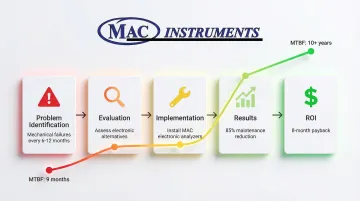
The key is matching the technology to the application severity—benign conditions may not justify the premium, but harsh environments deliver rapid return on investment.
Need reliable measurement in high-temperature applications? Contact MAC Instruments at 419.621.2322 or info@macinstruments.com to discuss your specific requirements.
Conclusion
Neither meter type is universally superior—the right choice depends on your specific application requirements, operating environment, accuracy needs, and total cost of ownership priorities.
Mechanical meters offer proven reliability and lower initial cost for clean fluids in moderate conditions with available maintenance resources. Electronic meters deliver enhanced long-term reliability, extended service life, and lower total cost in harsh environments, critical processes, or applications where sustained accuracy and uptime are essential.
Your decision framework: Evaluate your operating conditions honestly, calculate true total cost including downtime and maintenance, and select the technology that delivers the lowest lifecycle cost while meeting your reliability requirements.
In most demanding industrial applications—power generation, refineries, chemical processing—that choice increasingly favors electronic measurement technologies. Companies like MAC Instruments specialize in electronic solutions (moisture analyzers and steam flow meters) precisely because these instruments provide the accuracy and durability required in extreme environments up to 1200°F.
Frequently Asked Questions
Which flow meter type has a longer lifespan in industrial applications?
Electronic flow meters typically last 10-15+ years with minimal maintenance, while mechanical meters average 3-7 years before major component replacement. Lifespan varies based on fluid properties, operating conditions, and maintenance quality.
How does temperature affect the reliability of mechanical vs electronic flow meters?
Mechanical meters experience accelerated wear at temperature extremes due to thermal expansion and seal failure. Electronic meters maintain reliability across wider temperature ranges—MAC Instruments' analyzers operate up to 2400°F, where mechanical alternatives fail rapidly.
What are the most common failure modes for mechanical flow meters?
Common failure modes include:
- Bearing wear from friction and particulates
- Seal leakage and contamination
- Blade or gear damage from debris
- Fouling or corrosion of moving components
Do electronic flow meters require more frequent calibration than mechanical meters?
Electronic meters require less frequent calibration (every 2-5 years) compared to mechanical meters (annually or bi-annually) because they maintain accuracy better with no wearing components.
Which flow meter type has lower total cost of ownership over 10 years?
While mechanical meters cost 30-60% less initially, electronic meters often have lower 10-year TCO in demanding applications. One analysis showed electronic meters saving 60% over 10 years ($10,900 vs. $26,850) through reduced maintenance, fewer replacements, and less downtime.
Can electronic flow meters operate reliably in high-vibration environments?
Electronic flow meters (particularly electromagnetic and Coriolis types) handle vibration better than mechanical meters because they have no moving parts to be damaged by vibration-induced wear or misalignment. Rosemount magnetic flowmeters are rated for 2G vibration (wall mount) and 5G (remote mount), while mechanical turbine bearings experience accelerated wear under continuous vibration.