Introduction
When steam enters a reactor at 200°F or nitrogen flows into a semiconductor chamber, your choice between mass flow and volumetric flow measurement directly impacts product quality, billing accuracy, and regulatory compliance. Flow measurement is critical to industrial process control across manufacturing plants, power generation facilities, and chemical processing operations worldwide.
The choice between mass flow and volumetric flow meters affects far more than numbers on a display. It determines whether your measurements remain accurate when temperatures spike during summer months. It affects whether your custody transfer calculations hold up during audits and whether your chemical reactions maintain stoichiometric precision.
According to industry research, switching from volumetric to mass flow measurement in custody transfer applications can improve accuracy by 1500%—the difference between 0.45% error and 0.03% error.
Understanding these differences helps you select the right measurement technology for your process. This guide breaks down the core differences between mass and volumetric flow measurement, explains when each technology excels, and provides practical selection criteria for your specific applications.
TLDR
- Mass flow meters measure actual molecular quantity—unaffected by temperature or pressure shifts
- Volumetric meters track physical space occupied, but readings change with temperature and pressure
- Choose mass flow for gas mixing, custody transfer, and applications needing exact molecular ratios
- Volumetric flow suits stable liquid applications—water distribution, HVAC, simple process monitoring
- Selection depends on fluid type, process stability, accuracy requirements, and budget constraints
Mass Flow vs Volumetric Flow: Quick Comparison
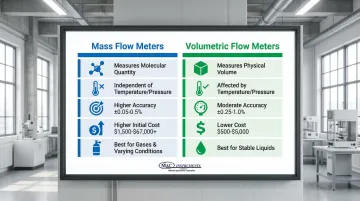
| Aspect | Mass Flow Meters | Volumetric Flow Meters |
|---|---|---|
| Measurement Principle | Number of molecules (mass) passing through system | Volume (3D space) occupied by fluid |
| Common Units | SCCM, SLPM, kg/s, lb/hr | GPM, LPM, CFM, m³/hr |
| Temperature & Pressure Sensitivity | Independent—readings remain constant | Dependent—readings change with conditions |
| Typical Accuracy | ±0.05% to 0.5% (Coriolis) ±1.0% to 3.0% (Thermal) |
±0.5% (Electromagnetic) ±0.25% to 1.0% (Turbine) |
| Initial Cost | $1,500 to $67,000+ | $500 to $5,000 (most applications) |
| Best Applications | Gas mixing, custody transfer, chemical reactions, varying conditions | Water distribution, HVAC, stable liquid processes |
| Maintenance Frequency | 12-24 months (Coriolis) 6-12 months (Thermal) |
3-6 months (Turbine) 6-12 months (Electromagnetic) |
What is Mass Flow?
Mass flow measures the actual quantity of matter—the number of molecules—passing through a system per unit time, regardless of temperature or pressure changes. When you measure 100 kg/hr of nitrogen, you're counting molecules, not the space they occupy.
Understanding Standardized Volumetric Units
Units like SCCM (standard cubic centimeters per minute) and SLPM (standard liters per minute) appear volumetric but actually represent mass flow. These "standardized volumetric" units reference a specific density at Standard Temperature and Pressure (STP) conditions.
When a gas supplier specifies 1,000 SCCM, they're describing a fixed molecular quantity that would occupy 1,000 cubic centimeters at standard conditions—not the actual volume in your pipe.
Common STP definitions include:
- NIST (US Industrial): 20°C (293.15 K) and 101.325 kPa
- IUPAC (Chemical Physics): 0°C (273.15 K) and 100 kPa
- CAGI (Compressed Air): 20°C (68°F) and 100 kPa
Discrepancies between STP definitions can introduce errors of ~1.3% in gas calculations if not explicitly defined. Always verify which standard your supplier uses.
The Ideal Gas Law Connection
The relationship PV = nRT (Pressure × Volume = number of moles × Gas constant × Temperature) explains why mass flow remains constant while volumetric flow changes. Double the pressure or increase temperature by 50°C, and the number of molecules (n) stays constant—but volume (V) changes proportionally. Mass flow meters measure n directly, eliminating the need for temperature and pressure compensation.
Mass Flow Meter Technologies
Coriolis meters operate on Newton's Second Law. Fluid flowing through vibrating tubes causes a twisting motion due to inertia.
The phase shift between inlet and outlet sensors is directly proportional to mass flow, achieving accuracies of ±0.05% to 0.1% for liquids.
Thermal mass meters use heat transfer principles. Fluid flow cools a heated sensor. The power required to maintain a constant temperature difference is proportional to mass flow rate and the fluid's specific heat.
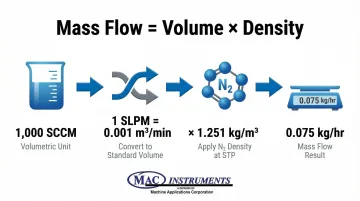
Conversion Example: To convert 1,000 SCCM of nitrogen to mass flow:
- Nitrogen density at STP (0°C, 1 atm): 1.251 g/L = 0.001251 kg/L
- 1,000 SCCM = 1 SLPM = 0.001 m³/min
- Mass flow = 0.001 m³/min × 1.251 kg/m³ = 0.001251 kg/min = 0.075 kg/hr
Use Cases of Mass Flow Meters
Gas Mixing and Blending: Semiconductor manufacturing requires precise gas ratios for Chemical Vapor Deposition (CVD). Mass flow controllers ensure consistent molecular delivery regardless of supply line pressure fluctuations, maintaining precise ratios for wafer fabrication.
Custody Transfer: In oil and gas operations, billing depends on actual material quantity, not volume. Replacing mechanical meters with Coriolis meters achieved 0.03% accuracy, exceeding custody transfer requirements by 1500% and eliminating loading mistakes worth millions in billing disputes.
Chemical Processing: Truck filling of chemical products where density varies with temperature requires mass metering to prevent under- or overloading.
Volumetric measurement could result in safety risks and financial losses when temperature shifts change fluid density by 5-10%.
What is Volumetric Flow?
Volumetric flow measures the three-dimensional space that fluid occupies as it passes through a system per unit time. When you measure 100 gallons per minute (GPM) of water, you're measuring physical volume, not molecular quantity.
How Conditions Affect Volumetric Flow
Gas compressibility and thermal expansion cause volumetric flow to vary significantly with temperature and pressure. A gas stream measuring 1,000 CFM at 70°F and 14.7 PSIA will measure only 500 CFM if pressure doubles to 29.4 PSIA—even though the same number of molecules flows through the pipe.
Volumetric Flow Meter Technologies
Electromagnetic Meters operate on Faraday's Law of Induction. Conductive fluid moving through a magnetic field generates voltage proportional to velocity.
The flow rate equals cross-sectional area × velocity (Q = A × v), achieving ±0.5% accuracy with 40:1 turndown.
Turbine Meters use a rotor that spins in the fluid stream. Angular velocity is proportional to fluid velocity, with pulses generated by passing blades that electronic sensors count.
Rotameters (variable area meters) feature a float within a tapered tube. The float rises until upward drag force and buoyancy equal downward gravitational force, with float height indicating volumetric flow rate.
Actual vs. Standardized Flow Rate
"Actual flow rate" refers to volume at current operating conditions, while "standardized flow rate" references volume at standard conditions. A gas compressor might draw 500 ACFM (actual cubic feet per minute) at inlet conditions but deliver only 100 SCFM (standard cubic feet per minute) when corrected to standard pressure and temperature.
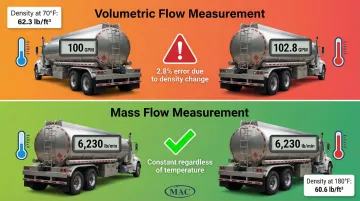
Water flowing at 100 GPM at 70°F demonstrates how temperature affects volumetric measurement:
- Water density at 70°F: 62.3 lb/ft³
- Water density at 180°F: 60.6 lb/ft³
- Volumetric change: (62.3/60.6) × 100 GPM = 102.8 GPM
- Mass flow remains constant: 100 GPM × 62.3 lb/ft³ = 6,230 lb/min
Use Cases of Volumetric Flow Meters
Municipal water systems operate under relatively stable conditions where liquid density remains nearly constant. Electromagnetic meters dominate these applications due to their non-intrusive design, zero pressure drop, and ability to handle slurries without clogging.
Building air handlers deliver specific volumes of conditioned air to maintain comfort. Since temperature and pressure remain stable in closed-loop HVAC systems, volumetric measurement provides adequate accuracy at lower cost than mass flow alternatives.
Applications like filter status monitoring or purge line verification rely on rotameters that require no external power and provide immediate visual indication. Where precision isn't critical, the ±2-4% accuracy suffices at a fraction of the cost of electronic meters.
Mass Flow vs Volumetric Flow: Which is Better?
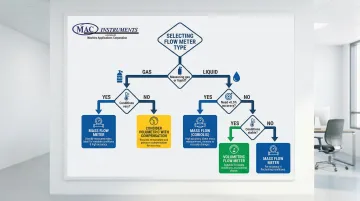
The right meter depends entirely on your fluid type, process conditions, and accuracy needs.
Choose Mass Flow When:
- Working with compressible gases in dynamic conditions
- Process conditions (temperature/pressure) vary significantly
- Precise molecular measurement is critical (chemical reactions, gas mixing)
- Custody transfer or billing requires maximum accuracy
- Density changes would impact product quality or safety
- Long-term accuracy without frequent recalibration is essential
For stable liquid processes, volumetric meters often provide better value:
Choose Volumetric Flow When:
- Measuring incompressible liquids under stable conditions
- Temperature and pressure remain relatively constant
- Density variations don't affect your process outcomes
- Initial cost is a primary constraint
- Simple monitoring is sufficient (not precision control)
- Conductive fluids allow electromagnetic measurement
Beyond these guidelines, weigh these practical considerations:
Fluid type determines feasibility—gases favor mass flow, while stable liquids work with volumetric. Process stability matters too: variable conditions demand mass flow; stable systems allow volumetric options.
Accuracy requirements drive technology choice. Applications needing <0.5% accuracy typically require mass flow (Coriolis). Budget is often decisive: volumetric meters cost 50-80% less initially. Finally, consider maintenance capability—Coriolis meters require less frequent calibration than turbine meters.
Real World Applications and Selection Guidance
Power Generation Industry
Steam flow measurement in power plants requires mass flow measurement for efficiency calculations and emissions control.
MAC Instruments' steam flow meters use critical flow principles to provide true mass flow measurement even with changing line pressure, operating at temperatures up to 1200°F. The meters feature no moving parts and maintain ±5% accuracy, making them ideal for boiler performance monitoring and steam system optimization.
Combustion air control presents another challenge. When air temperature varies by 50°F between winter and summer, volumetric flow readings shift by 8-10% even with constant molecular delivery. Mass flow ensures consistent air-fuel ratios for optimal combustion efficiency and emissions compliance.
Oil & Gas and Chemical Processing
In oil and gas operations, custody transfer applications require maximum accuracy. Even 0.1% error translates to thousands of dollars in disputes.
API MPMS Chapter 5.6 explicitly covers Coriolis meters for liquid hydrocarbon measurement, recognizing their superior accuracy and immunity to viscosity changes.
Batch processing in chemical manufacturing demands precise molecular ratios. When mixing reactants, the chemical balance depends on molecular quantities, not volumes.
A 2% volumetric error caused by temperature variation could result in incomplete reactions, off-spec product, or safety hazards.
Food & Beverage and Water Treatment
Liquid filling operations under controlled conditions work well with volumetric flow measurement. Bottling lines maintaining consistent product temperature can use electromagnetic or turbine meters at a fraction of Coriolis meter costs.
Water treatment plants processing millions of gallons daily rely on electromagnetic meters for their reliability with conductive liquids and slurries. Key advantages include:
- No clogging when handling wastewater solids
- Zero pressure drop across the meter
- 40:1 turndown ratio for operational flexibility
- Moderate cost compared to mass flow alternatives
Conclusion
The choice between mass flow and volumetric flow meters hinges on whether molecular quantity or physical volume matters most to your process. Gas applications with varying conditions almost always require mass flow measurement, while stable liquid processes often work well with volumetric alternatives. Chemical reactions, custody transfer, and precision mixing demand the accuracy and condition-independence that only mass flow provides.
When evaluating meters, look beyond initial accuracy specifications to total cost of ownership:
- Coriolis meters: Cost 2-3× more upfront, but 12-24 month calibration cycles reduce TCO by 10-20% over a decade
- Turbine meters: Lower capital cost, but require inspection every 3-6 months
- Installation savings: Eliminating straight-pipe requirements offsets higher capital costs
The long-term economics often favor higher-precision technologies.
The right meter delivers accurate data that improves process efficiency, ensures regulatory compliance, and prevents costly errors—whether that's a $500 rotameter for a purge line or a $50,000 Coriolis meter for custody transfer. For applications involving moisture content in gas streams or humidity control in industrial processes, specialized measurement approaches like those from MAC Instruments complement flow metering by providing NIST-traceable accuracy in extreme temperature environments up to 1200°F.
Frequently Asked Questions
What is the difference between a mass flow meter and a volumetric flow meter?
Mass flow meters measure the number of molecules (mass) passing through a system, independent of temperature and pressure changes. Volumetric flow meters measure the physical space occupied by fluid, which changes when temperature or pressure varies.
Which is more accurate, mass flow meters or volumetric flow meters?
Mass flow meters typically provide higher accuracy in dynamic conditions because they're independent of temperature and pressure changes. Coriolis meters achieve ±0.05% to 0.1% accuracy, while volumetric meters depend on stable conditions and degrade when density changes.
Is GPM a volumetric or mass flow rate?
GPM (gallons per minute) is a volumetric flow unit measuring volume per time, not mass. It indicates the physical space occupied by fluid passing through the system each minute.
What is the difference between CCM and SCCM?
CCM (cubic centimeters per minute) is actual volumetric flow at current operating conditions. SCCM (standard cubic centimeters per minute) is standardized volumetric flow representing mass flow at reference conditions (typically 0°C and 1 atm), making it independent of actual temperature and pressure.
Can you convert between mass flow and volumetric flow rates?
Yes, conversion requires knowing fluid density: mass flow = volumetric flow × density. For gases, you must specify temperature and pressure conditions since density changes significantly. For liquids with constant density, conversion is straightforward.
What industries typically use mass flow meters vs. volumetric flow meters?
Mass flow meters are common in semiconductor manufacturing, chemical processing, and oil & gas custody transfer where precision matters. Volumetric flow meters dominate water treatment, HVAC systems, and simple liquid handling where conditions remain stable.