Introduction
Accurate flow measurement is the backbone of operational efficiency, safety, and profitability across industries like power generation, oil and gas, water treatment, and manufacturing. When flow meters fail to deliver precise data, the consequences ripple through entire operations—inefficient processes waste energy, safety systems fail to detect hazards, and costly downtime disrupts production schedules.
Choosing the wrong flow meter can be particularly expensive. A differential pressure meter installed in a viscous fluid application may deliver inaccurate readings, while an electromagnetic meter used with non-conductive hydrocarbons simply won't function.
The global flow meter market, valued at $9.1 billion in 2024 and projected to reach $12.6 billion by 2029 [source citation needed], demonstrates how heavily industries depend on accurate flow measurement for process control and regulatory compliance.
Understanding which flow meter technology matches your application requirements is essential for avoiding costly mismatches. This guide covers the major types of flow meters, their strengths and limitations, and how to select the best technology based on fluid properties, accuracy requirements, and installation constraints.
TLDR
- Flow meters measure liquid or gas movement rates through pipes, enabling process control, energy management, and regulatory compliance
- Different meter technologies suit specific fluids—conductivity, viscosity, and cleanliness determine your best option
- Match accuracy requirements and flow range to your application before comparing purchase prices
- Factor in energy losses, maintenance intervals, and calibration frequency when calculating true lifetime costs
What Is a Flow Meter?
Accurate flow measurement drives efficiency in industrial operations—from tracking steam consumption in power plants to monitoring chemical dosing in manufacturing. A flow meter measures the volumetric or mass flow rate of liquids, gases, or steam moving through a piping system.
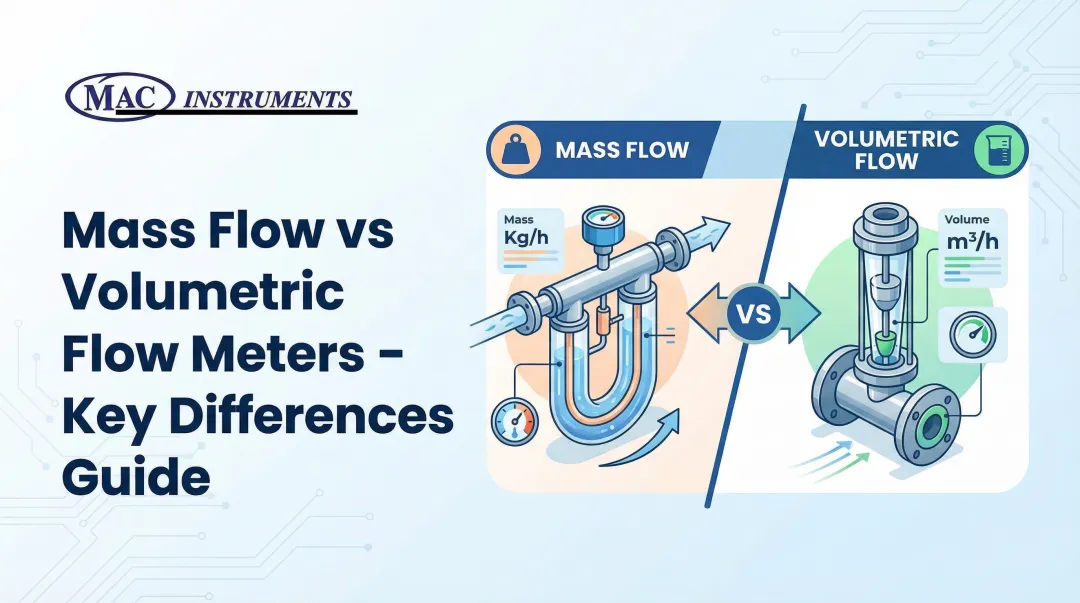
These devices provide critical data in units such as gallons per minute (GPM), liters per second (L/s), cubic meters per hour (m³/h), or kilograms per hour (kg/h). The choice between volumetric and mass measurement depends on your application requirements.
Volumetric vs. Mass Measurement:
- Volumetric flow measures fluid volume passing a point over time, but fluctuates with temperature and pressure changes
- Mass flow measures actual mass passing through, staying stable regardless of density changes—ideal for chemical processing and custody transfer
Flow meters range from simple mechanical devices to sophisticated digital instruments with remote monitoring capabilities. Modern meters often provide multivariable outputs, measuring flow, temperature, density, and pressure at once.
For steam measurement applications, specialized devices like those manufactured by MAC Instruments offer high-temperature capabilities up to 1200°F, providing accurate flow data in demanding industrial environments.
Why Flow Measurement Matters in Industrial Applications
Accurate flow measurement directly impacts three critical operational areas:
Process Optimization and Cost Reduction: Flow data enables precise control of chemical dosing, fuel consumption, and steam usage. In HVAC systems and power generation, accurate measurement drives system optimization that delivers measurable energy savings.
For example, optimizing moisture control in paper mills can save $382 per day in energy costs—approximately $133,700 annually for a facility operating 350 days per year.
Regulatory Compliance: Environmental regulations demand precise flow measurement for emissions monitoring, water usage reporting, and energy management. Key requirements include:
- EPA standards under 40 CFR 80.155(a)(3) for biogas and Renewable Natural Gas (RNG)
- Continuous emission monitoring meeting CFR Part 60 and Part 75 standards
- Non-compliance penalties including substantial fines and operational shutdowns
Safety and Equipment Protection: Improper flow measurement creates safety hazards through undetected leaks, pressure buildup, or chemical imbalances. Equipment damage from cavitation, thermal stress, or mechanical wear often traces back to inadequate flow monitoring.
In custody transfer applications—where product ownership changes hands—measurement errors of just 0.1% can translate to millions of dollars in annual losses for high-volume pipelines.
Types of Flow Meters
Selecting the wrong flow meter costs industrial facilities thousands in inaccurate readings, process inefficiencies, and premature equipment failure. With dozens of technologies available, matching the right meter to your specific application—whether you're measuring steam in power generation, process gases in refineries, or liquids in food processing—requires understanding how each technology works.
Flow meters use different measurement technologies suited to specific fluids, operating conditions, and accuracy requirements. The right choice depends on your fluid properties, flow rates, and environmental factors.
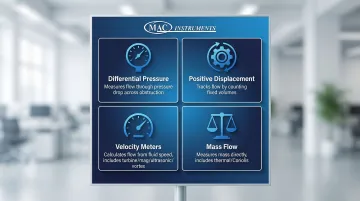
The main categories include:
- Differential pressure meters – Measure flow through pressure drop across an obstruction
- Positive displacement meters – Track flow by counting fixed volumes
- Velocity meters – Calculate flow from fluid speed (turbine, electromagnetic, ultrasonic, vortex)
- Mass flow meters – Measure mass directly rather than volume (thermal, Coriolis)
This guide breaks down each technology's measurement principles, ideal applications, and key limitations. You'll learn which meters handle high temperatures, which work with viscous fluids, and which deliver the accuracy your process demands.
Differential Pressure Flow Meters
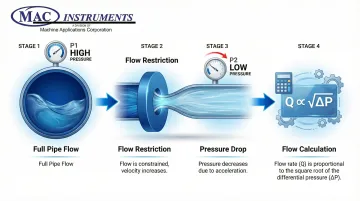
Differential pressure (DP) meters measure flow by detecting pressure drop across a restriction, typically an orifice plate, Venturi tube, or flow nozzle, based on Bernoulli's principle.
As fluid accelerates through the restriction, pressure decreases in proportion to flow rate.
Common Designs
- Orifice plates: Sharp-edged restriction offering lowest purchase cost
- Venturi tubes: Tapered design minimizing pressure loss (5-10% vs. 40-95% for orifice plates)
- Flow nozzles: Erosion-resistant option ideal for high-velocity steam
- Pitot tubes: Single-point measurement ideal for large pipes and retrofit applications
Key Advantages
- Proven technology with decades of field experience across all industries
- No moving parts to wear or maintain
- Works with liquids, gases, and steam across wide temperature and pressure ranges
- Lowest initial cost, especially for large pipe diameters
- Complies with strict standards (ISO 5167, ASME MFC-3M) ensuring predictable performance
These meters do have tradeoffs to consider:
Limitations
- Permanent pressure loss increases pumping energy costs (orifice plates lose 40-95% of generated differential)
- Installation-sensitive accuracy requires 10-40 pipe diameters of straight run
- Limited turndown ratio (typically 6:1, extending to 12:1 with calibration)
- Not suitable for dirty fluids, slurries, or low flow rates
- Accuracy degrades with wear, pipe roughness, or flow profile disturbances
Best Applications: General process monitoring, steam measurement, natural gas custody transfer, and high-pressure/high-temperature environments where energy costs are manageable.
Positive Displacement Flow Meters
Positive displacement (PD) meters trap fixed volumes of fluid in chambers and count fill-and-empty cycles to calculate total flow. This direct volumetric measurement delivers excellent accuracy independent of flow profile disturbances, making them ideal for precision applications.
Three primary designs dominate the market, each suited to specific fluid types:
Common Designs:
- Oval gear: Two meshing gears trap fluid; achieves 0.1% accuracy for fluids >10 cP
- Nutating disc: Standard for residential water metering; robust and cost-effective
- Rotary vane: Petroleum industry standard for crude oil and refined fuels
Advantages and Limitations
Key Advantages:
- Excellent accuracy (±0.1% to ±0.5%) for custody transfer and precision batching
- Direct volumetric measurement unaffected by viscosity or flow profile
- Performs excellently with high-viscosity fluids (up to 1,000,000 cP)
- High turndown ratio (up to 100:1, typically 15:1 in standard models)
- Accuracy often improves as viscosity increases due to reduced slippage
Limitations:
- Moving parts with tight clearances subject to wear from abrasive fluids
- Requires clean fluids—you must filter particles >100 microns
- Flow range more limited than velocity-based meters
- Demands regular recalibration and maintenance
- Not suitable for slurries, dirty fluids, or applications with entrained gas
Best Applications: Custody transfer of petroleum products, chemical batching and dosing, viscous liquid measurement (oils, syrups, polymers), and applications requiring direct volumetric totalization.
Turbine Flow Meters
Turbine meters use a rotor that spins at a speed proportional to fluid velocity. Magnetic or optical sensors detect rotational speed to calculate flow rate, offering high accuracy for clean, low-viscosity liquids.
Construction and Design
Rotors are typically CD4MCU stainless steel with tungsten carbide or ceramic shafts and bearings for wear resistance. Sanitary designs meeting 3-A standards serve food, beverage, and pharmaceutical applications.
Key Advantages
- High accuracy (±0.5% to ±1% standard, ±0.25% with linearization)
- Wide flow range with 10:1 turndown ratio
- Low pressure drop compared to DP meters
- Compact design suitable for tight installations
- Cost-effective for clean liquid applications
Limitations
- Mechanical wear degrades accuracy over time, requiring periodic recalibration
- Highly sensitive to debris—slurries or dirty fluids damage bearings and rotors
- Performance affected by flow profile; requires straight pipe runs
- Not suitable for viscous fluids—accuracy degrades in laminar flow (low Reynolds numbers)
- Cavitation can damage rotor geometry
Best Applications
Turbine meters excel in specific industrial environments:
- Fuel dispensing and custody transfer applications
- Water distribution systems
- Chemical processing with clean fluids
- Cryogenic liquid measurement
- Sanitary liquid transfer in food and pharmaceutical industries
Electromagnetic Flow Meters (Mag Meters)
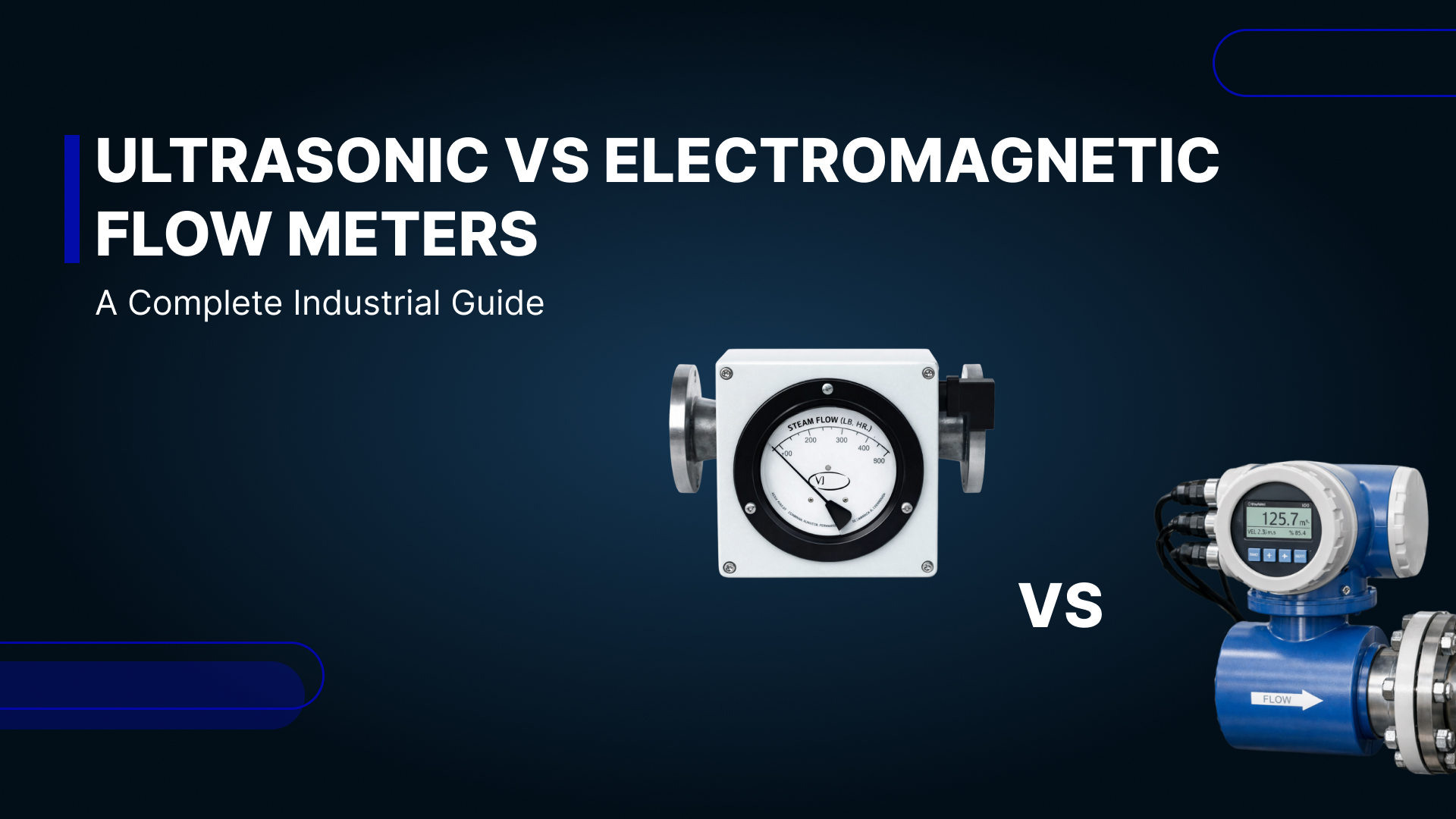
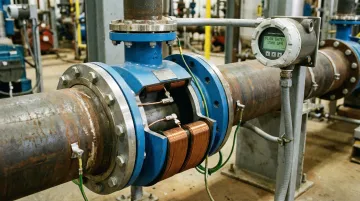
Electromagnetic (mag) meters measure flow without touching the fluid itself. They apply Faraday's law of electromagnetic induction—when conductive fluid flows through a magnetic field, it generates voltage proportional to velocity.
This non-intrusive approach offers exceptional reliability with no moving parts.
How Electromagnetic Flow Meters Work
The meter generates a magnetic field perpendicular to flow. As conductive fluid passes through, it induces voltage across electrodes mounted in the pipe wall.
The voltage magnitude directly indicates flow velocity, providing accurate measurement without physical obstruction.
Key Advantages
These operating characteristics translate into significant practical benefits:
- No obstruction to flow path—zero pressure drop
- No moving parts requiring maintenance
- Works with dirty, corrosive, and abrasive fluids including slurries
- Highly accurate (±0.5% standard, ±0.2% high-performance models)
- Bi-directional measurement capability
- Unaffected by viscosity, density, temperature, or pressure
Limitations
- Only works with electrically conductive fluids (minimum 5 µS/cm, ideal >30 µS/cm)
- Cannot measure hydrocarbons, gases, or distilled water
- Requires external power supply
- Higher initial cost than mechanical meters
- Proper grounding critical to prevent errors
- Requires straight pipe runs (typically >5 DN upstream, >2 DN downstream)
Best Applications
Water and wastewater treatment, mining slurries, chemical processing, pulp and paper, food and beverage processing, and any application with conductive, dirty, or corrosive liquids.
Ultrasonic Flow Meters
Ultrasonic meters use sound waves to measure flow without contacting the fluid. Two technologies serve different applications: transit-time for clean fluids and Doppler for fluids containing particles or bubbles.
Transit-Time Technology: Measures time difference between ultrasonic signals sent with and against flow direction. Works with clean, homogenous liquids like water, oil, and chemicals.
- Accuracy: ±0.5% to ±2% (clamp-on), ±0.15% (high-end inline)
- Application: Clean liquids, large pipes, retrofit installations
Doppler Technology: Measures frequency shift of signals reflected off suspended particles or bubbles. Requires solids/bubbles (>100 PPM) to function.
- Accuracy: ±2% to ±5%
- Application: Wastewater, slurries, aerated liquids
Installation Options:
- Clamp-on: Non-invasive sensors mount externally on existing pipe walls, eliminating the need for process shutdown during installation. Ideal for temporary monitoring or retrofit applications where cutting into pipes isn't feasible.
- Inline: Wetted sensors are permanently integrated into the pipe system, providing superior accuracy and long-term stability. Best suited for critical measurement points requiring consistent ±0.15% accuracy in custody transfer or process control.
Key Advantages:
- Non-intrusive clamp-on installation eliminates contamination risk
- No moving parts to wear or maintain, plus zero pressure loss from flow obstruction
- Suitable for large pipe diameters where other technologies become impractical
- Works with wide range of clean liquids and gases
Limitations:
- Accuracy affected by bubbles, solids, pipe coatings, and corrosion
- Requires proper sensor placement and calibration
- Higher cost than mechanical alternatives
- Performance sensitive to flow profile—requires significant straight runs (often 10 DN upstream)
- Clamp-on accuracy depends heavily on pipe wall condition and coupling quality
Best Applications: Large water distribution pipes, clean chemical transfer, oil pipelines, retrofit installations where process shutdown is impractical, and custody transfer applications requiring non-invasive verification.
Vortex Flow Meters
Vortex meters detect vortices (swirls) created when fluid flows past a bluff body placed in the flow stream. Vortex shedding frequency is directly proportional to flow velocity, following the von Kármán principle.
How Vortex Meters Work
The technology relies on a simple but effective mechanism:
- A non-streamlined obstruction (bluff body) sits in the flow path, creating alternating vortices downstream
- Piezoelectric or capacitive sensors detect the vortex frequency
- The system calculates flow rate based on this frequency measurement
Key Advantages:
- No moving parts to wear or maintain
- Handles liquids, gases, and steam with single meter design
- Relatively low maintenance compared to mechanical meters
- Good accuracy (±1% of rate) over wide flow ranges
- Suitable for high-temperature steam applications
Limitations:
- Not suitable for low flow rates—requires minimum Reynolds number
- Cannot measure high-viscosity fluids accurately
- Sensitive to pipe vibrations causing false readings
- Requires stable flow profile with adequate straight pipe runs
- Moderate pressure drop from bluff body obstruction
- Performance degrades with changing fluid properties
Ideal Applications
Vortex meters excel in several industrial scenarios:
- Steam measurement in power generation and HVAC systems
- Clean gas measurement in chemical processing
- Energy management systems requiring versatile measurement
- Applications needing one meter for multiple fluid types
For steam flow applications, companies like MAC Instruments offer specialized vortex-based solutions designed for high-temperature industrial environments, providing the durability and accuracy required in power generation and process industries.
Mass Flow Meters (Coriolis and Thermal)
Mass flow meters directly measure mass flow rate rather than volumetric flow, making them ideal when fluid density or temperature varies significantly.
The two primary types—Coriolis and thermal—use different principles but both provide direct mass measurement.
Coriolis Mass Flow Meters
Operating Principle
Fluid flows through vibrating tubes, creating Coriolis forces that cause tube deflection proportional to mass flow rate.
Sensors detect this deflection to calculate mass flow, density, and temperature simultaneously.
Key Advantages
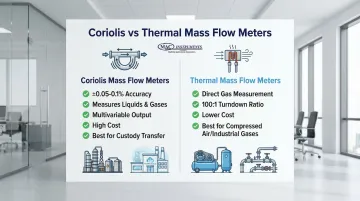
- Exceptional accuracy (±0.05% to ±0.1% for liquids, ±0.25% for gases)
- Direct mass measurement independent of density, viscosity, temperature, and pressure
- Multivariable output: mass flow, density (±0.2 kg/m³), and temperature in single device
- No moving parts or wear components
- Works with wide range of fluids including corrosive, viscous, and non-Newtonian liquids
- Bi-directional measurement capability
Limitations
- High initial cost, especially for large pipe sizes
- Typically limited to ≤16 inches (400 mm) due to size and cost constraints
- Sensitive to external vibration—requires proper mounting and isolation
- Bulky compared to other technologies
- Installation conditions affect accuracy
Best Applications
Coriolis meters excel in custody transfer of high-value liquids and gases (approved by American Petroleum Institute Chapter 5.6 and American Gas Association Report No. 11). They're also ideal for chemical batching, reactor feed control, pharmaceutical manufacturing, and any application requiring simultaneous mass, density, and temperature measurement.
Thermal Mass Flow Meters
Thermal meters measure heat transfer from a heated sensor to flowing gas. The heat dissipation rate indicates gas mass flow directly.
Advantages
- Direct gas mass measurement
- No moving parts
- Wide turndown ratio (typically 100:1)
- Low pressure drop
- Suitable for dry, clean compressed air and industrial gases
Limitations
- Accuracy affected by gas composition changes
- Best suited for gases, not liquids
- Requires clean, dry gas
- Performance varies with gas moisture content
Typical Applications
These meters work well for compressed air monitoring, industrial gas measurement, and leak detection where clean, dry gases and wide turndown ratios are priorities.
How to Choose the Right Flow Meter for Your Application
Selecting the optimal flow meter requires systematic evaluation of fluid properties, accuracy requirements, installation constraints, and total cost of ownership.
Step 1: Identify Fluid Properties
Conductivity
- Conductive fluids (>5 µS/cm): Electromagnetic meters work well for these applications
- Non-conductive fluids: Rule out electromagnetic meters; consider ultrasonic, turbine, or DP instead
Viscosity
- Low viscosity (<10 cP): Turbine, mag, ultrasonic, and vortex meters all perform reliably
- High viscosity (>100 cP): Positive displacement or Coriolis meters are preferred
- Very high viscosity (>1,000 cP): Positive displacement is often the only practical option
Cleanliness
- Clean fluids: All flow meter technologies are suitable
- Dirty fluids or slurries: Mag meters, Doppler ultrasonic, or DP meters with Venturi tubes handle particulates well
- Abrasive fluids: Avoid turbine and PD meters; mag or ultrasonic meters minimize wear
Phase and Composition
- Single-phase liquids: Most technologies work well
- Gas and steam applications: DP, vortex, thermal mass, or Coriolis meters are designed for vapor measurement
- Multiphase flows: Require specialized meters with advanced sensing capabilities
Step 2: Determine Accuracy and Range Requirements
| Application Type | Required Accuracy | Recommended Technologies |
|---|---|---|
| Custody Transfer | ±0.1% - ±0.25% | Coriolis, High-Accuracy Ultrasonic, PD |
| Process Control | ±1% - ±2% | Mag, Vortex, Turbine, Standard Ultrasonic |
| General Monitoring | ±2% - ±5% | DP (Orifice), Clamp-on Ultrasonic |
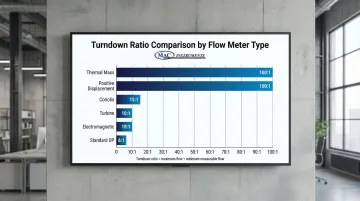
Turndown Ratio
The turndown ratio—the ratio of maximum to minimum measurable flow—determines how well a meter handles variable-flow processes.
- High turndown (100:1): PD, thermal mass
- Medium turndown (10-15:1): Turbine, Coriolis, mag
- Low turndown (6:1): Standard DP meters
Once you've defined your accuracy needs, practical installation factors narrow your options further.
Step 3: Evaluate Installation Constraints
Straight Pipe Requirements:
- DP, mag, ultrasonic, vortex: Require 5-40 pipe diameters upstream, 2-5 pipe diameters downstream
- Coriolis, PD: Minimal straight run requirements
Power Availability:
- Mag, ultrasonic, Coriolis: Require external power
- DP, mechanical turbine, PD: Can operate without power (mechanical output)
Process Shutdown:
- Clamp-on ultrasonic: No shutdown required
- Inline meters require process interruption for installation
Environmental Conditions:
- Outdoor/hazardous areas: Consider explosion-proof ratings, temperature limits
- Extreme temperatures: DP and vortex handle highest temperatures; mag and ultrasonic have limitations
Step 4: Calculate Total Cost of Ownership
Initial Purchase Price
- Lowest cost: DP (orifice), basic turbine
- Medium cost: Mag, vortex, PD, ultrasonic
- Highest cost: Coriolis, high-accuracy ultrasonic
Energy Costs
DP meters with orifice plates create permanent pressure loss that increases pumping costs. In high-flow applications, this energy penalty can exceed the purchase price within months.
Maintenance
- Lowest maintenance: Mag, ultrasonic, Coriolis, vortex (no moving parts)
- Medium maintenance: DP meters (periodic inspection and component replacement)
- Highest maintenance: Turbine and PD meters (bearing replacement, recalibration)
Calibration Frequency
- Custody transfer (legal/financial transactions): Every 6-12 months or per regulatory requirements
- Process control: Annual recalibration recommended
- General monitoring: Every 2-3 years typically sufficient
Common Flow Meter Selection Mistakes to Avoid
Even experienced engineers make critical selection errors that compromise performance and inflate costs. Avoid these five common mistakes:
Over-specifying accuracy — Choosing a Coriolis meter with ±0.1% accuracy for general process monitoring where ±2% would suffice wastes thousands of dollars. Match accuracy to actual process requirements, not aspirational precision.
Ignoring fluid properties — Installing a mag meter on non-conductive hydrocarbon streams or a turbine meter in dirty slurry applications leads to immediate failure. Verify conductivity, viscosity, and cleanliness before selection. For steam applications, MAC Instruments' steam flow meters are engineered specifically for high-temperature moisture conditions up to 1200°F.
Underestimating installation requirements — Failing to provide adequate straight pipe runs, proper grounding, or power supply results in poor performance. Review installation specifications during design phase, not after equipment arrives.
Focusing only on purchase price — A $500 orifice plate that costs $10,000 annually in pumping energy is more expensive than a $5,000 mag meter with zero pressure drop. Calculate total cost of ownership over expected equipment life.
Neglecting maintenance access — Installing meters in locations requiring scaffolding, confined space entry, or process shutdown for routine maintenance increases long-term costs dramatically. Consider accessibility during design.
Conclusion
Flow meters are essential instruments for process control, energy management, and regulatory compliance across diverse industries—from power generation and oil refining to water treatment and chemical manufacturing. The global market's projected growth to $12.6 billion by 2029 reflects their increasing importance in optimizing industrial operations.
Understanding the seven major flow meter technologies and their specific strengths enables informed selection that balances accuracy, reliability, and cost-effectiveness:
- Differential pressure meters offer proven, cost-effective solutions for general monitoring
- Positive displacement and Coriolis meters deliver precision for custody transfer
- Electromagnetic meters excel with conductive liquids in harsh environments
- Ultrasonic meters provide non-invasive measurement for large pipes
The right choice depends on your specific application requirements—fluid properties, accuracy needs, installation constraints, and total cost of ownership.
For specialized applications involving steam flow metering or high-temperature moisture measurement in industrial processes, consider consulting with manufacturers who focus on these demanding conditions. MAC Instruments, manufacturing moisture analyzers and steam flow meters since 1990, specializes in high-temperature measurement for power generation, oil and gas refineries, and manufacturing operations requiring measurement capabilities up to 1200°F.
Frequently Asked Questions
What is the purpose of a flow meter?
Flow meters measure fluid movement through pipes for process control, consumption monitoring, quality assurance, and regulatory compliance. They provide critical data for billing, custody transfer, emissions monitoring, and safety systems.
How many types of flow meters are there?
Seven major categories exist: differential pressure, positive displacement, turbine, electromagnetic, ultrasonic, vortex, and mass flow meters. Each category includes numerous variations tailored to specific applications.
Which flow meter is the most accurate?
Coriolis mass flow meters offer the highest accuracy (±0.05% to ±0.1%), followed by electromagnetic (±0.2% to ±0.5%) and turbine meters (±0.25% to ±0.5%). The best choice depends on your application, fluid properties, and installation conditions.
What are the flow meters used in industry?
Common applications include differential pressure and vortex meters for steam/gas, electromagnetic meters for water/wastewater, turbine meters for fuel and chemicals, Coriolis meters for custody transfer, and positive displacement meters for viscous liquids.
What is the difference between ultrasonic and Coriolis flow meters?
Ultrasonic meters use sound waves for volumetric measurement in clean fluids with non-invasive installation. Coriolis meters use vibrating tubes for direct mass flow measurement, offering higher accuracy (±0.1% vs. ±0.5-2%) and working with viscous or multiphase fluids while measuring density and temperature simultaneously.
What are the three methods of measuring flow?
The three fundamental approaches are: differential pressure (measuring pressure drop across a restriction like an orifice plate), velocity (measuring fluid speed using turbine, mag, ultrasonic, or vortex technology and calculating flow), and positive displacement (counting fixed volumes of fluid passing through chambers).