Introduction
Your facility invests in a new ultrasonic flow meter for custody transfer applications, expecting the advertised ±0.5% accuracy. Six months later, financial reconciliation reveals a 3% discrepancy.
The meter hasn't failed. Improper installation, upstream piping disturbances, or entrained gas have quietly eroded performance far below specification.
This scenario plays out across industries daily. Modern transit-time ultrasonic flow meters achieve ±0.5% to ±1.0% accuracy under optimal conditions, with advanced multi-path inline models reaching ±0.15% for custody transfer.
Real-world performance depends heavily on installation quality, fluid properties, and maintenance practices. For custody transfer, process control, and billing applications where even small errors translate to significant financial impact, understanding what affects accuracy is critical.
TLDR: Key Takeaways on Ultrasonic Flow Meter Accuracy
- Transit-time meters achieve ±0.5% to ±1.0% accuracy for clean liquids
- Doppler meters provide ±2.0% to ±5.0% accuracy for slurries and particle-laden fluids
- Installation errors from improper straight pipe runs can introduce 5% to 20% measurement error
- Inline meters (±0.5%) outperform clamp-on models (±1.0% to ±3.0%) but require pipe modification
- Built-in diagnostics extend calibration intervals to 2-5 years without meter removal
Understanding Ultrasonic Flow Meter Accuracy: Definitions and Specifications
What Accuracy Really Means in Flow Measurement
Accuracy represents the closeness of a measured flow rate to the true value. This differs from precision, which describes measurement consistency regardless of correctness. A meter can be highly precise (repeatable) yet consistently inaccurate if improperly calibrated.
Manufacturers express accuracy two ways:
% of Reading: Error is a percentage of the actual measured flow. A meter specified at ±1% of reading maintains that accuracy across its turndown range. At 100 GPM, the error is ±1 GPM; at 10 GPM, it's ±0.1 GPM.
% of Full Scale: Error is a fixed percentage of maximum capacity. A 100 GPM meter with ±1% full scale accuracy has ±1 GPM error at all flow rates. At 10 GPM, this becomes a 10% error—a critical distinction for variable flow applications.
Accuracy vs. Repeatability vs. Resolution
These three specifications define different aspects of meter performance:
- Repeatability measures consistency under identical conditions. High-end ultrasonic meters achieve 0.02% to 0.25% repeatability, meaning repeated measurements of the same flow vary minimally.
- Resolution indicates the smallest detectable flow change. Advanced meters can detect changes as small as 0.01% of full scale.
- Accuracy combines both factors with calibration uncertainty.
Think of target shooting: accuracy is hitting the bullseye, repeatability is grouping shots tightly, and resolution is how finely you can adjust your aim. A meter can be repeatable (tight grouping) without being accurate (missing the bullseye).
Transit-Time vs. Doppler Ultrasonic Meters
Understanding these two technologies helps explain their different accuracy capabilities:
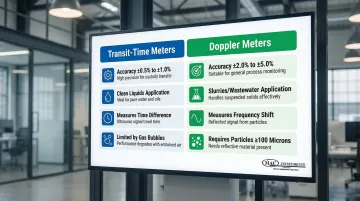
| Characteristic | Transit-Time Meters | Doppler Meters |
|---|---|---|
| Accuracy | ±0.5% to ±1.0% (standard); ±0.15% for multi-path custody transfer | ±2.0% to ±5.0% of full scale |
| Best Application | Clean to moderately dirty liquids | Slurries, wastewater, aerated fluids |
| Method | Measures time difference between upstream/downstream ultrasonic signals | Measures frequency shift of ultrasound reflected from particles |
| Key Limitation | Degraded by gas bubbles or excessive solids | Requires minimum 75 ppm of particles/bubbles ≥100 microns |
Accuracy Specifications: Reading the Fine Print
Manufacturer datasheets often specify accuracy as a composite: "±0.5% of reading ±0.05% of full scale." This means total error combines both components. At high flow rates, the "% of reading" dominates; at low flows, the fixed "% of full scale" becomes significant.
Key factors that affect real-world accuracy:
- Lab vs. field performance: Factory calibration occurs under controlled conditions with ideal straight pipe runs, stable temperature, and single-phase flow—conditions field installations rarely match
- Installation standards: For custody transfer, AGA-9 standards require configurations that limit additional error to ±0.3%
- Reynolds number range: Accuracy specifications typically apply to turbulent flow (Re > 10,000); transitional flow (Re 2,000-10,000) may reduce accuracy unless the meter compensates for changing velocity profiles
Linearity and Its Impact on Accuracy
Linearity describes how consistently a meter maintains accuracy across its flow range. Advanced meters achieve ±0.15% linearity, meaning deviation from the calibration curve remains minimal from minimum to maximum flow.
Poor linearity creates larger errors at flow extremes. A meter with good mid-range accuracy but poor linearity may show 2-3% error at 10% of full scale.
This makes it unsuitable for applications with wide flow variation.
Factors That Affect Ultrasonic Flow Meter Accuracy
Fluid Properties and Their Impact
Viscosity alters the velocity profile within the pipe. Reynolds number—which incorporates viscosity, velocity, density, and pipe diameter—determines whether flow is laminar, transitional, or turbulent. Ultrasonic meters assume a specific velocity profile; significant viscosity changes can introduce errors if not compensated.
Temperature affects both the fluid and meter. Temperature impacts accuracy in two ways:
- Sound speed variation: A 1°F error in temperature measurement causes 0.13% error in calculated speed of sound for natural gas
- Thermal expansion of the meter body, changing acoustic path length
- Temperature compensation in quality meters limits error to 0.03%
Density variations matter primarily when converting volumetric to mass flow. For custody transfer of hydrocarbons with varying composition, real-time density compensation is essential.
Installation Effects: The Hidden Accuracy Killer
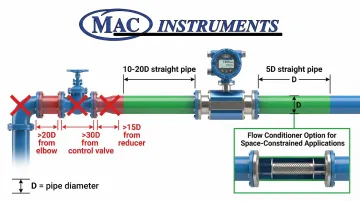
Upstream piping disturbances represent the single largest source of field measurement error. Elbows, valves, reducers, and pumps create swirl and asymmetric flow profiles that can introduce 5% to 20% error in severe cases.
Preventing installation-related errors requires adequate straight pipe runs.
Standard requirements specify:
- 10 to 20 pipe diameters (D) upstream of straight pipe
- 5D downstream of straight pipe
- Flow conditioners when space is limited
For custody transfer, AGA-9 recommends configurations limiting installation error to ±0.3%. A 6-inch meter requires 60-120 inches (5-10 feet) of upstream straight pipe—often difficult in retrofit applications.
Clamp-on meters add another layer of complexity. Transducer alignment is critical—misalignment, poor acoustic coupling, or surface contamination (rust, paint) degrades signal quality and accuracy.
Proper coupling gel application and precise spacing per manufacturer specifications are required.
Process Conditions: Pressure and Temperature
Process pressure variations affect meter body geometry through mechanical expansion, though properly designed meters limit this to <0.01% error.
Pressure also affects fluid properties—density, viscosity, and speed of sound—requiring compensation for accurate measurement.
Temperature compensation is critical. Without it, temperature variations can add 0.03% or more error. Advanced meters measure temperature continuously and apply real-time corrections to both fluid properties and meter geometry.
Multi-Phase Flow and Contaminants
Gas bubbles are particularly problematic for transit-time meters. Entrained gas scatters ultrasonic signals, causing measurement errors approximately equal to the gas fraction—0.1% gas content causes roughly 0.1% error. At higher concentrations, meters may fail entirely.
Solids affect meters differently by technology. Transit-time meters typically handle up to 10% solids by volume in moderately dirty liquids. Doppler meters require solids for operation but with reduced accuracy (±2% to ±5%).
Modern meters provide diagnostic capabilities that detect multi-phase conditions—monitoring signal strength, gain adjustments, and speed of sound deviations to alert operators before accuracy degrades significantly.
Calibration and Verification
Manufacturers ship meters factory-calibrated under controlled conditions. Field verification confirms continued accuracy without full recalibration. For custody transfer, verification intervals typically range from 2-5 years, though diagnostic monitoring can extend these intervals.
In-situ verification methods include:
- Zero-flow verification (confirming zero reading with no flow)
- Speed of sound comparison (measured vs. calculated from fluid properties)
- Diagnostic parameter trending (signal strength, profile factor)
- Comparison to a calibrated reference meter
Long-Term Stability and Drift
Ultrasonic meters excel in long-term stability due to having no moving parts. Field studies show ultrasonic meters maintain stable calibration factors over time, unlike turbine meters where bearing wear causes progressive accuracy degradation.
Factors that can cause drift include:
- Transducer degradation (rare but possible over 10+ years)
- Coating buildup on transducers (in dirty applications)
- Electronic component aging (minimal with modern digital designs)
Properly maintained ultrasonic meters typically show <0.1% drift over 5+ years, making them ideal for applications where meter removal for recalibration is costly or disruptive.
How Ultrasonic Flow Meters Compare to Other Technologies
Accuracy Comparison: Ultrasonic vs. Other Flow Meter Types
Different technologies offer varying accuracy-cost-application trade-offs:
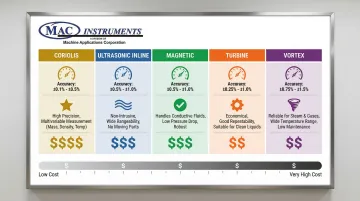
| Technology | Typical Accuracy | Primary Advantage | Relative Cost |
|---|---|---|---|
| Coriolis | ±0.05% to ±0.2% | Highest accuracy, direct mass flow | Very High |
| Ultrasonic (Inline) | ±0.5% to ±1.0% | No pressure drop, large line sizes | High |
| Magnetic | ±0.2% to ±1.0% | Unaffected by gas bubbles | Medium |
| Turbine | ±0.5% to ±1.0% | Clean liquids/gases | Lower |
| Vortex | ±0.7% to ±1.5% | Steam, no moving parts | Medium |
Accuracy alone shouldn't drive selection. Application suitability, total cost of ownership, and operational requirements matter equally.
Ultrasonic vs. Magnetic Flow Meters
Both technologies achieve <±1% accuracy for conductive liquids, but differ in key areas:
Ultrasonic advantages:
- Non-invasive clamp-on installation option
- Zero pressure drop
- No moving parts or electrodes to foul
- Works with non-conductive fluids
Magnetic advantages:
- Unaffected by gas bubbles (measures average velocity)
- Better for slurries and highly conductive fluids
- Simpler installation for inline models
Given these differences, clean water applications in large pipes (>6 inches) favor ultrasonic meters. They provide better total cost of ownership due to easier installation and zero pressure drop.
Comparing Ultrasonic and Coriolis Meters
Coriolis meters deliver superior accuracy (±0.1% to ±0.2%) and measure mass flow directly, making them ideal for custody transfer of high-value fluids. However, they cost 3-5x more than ultrasonic meters and create pressure drop.
For large line sizes (>6 inches), Coriolis costs rise exponentially while ultrasonic costs scale more linearly.
In applications where ±0.5% accuracy suffices—most industrial process control—ultrasonic meters provide adequate performance at significantly lower cost.
Mechanical Meters vs. Ultrasonic Technology
Maintenance requirements differ dramatically:
- Turbine meters: Regular bearing inspection and rotor replacement
- Ultrasonic meters: Only periodic transducer inspection and signal quality verification
Accuracy degradation over time favors ultrasonic technology:
- Mechanical meters lose accuracy as bearings wear and clearances increase
- Ultrasonic meters maintain calibration for years without mechanical drift
Difficult fluids highlight ultrasonic advantages:
- High viscosity, corrosive, or high-temperature fluids destroy turbine bearings
- Ultrasonic meters handle these conditions with no wetted electronics or moving parts
When Ultrasonic Meters Offer the Best Accuracy-to-Cost Ratio
Ultrasonic meters excel in:
- Large pipe diameters (>6 inches) where Coriolis costs become prohibitive
- Clean to moderately dirty liquids where transit-time technology works reliably
- Custody transfer of hydrocarbons where ±0.5% accuracy meets contractual requirements
- Retrofit applications where clamp-on installation avoids shutdown costs
Total cost of ownership includes installation, maintenance, and verification. Ultrasonic meters require no pressure compensation (allowing smaller pumps), minimal maintenance, and extended verification intervals.
For applications matching ultrasonic strengths, ROI occurs within 2-3 years compared to alternative technologies.
Installation Best Practices for Optimal Accuracy
Upstream and Downstream Piping Requirements
Proper flow profile development is essential for achieving specified accuracy. The pipe must allow the flow to stabilize before reaching the meter.
Industry standards require:
- 10-20D upstream straight pipe (20D after severe disturbances like double elbows)
- 5D downstream straight pipe
- Flow conditioners when space is limited
AGA-9 recommends specific configurations to limit installation uncertainty to ±0.3%. For a 12-inch meter, this translates to 120-240 inches (10-20 feet) of upstream pipe—a significant space requirement in crowded facilities.
Space-constrained installations: Flow conditioners reduce requirements to 5-10D upstream while maintaining custody transfer accuracy. This makes them valuable for retrofits where full straight runs aren't feasible.
Proper Transducer Mounting and Alignment
Installation quality directly determines accuracy for clamp-on meters. Follow these procedures to ensure optimal performance:
- Calculate exact transducer spacing using meter software (accounts for pipe size, wall thickness, material, fluid properties)
- Prepare mounting surface (remove rust, paint, scale)
- Apply coupling gel generously to eliminate air gaps
- Verify signal strength and quality meet specifications
- Use appropriate mounting method (V-method for small pipes, Z-method for large pipes or attenuating fluids)
Poor coupling or misalignment can degrade accuracy from ±1% to ±5% or cause complete measurement failure.
Environmental Considerations
Beyond installation geometry, environmental factors influence measurement stability.
Temperature effects: Most meters specify operating ranges of -40°F to 140°F for electronics. Within these specifications, temperature impacts are minimal (typically <0.01%).
Vibration concerns: Nearby pumps or machinery can affect transducer mounting and signal quality. In severe cases, use vibration isolation or remote mounting to protect measurement integrity.
Electrical interference: VFDs, motors, and high-voltage equipment can corrupt signals. Proper grounding and shielded cabling prevent these issues.
Maintaining Accuracy Over Time
Diagnostic Monitoring and Trending
Modern meters provide extensive diagnostics that serve as early warning systems.
Monitor these critical parameters:
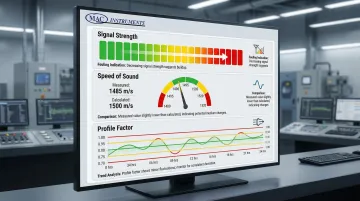
- Signal strength: Decreasing strength suggests transducer fouling or fluid changes
- Speed of sound: Comparing measured to calculated (from P/T/composition) detects temperature errors or composition changes
- Profile factor: Changes indicate upstream blockages or buildup
Trending these parameters detects performance degradation before it affects custody transfer. This enables proactive maintenance rather than reactive troubleshooting.
Verification Procedures
Regular verification confirms your meters maintain accuracy between calibrations. On-site verification methods avoid costly meter removal:
Zero-flow verification: With flow stopped, meter should read zero. Non-zero readings indicate drift or electronic issues.
Speed of sound check: Measured SOS should match theoretical values calculated from pressure, temperature, and fluid composition. Deviations suggest measurement problems.
Diagnostic parameter review: Signal strength, gain, and profile factors should remain stable over time.
When verification indicates drift beyond acceptable limits, recalibration at an accredited flow lab may be necessary. However, ultrasonic meters' excellent stability means this typically occurs only every 2-5 years for custody transfer applications.
Preventive Maintenance
Ultrasonic meters require minimal maintenance compared to mechanical alternatives.
Essential maintenance activities include:
- Periodic transducer inspection (visual check for damage or coating buildup)
- Cable integrity checks (especially for clamp-on installations in harsh environments)
- Zero flow verification (annually or per custody transfer requirements)
- Diagnostic parameter trending (continuous or monthly)
Following these maintenance practices preserves measurement accuracy and extends equipment life. For custody transfer applications, work with accredited calibration labs offering NIST-traceable services to maintain regulatory compliance.
Choosing the Right Ultrasonic Flow Meter for Your Application
Clamp-On vs. Inline Ultrasonic Meters
Inline meters provide superior accuracy (±0.5% typical) with calibrated spool pieces and known geometry. They require cutting the pipe but offer the highest performance for custody transfer and critical process control.
Clamp-on meters deliver ±1.0% to ±2.0% accuracy (or ±3.0% in challenging installations) but install without process shutdown. They're ideal for:
- Temporary measurements and audits
- Retrofit applications where shutdown is costly
- Corrosive fluids where non-invasive measurement avoids material compatibility issues
- Check metering to verify other instruments
Transit-Time vs. Doppler Selection
Transit-time meters work best with clean to moderately dirty fluids (<10% solids) and deliver ±0.5% to ±1.0% accuracy when the liquid is relatively uniform in composition.
Doppler meters handle fluids with significant solids or bubbles (>75 ppm of particles ≥100 microns). They're designed for slurries, wastewater, and aerated streams, typically offering ±2% to ±5% accuracy.
Key Specifications to Evaluate
Once you've selected the right meter type, evaluate these critical specifications:
- Rangeability: Ultrasonic meters often exceed 20:1 or 100:1 turndown while maintaining accuracy—far superior to mechanical meters
- Reynolds number range: Ensure specifications cover your operating conditions, especially for viscous fluids
- Output options: 4-20mA, pulse, HART, Modbus, or other protocols for integration with control systems
- Diagnostics: Advanced diagnostics enable predictive maintenance and extended verification intervals
Match meter capabilities to your accuracy requirements and budget. A ±0.15% custody transfer meter costs significantly more than a ±1% process meter—specify only the accuracy you actually need.
Real-World Accuracy Considerations by Industry
Oil and Gas Applications
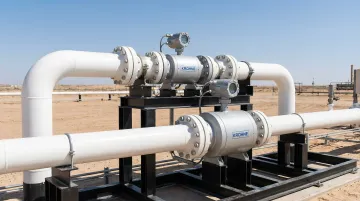
Custody transfer in oil and gas demands the tightest accuracy. Operators typically target ±0.25% to ±0.5% total measurement uncertainty for large volume transfers where small errors represent significant financial impact.
Why such tight tolerances? In a 50,000 barrel/day crude oil operation at $75/barrel, even a ±0.5% measurement error translates to roughly $18,750 daily variance—over $6.8 million annually.
Maintaining this accuracy requires addressing several technical challenges:
- Viscosity variations in crude oil affect velocity profiles and measurement consistency
- Reynolds number correction compensates for changing flow conditions
- Multi-path transducer designs maintain accuracy across varying fluid properties
- AGA-9 compliance mandates flow calibration and strict installation protocols
Water and Wastewater
Municipal water systems prioritize different accuracy benchmarks than oil and gas operations.
Billing applications typically accept ±1% to ±2% accuracy. The focus shifts to long-term reliability, low maintenance, and measuring low flows accurately to capture revenue from leaks and low-usage periods.
Partially filled pipes cause measurement problems in municipal systems. Operators address this by:
- Installing meters with sufficient downstream backpressure to ensure full pipe conditions
- Using specialized meter designs that compensate for partial fill
- Positioning meters at low points in the system where pipes remain full
Chemical Processing
Chemical processing shifts focus from billing accuracy to process consistency.
Batch control and recipe management require reliable measurement to maintain product quality. A pharmaceutical batch worth $500,000 can be ruined by improper ingredient ratios caused by flow measurement errors.
Ultrasonic meters excel in chemical applications because:
- No wetted electronics or moving parts that corrode in aggressive chemicals
- Handles high-temperature, corrosive fluids safely
- Provides ±1% accuracy with ±0.1% repeatability for batch-to-batch consistency
- Non-invasive measurement reduces contamination risk
The high repeatability matters more than absolute accuracy here—consistent measurements ensure each batch matches the proven recipe.
Frequently Asked Questions
How accurate are ultrasonic flow meters?
Transit-time ultrasonic flow meters achieve ±0.5% to ±1.0% accuracy under optimal conditions, with advanced multi-path models reaching ±0.15% for custody transfer. Field performance depends on installation quality, fluid properties (cleanliness, single-phase flow), and maintenance practices.
What is the most accurate type of flowmeter?
Coriolis mass flow meters offer the highest accuracy (±0.1% to ±0.2%), followed by high-end ultrasonic and magnetic meters (±0.5% to ±1.0%). Ultrasonic meters often provide the best value for large line sizes when balancing accuracy against cost and application suitability.
Do ultrasonic flow meters require calibration?
Meters come factory-calibrated and typically require verification every 2-5 years for custody transfer applications. Many installations use diagnostic monitoring to extend verification intervals, checking parameters like speed of sound and signal strength to confirm continued accuracy without meter removal.
Can ultrasonic flow meters measure dirty liquids accurately?
Transit-time meters work best with clean to moderately dirty liquids (<10% solids by volume), while Doppler meters handle dirtier fluids with reduced accuracy (±2% to ±5%). Matching technology to application is critical—using transit-time meters on slurries results in measurement failure.
What factors most affect ultrasonic flow meter accuracy in the field?
The top three factors are improper installation (inadequate straight pipe runs causing 5-20% errors), multi-phase flow conditions (gas bubbles scattering ultrasonic signals), and poor transducer mounting/coupling for clamp-on meters. Proper installation following manufacturer specifications is critical to achieving rated accuracy.
How do I verify my ultrasonic flow meter is still accurate?
Use in-situ verification methods like zero-flow checks, speed of sound comparison, and diagnostic parameter trending (signal strength, profile factor). For critical applications, recalibration at an accredited facility every 2-5 years ensures continued accuracy; meters typically show <0.1% drift over 5+ years.