Introduction
Accurate flow measurement can make or break industrial operations. Yet many facilities struggle with measurement errors that cascade into process inefficiencies, unplanned downtime from invasive installations, and unreliable readings across diverse fluid types.
The financial impact is substantial. A single percentage point of measurement error in a chemical processing plant can translate to thousands of dollars in wasted materials annually, while shutting down a pipeline for meter installation can cost $5,000 to $15,000 in labor and lost production.
Ultrasonic flow sensors offer a solution that addresses these challenges directly. This guide compares the top ultrasonic flow sensors based on accuracy, reliability, and application versatility.
You'll learn the critical differences between transit-time and Doppler technologies, understand when clamp-on versus inline installation makes sense, and discover which sensors best match your specific fluid characteristics, pipe dimensions, and operational constraints.
TLDR
- Sound wave technology delivers ±0.5-2% accuracy with zero media contact
- Transit-time sensors (82% of market) work best for clean liquids; Doppler sensors handle particle-laden fluids
- Choose clamp-on for zero downtime or inline for maximum accuracy
- The global market reached $2.1 billion in 2024, growing at 6.5% annually driven by water infrastructure and oil/gas applications
- Match sensor technology to fluid type, pipe size, and total ownership cost
Overview of Ultrasonic Flow Sensors in Industrial Applications
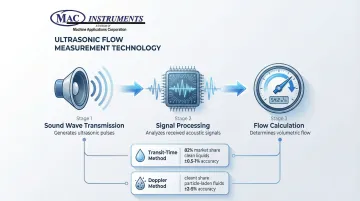
Ultrasonic flow sensors use high-frequency sound waves to measure fluid velocity and calculate volumetric flow rate without physical contact with the media. Unlike mechanical meters with moving parts, these devices transmit ultrasonic pulses through the pipe wall or directly into the fluid stream, measuring either transit time differences or frequency shifts to determine flow velocity.
Industrial adoption of ultrasonic technology has accelerated significantly. The global ultrasonic flow meter market reached $2.1 billion in 2024, with projections showing 6.5% annual growth through 2029.
This expansion is driven by several factors:
- Water infrastructure modernization projects
- Custody transfer requirements in oil and gas (62% of market share)
- Chemical processing facilities seeking non-invasive measurement solutions
Transit-time technology dominates with approximately 82% market share, preferred for its superior accuracy (±0.5% to ±1%) in clean liquid applications.
Water and wastewater treatment represents the fastest-growing sector at 9.74% CAGR. This growth stems from leak detection initiatives and the ability to retrofit aging infrastructure without service interruption.
The following sections identify the top ultrasonic flow sensors based on measurement accuracy, build quality, application range, ease of installation, and proven performance across diverse industrial environments.
Top Ultrasonic Flow Sensors for Accurate Fluid Measurement
These sensors were selected based on measurement accuracy, build quality, application versatility, ease of installation, and documented industrial track record across multiple sectors.
Endress+Hauser Proline Prosonic Flow W 400
Endress+Hauser, a Swiss industrial process engineering manufacturer, specializes in liquid analysis and flow instrumentation. The Prosonic Flow W 400 offers advanced diagnostic capabilities, web-based remote access, and proprietary FlowDC technology that reduces straight-run requirements.
This makes it particularly useful for retrofit installations where piping constraints limit traditional meter placement.
| Feature Category | Specifications |
|---|---|
| Key Technical Specifications | Accuracy: ±2% of reading (DN25-200 and >DN200); ±3% (DN15) Principle: Transit-time ultrasonic Pipe Range: DN 15 to 4000 (1/2" to 160") Temperature: -40 to +130°C (-40 to +266°F) Pressure: Non-invasive (no pressure limitation) |
| Installation Type & Compatibility | Type: Clamp-on (non-invasive) Pipe Materials: Metal, plastic, concrete, composite Fluid Compatibility: Clean to slightly contaminated liquids, water, wastewater |
| Unique Features & Advantages | Heartbeat Technology: Continuous self-diagnostics and in-situ verification Integrated Web Server: Remote access for configuration and monitoring FlowDC Functionality: Reduces straight-run requirements in disturbed flow profiles Wide Pipe Range: Handles pipes up to 160" diameter for large infrastructure |
Siemens SITRANS FUS1010
Siemens brings decades of digitalization expertise to flow measurement. The SITRANS FUS1010 switches between transit-time and Doppler measurement based on fluid conditions, making it highly versatile for facilities with varying process streams.
Its wide-beam technology enhances signal strength by using pipe wall resonance.
| Feature Category | Specifications |
|---|---|
| Key Technical Specifications | Accuracy: ±0.5% to 1.0% of flow (velocities >0.3 m/s) Principle: Wide-beam transit-time and Doppler (dual mode) Pipe Range: 6.4 mm to 9.14 m (0.25" to 360") Temperature: -40 to +120°C standard; optional to +230°C Pressure: Non-invasive (no pressure limitation) |
| Installation Type & Compatibility | Type: Clamp-on (non-invasive) Pipe Materials: Metal, plastic, lined pipes Fluid Compatibility: Clean liquids (transit-time mode) or particle-laden fluids (Doppler mode) |
| Unique Features & Advantages | Dual Mode Operation: Automatically switches between transit-time and Doppler based on fluid conditions ZeroMatic Path: Sets zero point without stopping flow Wide Beam Technology: Uses pipe wall resonance for enhanced signal strength Extreme Temperature Option: Handles applications up to 230°C |
KROHNE OPTISONIC 6300
KROHNE designed the OPTISONIC 6300 with installation simplicity as a core principle. Its rail-mounted sensor system ensures precise alignment and repeatability, while X-Mode dual-path configuration provides redundancy for critical applications.
NAMUR NE107 diagnostics integration makes it well-suited for chemical processing facilities with predictive maintenance programs.
| Feature Category | Specifications |
|---|---|
| Key Technical Specifications | Accuracy: <±1% of measured flow rate (DN ≥50) Principle: Transit-time ultrasonic Pipe Range: DN 15 to 4000 (1/2" to 160") Temperature: -40 to +120°C standard; XT version to +200°C Pressure: Non-invasive (no pressure limitation) |
| Installation Type & Compatibility | Type: Clamp-on (non-invasive) Pipe Materials: Metal, plastic, concrete Fluid Compatibility: Clean to slightly contaminated liquids |
| Unique Features & Advantages | Rail Mounting System: Ensures accurate, repeatable sensor alignment X-Mode Configuration: Dual-path measurement for enhanced reliability NAMUR NE107 Diagnostics: Industry-standard predictive maintenance integration XT High-Temperature Version: Extends capability to 200°C for demanding processes |
GE Panametrics AquaTrans AT600
GE Panametrics (now part of Baker Hughes) has been a leader in ultrasonic flow and gas analysis for decades. The AquaTrans AT600 was engineered as a cost-effective solution for water and wastewater utilities, featuring patented correlation transit-time technology.
Its permanent solid couplant eliminates ongoing gel maintenance, providing a significant operational advantage for large-scale municipal deployments.
| Feature Category | Specifications |
|---|---|
| Key Technical Specifications | Accuracy: ±1% of reading (pipe >2"); ±2% (pipe <2") Principle: Patented correlation transit-time Pipe Range: 15 mm to 7600 mm (0.5" to 300") Temperature: -40 to 150°C standard; optional to 400°C Pressure: Non-invasive (no pressure limitation) |
| Installation Type & Compatibility | Type: Clamp-on (non-invasive) Pipe Materials: Metal, plastic, concrete Fluid Compatibility: Water, wastewater, clean liquids |
| Unique Features & Advantages | Solid Couplant Technology: Permanent coupling eliminates gel maintenance Extreme Temperature Option: Handles applications up to 400°C Water-Optimized Design: Purpose-built for municipal and industrial water applications Certifications: CE, UL, CSA, MCert (pending) for regulatory compliance |
Fuji Electric M-Flow PW
Fuji Electric designed the M-Flow PW for space-constrained installations and rapid commissioning. Its compact transmitter design and simplified menu system enable faster deployment in facilities where panel space is limited.
The straightforward interface requires minimal training for maintenance staff.
| Feature Category | Specifications |
|---|---|
| Key Technical Specifications | Accuracy: ±1.0% of rate (standard velocities) Principle: Transit-time ultrasonic Pipe Range: 25 mm to 1200 mm Temperature: -20 to +100°C (fluid temperature) Pressure: Non-invasive (no pressure limitation) |
| Installation Type & Compatibility | Type: Clamp-on (non-invasive) Pipe Materials: Metal, plastic Fluid Compatibility: Clean liquids |
| Unique Features & Advantages | Compact Transmitter: Space-efficient design for crowded installations Fast Signal Processing: Rapid response to flow changes Simplified Menu System: Quick commissioning and reduced training requirements Cost-Effective Integration: Attractive price point for multi-point installations |
How We Chose the Best Ultrasonic Flow Sensors
Common Selection Mistakes
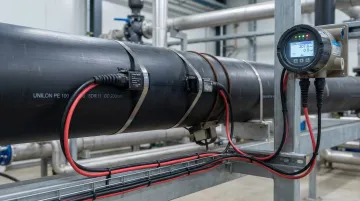
Many facilities make costly errors when specifying ultrasonic flow meters. The most frequent mistake is choosing based solely on purchase price without calculating total cost of ownership—a clamp-on meter costing $3,000 more than an inline alternative can save $5,000 to $15,000 in installation costs by eliminating pipe cutting and process shutdown.
Other critical errors include:
- Ignoring fluid characteristics: Specifying transit-time sensors for particle-laden fluids (which require Doppler technology) or vice versa
- Overlooking installation constraints: Failing to verify available straight-run pipe sections before purchase
- Underestimating maintenance costs: Not accounting for periodic couplant replacement in clamp-on installations or sensor fouling in inline wetted designs
- Mismatching pipe size capabilities: Selecting sensors rated for smaller diameter ranges than actual field conditions
Evaluation Framework
Our selection process prioritized five core criteria:
Measurement Accuracy and Repeatability: We evaluated published accuracy specifications across the operating range, with preference for sensors achieving ±0.5% to ±1% for inline transit-time applications and ±1% to ±2% for clamp-on installations.
Repeatability matters as much as accuracy—consistent readings enable reliable process control even if absolute accuracy requires periodic calibration.
Compatibility with Fluid Types and Pipe Materials: The best sensors handle diverse applications without extensive customization. We prioritized models supporting multiple pipe materials (metal, plastic, concrete, composite) and clear fluid compatibility specifications.
Ease of Installation and Commissioning: Installation complexity directly impacts total cost. Clamp-on models with rail-mounting systems, automatic transducer spacing calculation, and simplified menu interfaces reduce commissioning time from hours to minutes. We favored sensors with clear documentation of straight-run requirements.
Durability and Maintenance Requirements: Industrial environments demand robust construction. We evaluated enclosure ratings (NEMA 4X/IP66 or better), temperature tolerance, and long-term maintenance needs such as couplant replacement frequency or sensor cleaning requirements.
Total Cost of Ownership: Beyond purchase price, we considered installation labor, downtime costs, calibration intervals, spare parts availability, and expected service life.
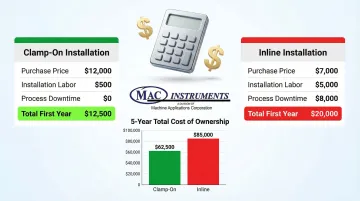
A $10,000 clamp-on meter requiring zero downtime often delivers better ROI than a $6,000 inline meter requiring $8,000 in installation costs.
Application-Specific Considerations
These criteria matter differently across industries. Different sectors prioritize different factors based on their operational realities:
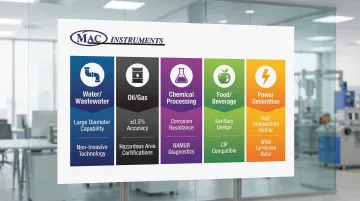
Water and Wastewater Treatment: Large pipe capability (up to 160" diameter) is essential for main distribution lines. Non-invasive installation enables leak detection programs without service interruption. Utilities value long-term stability and minimal maintenance given the distributed nature of installations.
Oil and Gas: Custody transfer applications demand maximum accuracy (±0.5%) and certifications for hazardous area installations (ATEX/IECEx). Diagnostic capabilities that detect flow profile disturbances or sensor degradation are critical for maintaining measurement integrity.
Chemical Processing: Corrosion resistance is paramount. Clamp-on sensors that never contact aggressive media eliminate leak paths associated with flanged inline meters. Process safety management programs favor sensors with predictive diagnostics like NAMUR NE107 integration.
Food and Beverage: Sanitary designs that meet 3-A or EHEDG standards are required. Clamp-on installation avoids creating dead legs or contamination risks. Clean-in-place (CIP) compatibility ensures sensors don't interfere with sanitation protocols.
Power Generation: High-temperature capability (up to 230°C for steam applications) and wide turndown ratios (200:1 or greater) enable accurate measurement across varying load conditions. Facilities prioritize sensors that maintain accuracy during load fluctuations and thermal cycling.
Conclusion
Selecting the right ultrasonic flow sensor requires balancing technical specifications with application-specific requirements.
Accuracy specifications alone don't guarantee operational success—a sensor delivering ±0.5% accuracy in ideal laboratory conditions may perform at ±3% in the field if installation constraints prevent adequate straight-run pipe sections or if fluid characteristics don't match the sensor's measurement principle.
Evaluate total cost of ownership rather than just initial purchase price. A clamp-on sensor costing $12,000 can deliver better five-year ROI than a $7,000 inline meter when you account for installation labor, process downtime, and maintenance requirements.
Before finalizing your selection, verify your facility can handle these installation requirements:
- 10-20 pipe diameters of straight run for optimal accuracy
- Alternative mounting locations if space constraints exist
- Flow conditioners to improve measurement consistency
- Adequate access for maintenance and calibration
Many industrial facilities need multiple measurement capabilities beyond flow monitoring. For high-temperature moisture monitoring in power generation stack emissions or cement kiln process control, look for providers offering NIST-traceable measurement systems designed for extreme environments up to 1200°F.
Frequently Asked Questions
What are the two types of ultrasonic sensors?
Transit-time sensors measure signal travel time differences in clean liquids and hold 82% market share, while Doppler sensors measure frequency shifts from particles or bubbles in the fluid. Transit-time meters work best for homogeneous liquids; Doppler meters handle fluids with suspended solids.
What is the difference between transit time and Doppler ultrasonic flow meters?
Transit-time meters require clean, homogeneous liquids and offer higher accuracy (±0.5% to ±1%), while Doppler meters work with fluids containing particles, bubbles, or solids but typically have lower accuracy (±2% to ±5%). Selection depends entirely on whether your fluid contains reflective particles.
When should I choose a clamp-on versus an inline ultrasonic flow meter?
Choose clamp-on meters for large pipes (>4"), non-invasive installations, or when process shutdown isn't feasible. Choose inline meters for smaller pipes (<2"), permanent installations, and when maximum accuracy (±0.5%) is required.
What accuracy can I expect from ultrasonic flow sensors?
Inline transit-time models reach ±0.5% to ±1%, clamp-on transit-time models achieve ±1% to ±2%, and Doppler models range from ±2% to ±5%. Actual accuracy depends on proper installation, adequate straight pipe runs, and stable fluid conditions.
What are common installation mistakes with ultrasonic flow meters?
Frequent errors include insufficient straight pipe runs (minimum 10D upstream/5D downstream), poor acoustic coupling in clamp-on installations as gel dries out, incorrect transducer spacing calculations, and failure to account for pipe wall conditions like internal linings or coatings that affect signal transmission.
How do ultrasonic flow meters compare to magnetic flow meters?
Ultrasonic meters measure non-conductive fluids and offer clamp-on options, while magnetic meters require conductive liquids (>5 μS/cm). Ultrasonic meters provide better turndown ratios (200:1 vs. 100:1), but magnetic meters typically deliver slightly better accuracy (±0.2% to ±0.5%).