The global flow meter market reflects this growing demand, projected to reach $19.46 billion by 2034 with mass flow technologies driving significant growth. Industries are shifting toward mass measurement because the financial stakes are substantial—a mere 0.3% measurement error in a single crude oil transfer can create a $105,000 discrepancy.
The fundamental challenge is this: volumetric flow meters measure how much space a fluid occupies, but they fail to account for density changes that occur with temperature and pressure variations. A cubic meter of gas at high pressure contains far more actual material than the same volume at low pressure. This creates measurement errors that cost facilities thousands in material waste, regulatory non-compliance, and inefficient operations.
This guide explains how mass flow meters work in operational terms—breaking down the measurement process into understandable stages and clarifying when mass flow measurement delivers value over traditional volumetric approaches.
TLDR
- Measures actual mass (kg/hr or lb/min), not volume—eliminating conversion calculations
- Delivers consistent accuracy despite temperature, pressure, or density fluctuations
- Two core technologies: Coriolis (vibrating tubes) for liquids, thermal (heat transfer) for gases
- Critical for custody transfer, billing, and processes with variable fluid properties
What Is a Mass Flow Meter?
A mass flow meter is an instrument that directly measures the mass flow rate of fluids (liquids or gases) moving through a pipeline. Unlike volumetric meters, it measures the actual amount of matter flowing—using units like kilograms per hour or pounds per minute—rather than the volume that matter occupies.
Mass flow meters solve a fundamental problem with volumetric measurements:
- Volumetric readings change with process conditions (pressure, temperature)
- A cubic meter of gas at high pressure contains far more mass than the same volume at low pressure
- For billing, batching, or chemical reactions, volumetric readings become unreliable and costly
Mass flow meters differ from volumetric flow meters with density compensation, which calculate mass indirectly using external sensors and formulas. True mass flow meters measure mass directly through physical principles. They're not suitable for every application—simple water flow monitoring in stable conditions may not justify their higher cost.
Mass measurement remains critical for industrial accuracy. Modern processes demand accountability for actual material consumed or produced, while regulatory custody transfer requires mass-based billing.
Automated control systems need measurements unaffected by ambient conditions. In pharmaceutical manufacturing, chemical processing, and energy production, precise mass tracking is non-negotiable.
Two primary technologies dominate mass flow measurement:
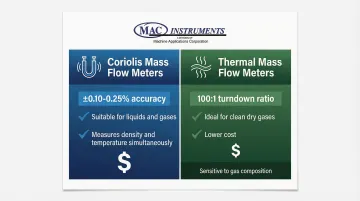
Coriolis meters use the Coriolis effect on vibrating tubes to measure mass directly. Suitable for both liquids and gases, they deliver exceptional accuracy (typically ±0.10% for liquids, ±0.25% for gases) and simultaneously measure density and temperature. This versatile technology handles the most critical applications.
Thermal meters measure gas flow based on heat transfer from a heated sensor to the flowing gas. The heat loss rate correlates directly to mass flow. Ideal for clean, dry gas applications, they offer lower cost and excellent turndown ratios (100:1) but are sensitive to gas composition and moisture.
How Does a Mass Flow Meter Work?
Mass flow meters operate through distinctly different physical principles depending on type, but both measure properties directly related to the mass of fluid in motion. This section focuses primarily on Coriolis meters as they represent the most common and versatile technology, with thermal principles noted where relevant.
Starting the Measurement Process
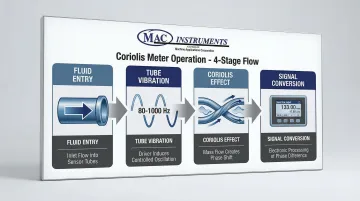
In Coriolis mass flow meters, measurement begins when process fluid enters the sensor housing and flows into one or more flow tubes. Manufacturers construct these tubes—typically U-shaped, straight, or delta-configured—from stainless steel or exotic alloys for corrosive services.
An electromagnetic driver (actuator) mounted on the flow tubes initiates vibration at the tubes' natural resonant frequency, typically 80-1000 Hz depending on tube size and design. The system carefully controls vibration amplitude—small enough to be barely noticeable but sufficient for accurate measurement.
This is a continuous process, not batch-based. The tubes vibrate constantly during operation, and flow measurement occurs in real-time with response times typically under one second. This makes Coriolis meters suitable for dynamic process control applications.
The Core Measurement Principle
The Coriolis effect in simple terms: When fluid flows through a vibrating tube, the combination of the tube's oscillation and the fluid's forward motion creates an inertial force (Coriolis force) that causes the tube to twist slightly. The amount of twist directly corresponds to the mass flow rate.
Physical mechanism:
- Fluid moving away from the drive point resists upward motion, causing that section to lag
- Fluid returning toward the drive point accelerates downward motion, causing it to lead
- This creates a measurable phase shift or time delay between the inlet and outlet sides of the tube
The sensing method: Precision motion sensors (typically electromagnetic velocity sensors or optical sensors) mount at the inlet and outlet sides to detect this phase difference or time lag, measured in microseconds. The transmitter electronics convert this directly into a mass flow rate signal.
Thermal mass flow meters work differently: They introduce a precise amount of heat into the gas stream via a heating element and measure the temperature change at sensors placed downstream. Gas flow cools the sensor proportionally to mass flow rate, following the principle that mass (not volume) carries heat away.
Maintaining Measurement Accuracy
Coriolis meters maintain accuracy under varying conditions through continuous self-monitoring. The transmitter continuously monitors the tubes' resonant frequency, which changes with the density of the fluid inside the tubes. This provides concurrent density measurement and allows the system to compensate for changes in fluid properties without recalibration.
Temperature compensation mechanisms: Precision temperature sensors (RTDs) mount on the flow tubes to monitor metal temperature. The transmitter applies correction factors accounting for changes in tube stiffness and dimensions from thermal expansion. This ensures measurement accuracy across the operating temperature range.
Handling challenging process conditions: Advanced transmitters include diagnostics that monitor tube vibration characteristics. They detect issues such as:
- Coating buildup on tube walls
- Corrosion or erosion damage
- Gas entrainment in liquids (appears as damping or changes in vibration pattern)
- External vibration interference
These diagnostics alert operators before measurement accuracy degrades significantly, enabling predictive maintenance.
Outputs and Integration
Coriolis mass flow meters provide multiple concurrent measurements from a single device:
- Direct mass flow rate (kg/hr, lb/min, etc.)
- Fluid density measurement (derived from resonant frequency)
- Temperature measurement (from RTD sensors)
- Volumetric flow rate (calculated by dividing mass flow by measured density)
Integration into process systems: The transmitter outputs standard industrial signals:
- 4-20 mA analog outputs (often with HART digital communication overlay)
- Digital protocols including Modbus, PROFIBUS, FOUNDATION Fieldbus, EtherNet/IP, and PROFINET
- Pulse/frequency outputs for flow totals
- Status relays for alarms and diagnostics
These signals connect to distributed control systems (DCS), programmable logic controllers (PLC), or SCADA systems for monitoring, recording, and closed-loop control.
Quality and reliability of output: Properly installed and maintained Coriolis meters typically achieve accuracy of ±0.1% to ±0.5% of reading (not full scale), with excellent repeatability of ±0.05%. This makes them suitable for custody transfer, batch control, and other applications where precision directly impacts product quality or financial accountability.
Where Mass Flow Meters Are Used
Mass flow meters fit into industrial workflows at critical points where measurement accuracy directly impacts operations, compliance, or profitability.
Typical Industrial Applications
Custody transfer and billing operations: Natural gas pipelines and refined petroleum loading terminals use Coriolis meters to measure the actual mass of product transferred, ensuring accurate billing regardless of temperature or pressure variations.
With potential errors of $105,000 on a single oil tanker load, precision is financially imperative.
Precise batching and blending: Pharmaceutical manufacturing and specialty chemical production require exact mass ratios of ingredients.
Mass flow meters enable automated batching systems that deliver consistent formulations regardless of ambient temperature changes or supply pressure fluctuations.
Reaction monitoring and control: Chemical processes depend on exact mass proportions of reactants. Mass flow meters provide the real-time feedback needed for automated control systems to maintain optimal reaction conditions and product quality.
Quality control applications: Food and beverage production uses mass flow meters for ingredient dosing where consistency determines taste, texture, and regulatory compliance. Recipe management systems rely on mass measurement to ensure every batch matches specifications.
Process Environments Where Mass Flow Meters Excel
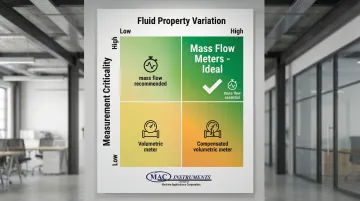
Mass flow meters deliver maximum value in applications with:
- Varying fluid properties: Temperature swings, pressure changes, or composition variations that would compromise volumetric measurement accuracy
- High-value products: Where measurement accuracy justifies the investment—pharmaceuticals, specialty chemicals, refined fuels
- Clean to moderately dirty fluids: Coriolis meters handle some solids content; thermal meters require clean, dry gases
- Multivariable measurement needs: Processes requiring simultaneous measurement of flow, density, and temperature from a single device
Industry-Specific Examples
These environmental requirements translate into specific industry applications across multiple sectors.
Oil and gas: Mass flow meters enable accurate custody transfer despite varying gas composition and operating conditions. Industry standards API MPMS Chapter 5.6 and AGA Report No. 11 specify them for fiscal metering applications.
Chemical processing: Precise reactant ratios ensure consistent product quality and minimize waste of expensive raw materials. Mass measurement eliminates errors from density changes during exothermic reactions.
Food and beverage: Sanitary Coriolis meters maintain recipe accuracy for taste and texture consistency while meeting strict hygiene requirements for cleanability and material compatibility.
Power generation: Fuel gas monitoring for combustion optimization requires accurate mass measurement because energy content relates to mass, not volume.
In facilities processing moisture-laden gases or steam, accurate mass flow measurement becomes critical for process efficiency.
Selecting Mass Flow Over Volumetric Measurement
Choose mass flow meters when:
- Billing or accountability requires mass-based measurement
- Process conditions vary significantly, affecting fluid density
- A single meter must handle multiple fluid types or grades
- Simultaneous density measurement adds operational value
- The cost of measurement error exceeds the meter investment
Conversely, volumetric meters may suffice for:
- Non-critical water flow monitoring
- Applications with stable temperature and pressure
- Low-value fluids where accuracy requirements are modest
- Budget-constrained projects where simpler technology meets needs
Conclusion
Mass flow meters measure the actual quantity of matter flowing through a process by detecting physical phenomena—Coriolis forces or heat transfer—that relate directly to mass rather than volume.
This provides measurement accuracy that remains stable despite changes in temperature, pressure, or fluid composition.
Understanding how mass flow meters work helps facility managers and engineers identify applications where the technology delivers ROI through:
- Improved measurement accuracy
- Reduced material waste
- Regulatory compliance
- Better process control
This knowledge also helps recognize situations where simpler, less expensive measurement methods meet your requirements.
Frequently Asked Questions
What is a mass flow meter and what is its working principle?
A mass flow meter measures the mass of fluid flowing through a pipe per unit time (kg/hr or lb/min). Coriolis meters measure tube twist from inertial forces, while thermal meters measure heat transfer rate—both proportional to mass flow.
What is the difference between a flowmeter and a mass flow meter?
"Flowmeter" is a general term for any flow device, while "mass flow meter" measures mass rate (kg/hr) rather than volumetric rate (liters/hr). Mass measurements remain accurate despite temperature or pressure changes, while volumetric measurements require density compensation.
What are the main types of mass flow meters?
Coriolis mass flow meters (±0.1% to ±0.5% accuracy, suitable for liquids and gases, higher cost) and thermal mass flow meters (±1% to ±2% accuracy, designed for gas measurement, lower cost). Coriolis dominates critical applications requiring maximum precision.
How accurate are mass flow meters?
Coriolis meters achieve ±0.1% to ±0.5% accuracy with ±0.05% repeatability, making them among the most accurate flow technologies. Thermal meters offer ±1% to ±2% accuracy, suitable for gas applications where extreme precision isn't required.
What industries commonly use mass flow meters?
Key industries include oil and gas (custody transfer), chemical and pharmaceutical (batch processing), food and beverage (ingredient dosing), power generation (fuel monitoring), and applications where measurement errors directly impact product quality, compliance, or profitability.
What are the advantages of mass flow meters over volumetric flow meters?
Key advantages include:
- Direct mass measurement unaffected by temperature, pressure, or density changes
- No separate density compensation equipment needed
- Simultaneous flow, density, and temperature measurement
- Superior accuracy for custody transfer and billing