Ultrasonic mass flow meters rarely fail outright. Instead, readings slowly drift, noise increases, or sensitivity drops while the meter continues to report values that look reasonable. These issues create uncertainty about whether changes are real process behavior or measurement degradation. That uncertainty shows up as control instability, allocation disputes, or numbers that become hard to defend later.
The real challenge is knowing when a meter is still fit for purpose and when it’s quietly becoming a source of risk. Subtle changes in signal quality, mounting, or electrical conditions often matter more than service intervals or calibration stickers. This article clarifies what actually degrades in ultrasonic mass flow meters and how those issues appear in real data.
Takeaways
Ultrasonic mass flow meters rarely fail hard; most problems appear as slow drift, added noise, or reduced sensitivity.
Plausible-looking numbers can still be wrong, especially after installation changes, electrical work, or long exposure to harsh conditions.
Transducers, mounting geometry, and signal integrity matter more than routine service intervals.
Calibration fixes offsets, not degraded signal paths or installation issues.
Maintenance decisions should be based on data behavior and risk, not on the assumption that “no moving parts” means no attention needed.
What Actually Degrades in Ultrasonic Mass Flow Meters
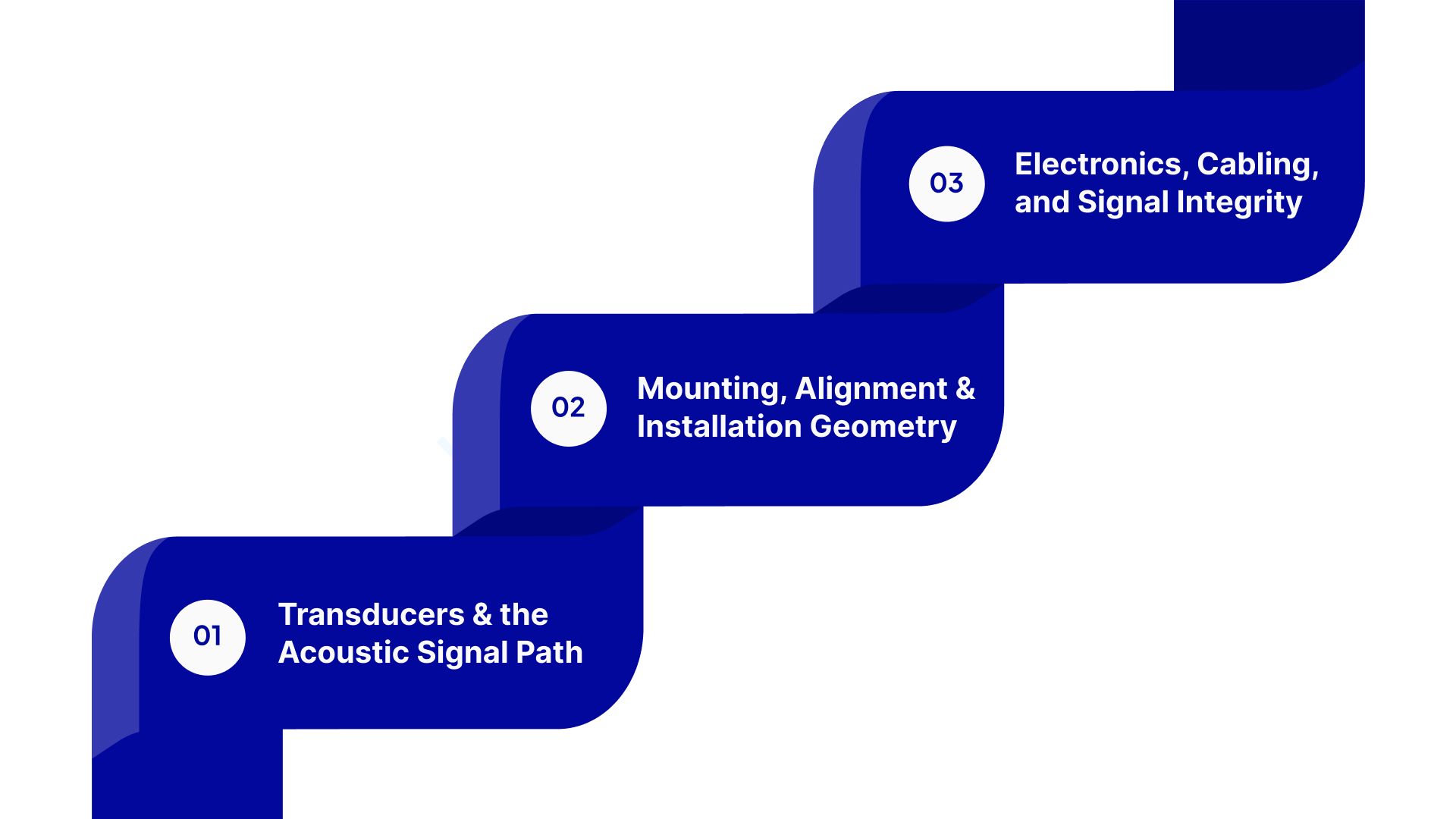
Ultrasonic mass flow meters don’t wear out the way mechanical meters do, but that doesn’t mean the measurement stays intact indefinitely. Degradation usually starts at the interfaces where sound is generated, transmitted, and interpreted, not inside the flow itself. These changes are incremental, often unnoticed during routine operation, and rarely flagged by diagnostics until data quality has already declined.
1. Transducers and the Acoustic Signal Path
Transducers are the core of the measurement, and their condition directly affects signal strength and timing accuracy. Over time, fouling, coating, erosion, or thermal stress can reduce acoustic coupling efficiency. Even small changes alter transit time measurement enough to introduce bias or reduce sensitivity, especially in applications with variable temperature or composition.
Because the meter continues to output stable-looking values, transducer degradation is often mistaken for slow process drift rather than a measurement issue.
How these signal changes actually appear in the data is usually the first clue that degradation has begun.
2. Mounting, Alignment, and Installation Geometry
Ultrasonic measurement depends on precise geometry. Clamp force, transducer spacing, alignment, and pipe condition all matter long after commissioning. Thermal cycling, vibration, pipe movement, or maintenance work upstream can subtly change those conditions without anyone touching the meter itself.
When geometry shifts, the signal path length and angle change, which directly affects the calculated flow. The result is often a gradual drift or reduced responsiveness rather than an abrupt failure.
These mechanical shifts tend to show up as changes in data behavior before they are visible on the hardware.
3. Electronics, Cabling, and Signal Integrity
Electrical degradation is one of the most common and least suspected contributors to ultrasonic meter issues. Aging cables, compromised shielding, poor grounding, or moisture ingress introduce noise and timing errors into the measurement. Power disturbances or nearby electrical work can create step changes that look like process events.
Because these issues are external to the meter body, they are frequently overlooked during maintenance reviews focused only on the instrument itself.
Those degradation mechanisms rarely announce themselves directly; they first show up as subtle, repeatable patterns in the flow data.
How Maintenance Issues Show Up in the Data (Before Failure)
Most ultrasonic mass flow meter problems surface in trends long before anyone questions the hardware. The meter continues to report values, alarms remain quiet, and the data stays within expected ranges. What changes is the behavior of the signal over time, especially when compared against process conditions.
Gradual Drift Over Time
Gradual drift is the most common early indicator of degradation. Flow values slowly move upward or downward without a corresponding change in process inputs, loads, or operating mode. Because the change is incremental, it is often rationalized as normal process variation until cumulative impact becomes visible in energy use, material balance, or allocation discrepancies.
Drift usually points to transducer degradation, mounting changes, or long-term electrical effects rather than a true process shift.
Increasing Noise or Variability
Another early sign is a widening of normal variability. Readings begin to fluctuate more than they used to under steady conditions, even though upstream and downstream variables remain stable. This is often blamed on the process, but in many cases it reflects declining signal quality, electrical interference, or weakening acoustic coupling.
Increased noise reduces confidence in short-term decisions and often leads to overly conservative control strategies.
Loss of Sensitivity
Loss of sensitivity occurs when the meter still responds to changes, but not by the expected amount. Real flow shifts are under-reported, making the process appear more stable than it actually is. This is particularly problematic during load changes, startups, or transitions between operating modes.
At this stage, the meter is still “working,” but its ability to represent reality is compromised.
Delayed or Lagging Response
In some cases, the signal responds correctly but too slowly. The flow trend lags behind known process events, creating delays in control action or apparent overshoot in downstream systems. This behavior is commonly tied to degraded transducers, mounting issues, or changes in thermal conditions along the signal path.
Lag is easiest to spot during startups, shutdowns, or intentional setpoint changes.
Once these data patterns are recognized, the next step is deciding which maintenance actions actually protect measurement quality and which ones only create the appearance of control.
Best Practices for Maintaining Your Flow Meter
Effective maintenance of ultrasonic mass flow meters is not about frequent intervention. It’s about targeted actions that preserve signal quality, geometry, and electrical integrity. When maintenance is driven by observed data behavior instead of fixed schedules, it does more to reduce risk with less disruption.
1. Inspection and Cleaning: When It Matters and When It Doesn’t
Transducer inspection and cleaning matter when there is evidence of fouling, coating, or signal degradation—not simply because time has passed. In clean, stable services, unnecessary cleaning introduces risk by disturbing alignment or coupling. In dirtier or high-temperature environments, infrequent inspection allows gradual degradation to go unnoticed.
Cleaning should be deliberate and minimal, focused on restoring signal quality rather than making the hardware look maintained.
If inspection restores signal behavior, the next concern is whether the installation itself has shifted.
2. Mounting and Mechanical Verification
Mounting conditions are rarely static over long periods. Clamp force relaxes, pipes move with temperature cycles, and vibration slowly changes alignment. These effects accumulate and directly influence transit time accuracy.
Periodic verification of transducer position, spacing, and mounting integrity is often more impactful than recalibration, especially after outages or mechanical work near the meter.
Even with perfect mounting, electrical integrity still determines how clean the measurement remains.
3. Electrical and System Checks
Grounding, shielding, and cable condition are frequent sources of measurement instability. Loose connections, moisture ingress, or nearby electrical changes introduce noise that cannot be corrected through calibration. These issues often present as increased variability or unexplained step changes.
Electrical checks should focus on consistency and signal integrity, not just continuity.
When these actions don’t restore confidence, calibration is often the next lever considered, but it has limits.
Maintenance Mistakes That Quietly Increase Risk
Many ultrasonic flow meter issues are not caused by neglect, but by maintenance actions that are technically correct and operationally misapplied. These traps tend to preserve the appearance of control while allowing measurement risk to grow.
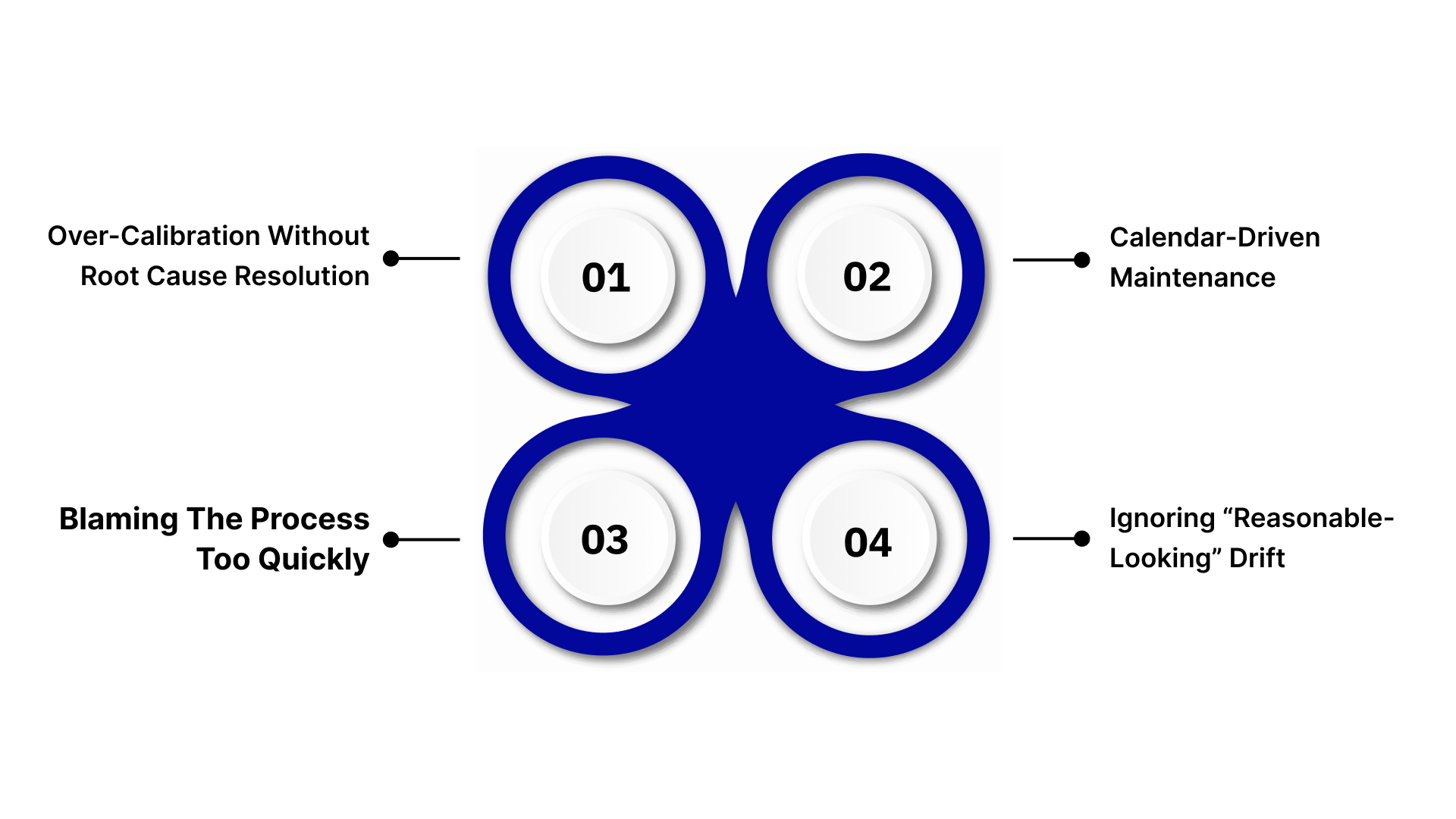
1. Over-Calibration Without Root Cause Resolution
Repeated calibration is often used to compensate for drift without addressing underlying causes such as mounting changes, fouling, or signal degradation. While recalibration may temporarily improve agreement, it can mask the real problem and accelerate long-term instability by normalizing degraded conditions.
2. Calendar-Driven Maintenance
Fixed maintenance intervals ignore how the environment, installation, and process variability affect ultrasonic measurement. In stable service, unnecessary intervention can introduce new errors; in harsh service, infrequent checks allow degradation to accumulate unchecked. Time alone is a poor proxy for measurement risk.
3. Blaming the Process Too Quickly
When flow data becomes noisy or inconsistent, the process is often assumed to be the source of the problem. This delays investigation into signal quality, mounting, or electrical integrity, and allows measurement degradation to persist under the assumption that operations are unstable.
4. Ignoring “Reasonable-Looking” Drift
Slow trend changes are frequently dismissed because values remain within expected ranges. Over time, these small deviations compound into material balance errors, energy inefficiencies, or reporting discrepancies that are harder to unwind later.
Knowing when internal maintenance is enough—and when it isn’t—is the final piece.
When Maintenance Escalation Is the Right Call
Escalation is appropriate when routine maintenance actions no longer restore confidence in the measurement. This is not a failure of upkeep, but a signal that the risk has moved beyond what incremental field adjustments can resolve.
Data No Longer Reconciles With Process Reality
If flow readings cannot be aligned with process behavior, material balances, or independent indicators, even after inspection and calibration, the issue is likely structural rather than procedural. At this point, continued minor adjustments add little value.
Calibration Produces Only Short-Lived Improvement
When calibration improves readings briefly before instability returns, the root cause is usually physical: transducer condition, mounting geometry, pipe effects, or signal path limitations. Calibration alone cannot correct these issues.
Uncertainty Around Installation or Assumptions
Unclear transducer spacing, alignment, acoustic path configuration, or pipe condition justifies escalation, particularly when the meter supports allocation, energy accounting, or reporting. Assumption uncertainty is itself a form of measurement risk.
Escalation is a recognition that protecting data credibility now requires deeper review, not more frequent routine action.
Conclusion
Ultrasonic mass flow meters become a liability when maintaining them turns into ongoing interpretation work. Slow drift, sensitivity loss, and mounting or signal issues don’t stop the meter from producing numbers; they just make every decision around those numbers harder to defend.
Over time, effort shifts from using the data to questioning it. What most plants ultimately want is flow data that stays stable, predictable, and uncontroversial.
In applications where steam or gas flow is critical, and conditions are harsh, that often means using measurement hardware designed to operate in-situ without fragile dependencies.
MAC Instruments provides steam and gas flow meters built for long-term stability in high-temperature, industrial environments, where minimizing maintenance and preserving data confidence matter more than managing ultrasonic limitations.
FAQs
How often should ultrasonic mass flow meters be inspected?
Inspection frequency should be driven by environment severity, data criticality, and observed trend behavior, not by a fixed schedule. Stable installations may require minimal intervention, while harsh or high-risk applications justify closer review.
What parts of an ultrasonic mass flow meter actually require maintenance?
Transducers, mounting conditions, and electrical signal paths are the primary maintenance concerns. The meter body itself typically requires little attention.
What causes gradual drift in ultrasonic flow measurements?
Drift is usually caused by transducer degradation, mounting changes, long-term thermal exposure, or electrical signal deterioration rather than true process change.
Is calibration always required after maintenance?
Calibration is appropriate after changes that affect offset or scale, such as transducer replacement or configuration updates. It does not correct fouling, mounting errors, or electrical noise.
Can ultrasonic meters degrade without triggering alarms?
Yes. Most degradation appears as slow drift, increased noise, or reduced sensitivity while diagnostics remain normal and values stay within expected ranges.