Moisture analyzer downtime is rarely caused by a single dramatic failure. In most industrial environments, downtime develops gradually, through fouling, drift, thermal stress, and maintenance practices that no longer match the conditions the analyzer is exposed to.
In many cases, the analyzer is still powered on. It may still be reporting numbers. But operators and engineers stop trusting the data, and once confidence is lost, the analyzer might as well be offline.
This article focuses on the maintenance-driven causes of moisture analyzer downtime, why standard care routines often fall short in real plants, and how experienced engineers reduce downtime by aligning maintenance practices with process reality.
Key Takeaways
Moisture analyzer downtime is usually caused by gradual maintenance-driven degradation (fouling, drift, heat stress), not sudden instrument failure.
An analyzer can be “online” but effectively down once operators stop trusting the data, forcing conservative operation and manual workarounds.
Repeated cleaning and frequent calibration often signal a mismatch between the analyzer and the process environment, not poor maintenance discipline.
Long-term uptime comes from reducing measurement dependencies and selecting analyzers designed for continuous, in-situ operation in hot, dirty, or steam-rich processes.
When downtime persists despite good maintenance, many teams evaluate MAC Instruments for its solid-state, low-maintenance approach focused on stability and audit-defensible data.
Moisture Analyzer Downtime Is Usually Preventable, If Maintenance Matches Reality
Most downtime problems start with good intentions and bad assumptions.
Most moisture analyzers do not fail because maintenance teams neglect them. They fail because maintenance programs are built on assumptions that do not hold up in continuous industrial service.
Many manufacturer-recommended maintenance schedules assume:
Clean or conditioned samples.
Intermittent exposure to heat.
Stable ambient conditions.
Easy access for inspection and service.
In real plants, moisture analyzers are often exposed to:
Continuous high temperatures.
Dirty, particulate-heavy gas streams.
Steam, condensation, or corrosive compounds.
Vibration and thermal cycling from surrounding equipment.
When maintenance routines do not account for these stresses, degradation accumulates quietly. By the time downtime becomes obvious, the underlying issues have often been developing for months.
What Is Moisture Analyzer Downtime?
Downtime isn’t just when the analyzer is off; it’s when the data stops being usable.
Moisture analyzer downtime occurs when moisture data becomes unavailable, unstable, or operationally untrustworthy due to maintenance, calibration, or environmental issues.
Importantly, downtime does not always mean the analyzer is powered off or faulted. Many analyzers remain “online” while delivering data that operators no longer rely on. In practice, this loss of confidence forces plants to fall back on manual sampling, conservative control strategies, or fixed setpoints, all of which introduce inefficiency and risk.
The Most Common Maintenance-Related Causes of Moisture Analyzer Downtime
These issues account for the majority of failures seen in day-to-day plant operation.
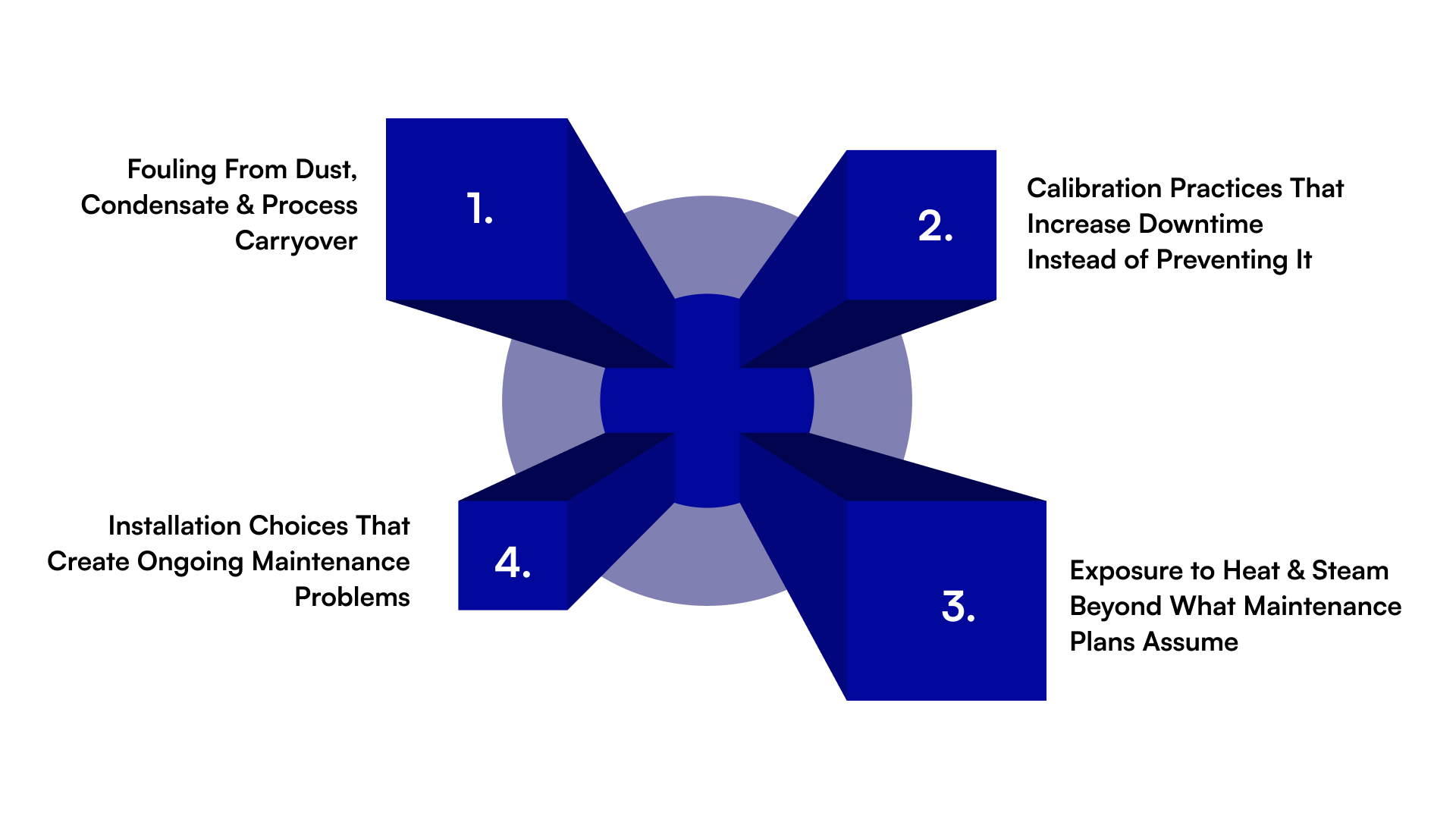
1. Fouling From Dust, Condensate, and Process Carryover
Fouling is one of the most common and least visible drivers of moisture analyzer downtime. Dust, fines, oils, tars, and condensed moisture gradually accumulate on sensing elements and probe surfaces.
Unlike sudden failures, fouling rarely triggers alarms. Instead, it causes:
Slow signal drift.
Increased response time.
Inconsistent readings during process changes.
Maintenance schedules based on calendar intervals often underestimate fouling rates in hot or dirty processes. By the time fouling is noticed, the analyzer may already be producing misleading data.
2. Calibration Practices That Increase Downtime Instead of Preventing It
Calibration is meant to protect measurement integrity, but poorly applied calibration practices often do the opposite.
Skipped calibration allows drift to go undetected, while excessive calibration introduces:
Frequent analyzer removal and reinstallation.
Increased risk of mechanical damage or misalignment.
Operator fatigue that leads to shortcuts.
When an analyzer needs constant recalibration to remain usable, the underlying issue is almost always environmental stress or an overly fragile measurement approach.
3. Exposure to Heat and Steam Beyond What Maintenance Plans Assume
Temperature ratings alone do not tell the full story about analyzer survivability.
Continuous heat accelerates seal degradation, electronic aging, and material fatigue. Steam-rich environments introduce condensation during startups, shutdowns, and load changes. Without maintenance practices designed around these realities, downtime becomes a recurring problem.
4. Installation Choices That Create Ongoing Maintenance Problems
Many long-term maintenance issues originate at installation.
Poor probe placement, inadequate drainage, or mounting in high-vibration zones can significantly increase fouling, drift, and calibration frequency, even when the analyzer itself is well designed.
Why Following the Maintenance Manual Is Often Not Enough
Maintenance manuals describe ideal conditions; plants rarely operate under them.
Manufacturer manuals cannot account for every process variable, especially in harsh industrial environments.
As a result, analyzers maintained strictly “by the book” may still suffer downtime because:
Fouling rates exceed assumed values.
Heat exposure is continuous rather than intermittent.
Access limitations delay corrective action.
Experienced engineers treat manuals as a baseline, then adapt maintenance practices based on actual operating conditions.
At this point, many teams begin evaluating analyzers designed to reduce maintenance drivers altogether, such as MAC Instruments, whose solid-state, in-situ moisture and steam analyzers are built for continuous high-temperature service without relying on optics, wet elements, purge air, or other fragile dependencies.
Best Practices for Moisture Analyzer Maintenance in Industrial Environments
These practices focus on preventing downtime rather than reacting to it.
1. Align Cleaning Frequency With Process Conditions, Not the Calendar
Cleaning schedules should be driven by fouling behavior and process variability, not fixed intervals. In dirty or high-temperature processes, waiting for visible degradation usually means downtime has already begun.
2. Treat Frequent Calibration as a Warning Signal
Calibration should verify performance, not compensate for instability. If frequent calibration is required, investigate environmental stress, fouling mechanisms, or excessive measurement dependencies rather than increasing calibration frequency.
3. Minimize Analyzer Removal and Reinstallation
Every removal increases the risk of damage, misalignment, and extended downtime. Maintenance strategies that keep analyzers installed, through in-situ verification and cleaning, consistently improve uptime.
4. Document Maintenance Actions With Downtime Impact in Mind
Recording why maintenance was required is more valuable than recording that it occurred. Over time, this documentation highlights recurring stressors and supports better equipment decisions.
How Maintenance Issues Translate Directly Into Process Downtime
Analyzer downtime rarely stays confined to the instrument.
When moisture analyzer data becomes unreliable, the operational response is almost never to “wait and see.” Engineers and operators compensate immediately, often without formally declaring the analyzer down.
The most common response is running conservatively. Dryers are over-dried to avoid a wet product. Steam rates are padded to protect quality. Setpoints are widened to avoid alarms driven by unstable readings. These changes are rational in the moment, but they come with real costs.
Over time, unreliable moisture data leads to:
Higher energy consumption occurs as processes are run hotter, longer, or drier than necessary.
Reduced throughput, because conservative control limits restrict operating windows.
Inconsistent product quality, especially in processes where moisture is tightly tied to yield, texture, or downstream handling.
Increased operator intervention occurs as teams rely on manual sampling or visual judgment instead of trusted signals.
In regulated or emissions-monitored processes, the impact is even more serious. If moisture data cannot be defended, plants may:
Lose confidence in historical records.
Struggle to explain data gaps or inconsistencies during audits.
Be forced into corrective actions or reporting assumptions that increase compliance risk.
In short, analyzer maintenance issues quietly turn into process downtime, even when production never fully stops.
How to Reduce Moisture Analyzer Downtime Long-Term
Long-term uptime comes from design and selection decisions, not hero maintenance.
Most plants can temporarily reduce downtime with increased attention, more cleaning, more calibration, and more troubleshooting. But that approach rarely scales. Sustainable uptime comes from reducing the reasons maintenance is needed in the first place.
Focus less on how to maintain an analyzer and more on why it needs maintenance so often. That shift drives better long-term decisions.
1. Reduce Maintenance Dependencies Wherever Possible
Each added dependency is another way for uptime to erode.
Optics can foul. Purge air can fail. Consumables can degrade or run out. Wet elements can dry unevenly or drift. Individually, these may seem manageable. Collectively, they create a maintenance burden that grows over time.
Every dependency adds:
A component that must be inspected or serviced.
A failure mode that may not trigger alarms.
A reason for operators to distrust the signal.
Reducing dependencies simplifies maintenance, lowers intervention frequency, and makes downtime events more predictable rather than reactive.
2. Match the Analyzer to Continuous, In-Situ Operation
Many analyzers perform acceptably in short-duration or controlled environments, but struggle in continuous industrial service.
Processes involving constant heat, steam, or dirty gas streams impose stresses that compound over time. Analyzers designed for these environments typically:
Tolerate continuous exposure rather than intermittent peaks.
Maintain stability despite fouling, vibration, and thermal cycling.
Require fewer removals for inspection or recalibration.
Matching the analyzer to the actual duty cycle — not just its nominal ratings — is one of the most effective ways to reduce long-term downtime.
3. Evaluate Total Maintenance Burden, Not Just Instrument Performance
Accuracy claims often dominate early selection discussions, but they rarely predict long-term uptime.
What matters operationally is:
How often is maintenance required?
How difficult it is to perform safely and consistently.
Whether maintenance actions introduce additional risk or variability.
How long the analyzer remains trusted between interventions.
An analyzer that delivers excellent performance but demands constant attention often costs more in downtime, energy waste, and lost confidence than it delivers in measurement value.
When Repeated Maintenance Becomes a Replacement Discussion
At some point, more maintenance stops delivering better results.
There is a clear inflection point where increased maintenance effort no longer improves reliability. Cleaning becomes more frequent. Calibration intervals shorten. Downtime events occur closer together.
When this pattern appears, the issue is rarely technician skill or discipline. It usually indicates a fundamental mismatch between the analyzer and the environment.
Signs that replacement should be considered include:
Maintenance frequency increasing year over year.
Downtime recurring despite corrective actions.
Operators consistently bypassing or ignoring the measurement.
Rising total cost of ownership driven by labor and lost production.
At this stage, replacing the analyzer with a more robust solution is often more cost-effective than continuing to fight the same failure modes. For high-temperature or harsh applications, evaluating in-situ, direct moisture measurement options, such as those developed by MAC Instruments, can help break the maintenance cycle and restore long-term reliability.
Applications Where Maintenance-Driven Downtime Is Most Common
Certain environments amplify maintenance challenges more than others.
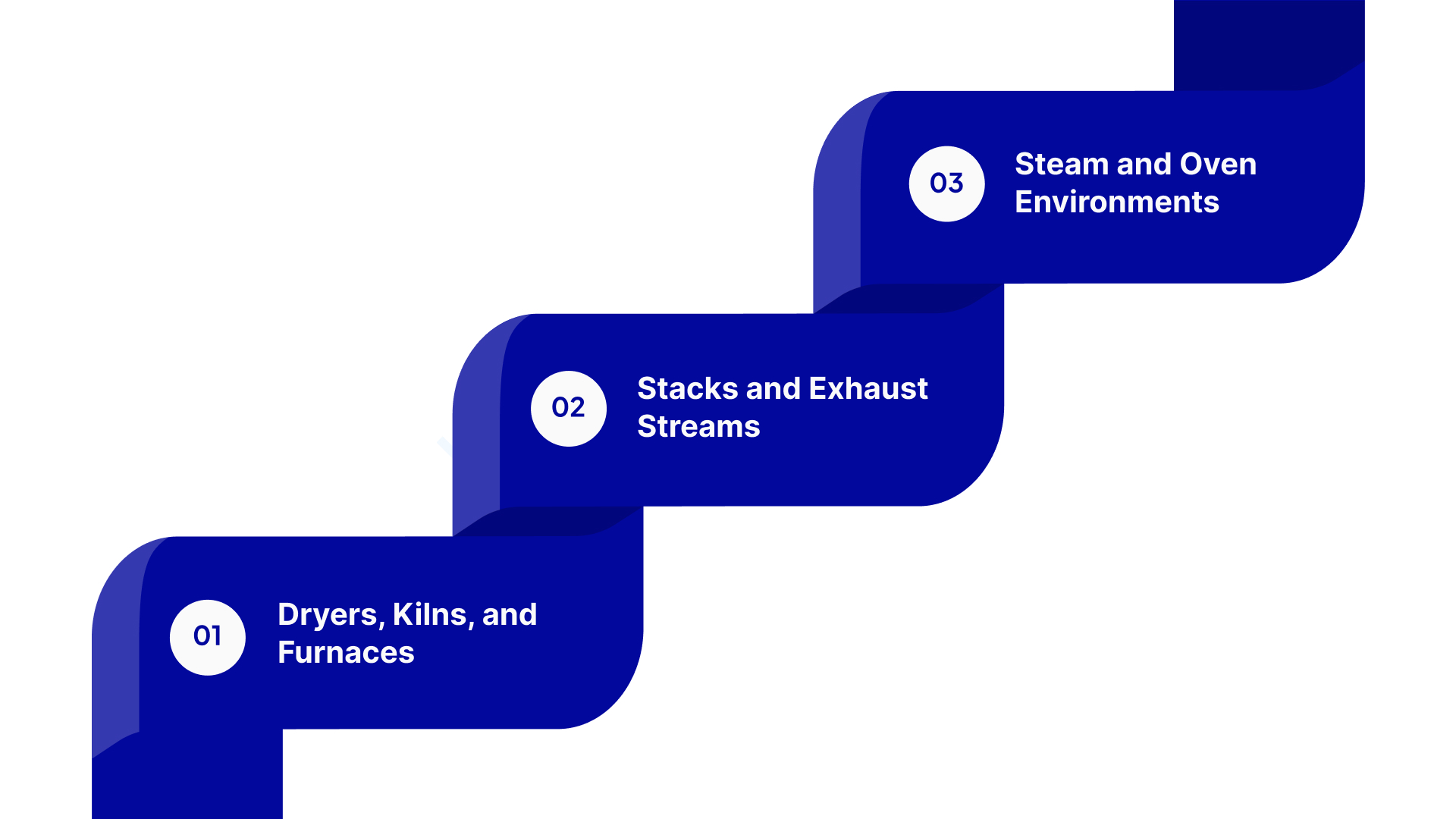
1. Dryers, Kilns, and Furnaces
High temperatures combined with particulate-laden gas streams accelerate fouling and material degradation. Continuous exposure leaves little recovery time between cycles, making maintenance intervals shorter and more disruptive.
2. Stacks and Exhaust Streams
Stack-mounted analyzers face extreme temperature gradients, corrosive components, and limited access. Downtime here carries added risk because unreliable moisture data can undermine emissions reporting and audit defensibility.
3. Steam and Oven Environments
Steam-rich processes introduce condensation during startups, shutdowns, and load changes. Thermal cycling and washdown conditions place constant stress on sensors, seals, and electronics, demanding analyzer designs that tolerate continuous exposure.
Conclusion
Moisture analyzer downtime almost always begins as a maintenance issue, but persistent downtime is usually a design-and-fit problem.
Increasing cleaning, calibration, and troubleshooting can temporarily stabilize performance, but when those efforts escalate without improving reliability, the analyzer is likely mismatched to the environment it operates in. At that point, maintenance is no longer preventing downtime; it is compensating for it.
This is where many experienced teams reassess their measurement approach and evaluate instruments engineered to reduce maintenance drivers altogether. For high-temperature, dirty, and regulated processes, MAC Instruments' solid-state, in-situ moisture and steam analyzers are designed for continuous operation without relying on fragile dependencies like optics, wet elements, purge air, or consumables.
If moisture analyzer downtime has become a recurring operational risk, the most productive next step is a technical evaluation focused on environmental fit, long-term stability, and maintenance burden, not another incremental change to the maintenance schedule. Request a quote with MAC Instruments today!
Frequently Asked Questions
1. How do you distinguish a maintenance problem from a fundamentally mismatched analyzer?
If maintenance frequency continues to increase without improving reliability, and corrective actions repeat without resolving root causes, the issue is usually an environmental mismatch rather than a maintenance discipline.
2. Why do some moisture analyzers appear “online” but are still considered down by operations?
Because the signal is unstable, drifting, or inconsistent enough that operators stop using it for control or decision-making. Trust, not power status, defines uptime.
3. At what point does frequent calibration become a red flag?
When calibration is required to compensate for drift caused by heat, fouling, or process variability, rather than normal aging, frequent calibration often signals dependency-driven instability.
4. Why does analyzer downtime often surface during audits instead of daily operation?
Audits force historical review and repeatability checks. Drift, data gaps, and undocumented interventions that were tolerated operationally become visible and problematic under scrutiny.
5. What evaluation criteria matter most when downtime is the primary concern?
Engineers should prioritize total maintenance burden, dependency count, in-situ verification capability, environmental survivability, and long-term signal stability over lab-grade accuracy claims.