Most moisture analyzers report a single number, but that number can be produced in very different ways. Two instruments can show the same moisture value while relying on entirely different physical mechanisms to get there. When readings disagree, drift over time, or behave unpredictably at higher temperatures, the issue is rarely calibration alone—it is usually the working principle behind the measurement.
Understanding how a moisture analyzer actually works is the fastest way to explain why some methods are stable, others are sensitive, and some quietly stop representing real conditions. Once the working principle is clear, the strengths, limits, and failure modes of each analyzer become much easier to recognize.
Key Takeaways
A moisture analyzer’s working principle defines how moisture is detected, not how it is displayed.
Different analyzers measure different physical effects, even if the output unit looks the same.
Most moisture analyzers rely on drying, inference, or chemical reaction.
The working principle determines accuracy limits, response time, and long-term stability.
Understanding the principle explains why moisture readings vary between instruments.
What Is the Working Principle of a Moisture Analyzer?
The working principle of a moisture analyzer is the physical or chemical method it uses to detect and quantify moisture in a sample. Rather than measuring “moisture” as an abstract property, each analyzer senses a specific effect, such as weight loss, energy absorption, electrical change, chemical reaction, or water vapor concentration, and converts that into a reported value.
This distinction matters because different principles respond differently to temperature, material composition, time, and environment. Two analyzers can report moisture in the same units while measuring fundamentally different phenomena, which is why their results may not agree under real operating conditions.
Moisture Analyzer Working Principles
Moisture analyzers are built around a small number of core working principles. Each principle defines how moisture is detected, what assumptions are required, and where the method performs well or breaks down.
Loss-on-Drying (LOD) Working Principle
Loss-on-drying analyzers determine moisture by heating a sample and measuring the reduction in mass as moisture evaporates. The difference between the initial and final weight is reported as moisture content.
This principle assumes that only water is lost during heating and that the sample itself does not decompose or volatilize. It is widely used in laboratory and batch testing under controlled conditions, but results depend strongly on temperature selection, drying time, and sample composition.
Infrared and Halogen Heating Working Principle
Infrared and halogen moisture analyzers are variations of the loss-on-drying approach. They use infrared radiation or halogen lamps to heat the sample more rapidly while a precision balance tracks weight loss in real time.
The faster heating shortens analysis time, but it also increases sensitivity to overheating and non-water mass loss. These analyzers still rely on the same core assumption as LOD methods: that weight loss corresponds directly to moisture removal.
Moisture Analyzer Working Principles (Common Methods Used Today)
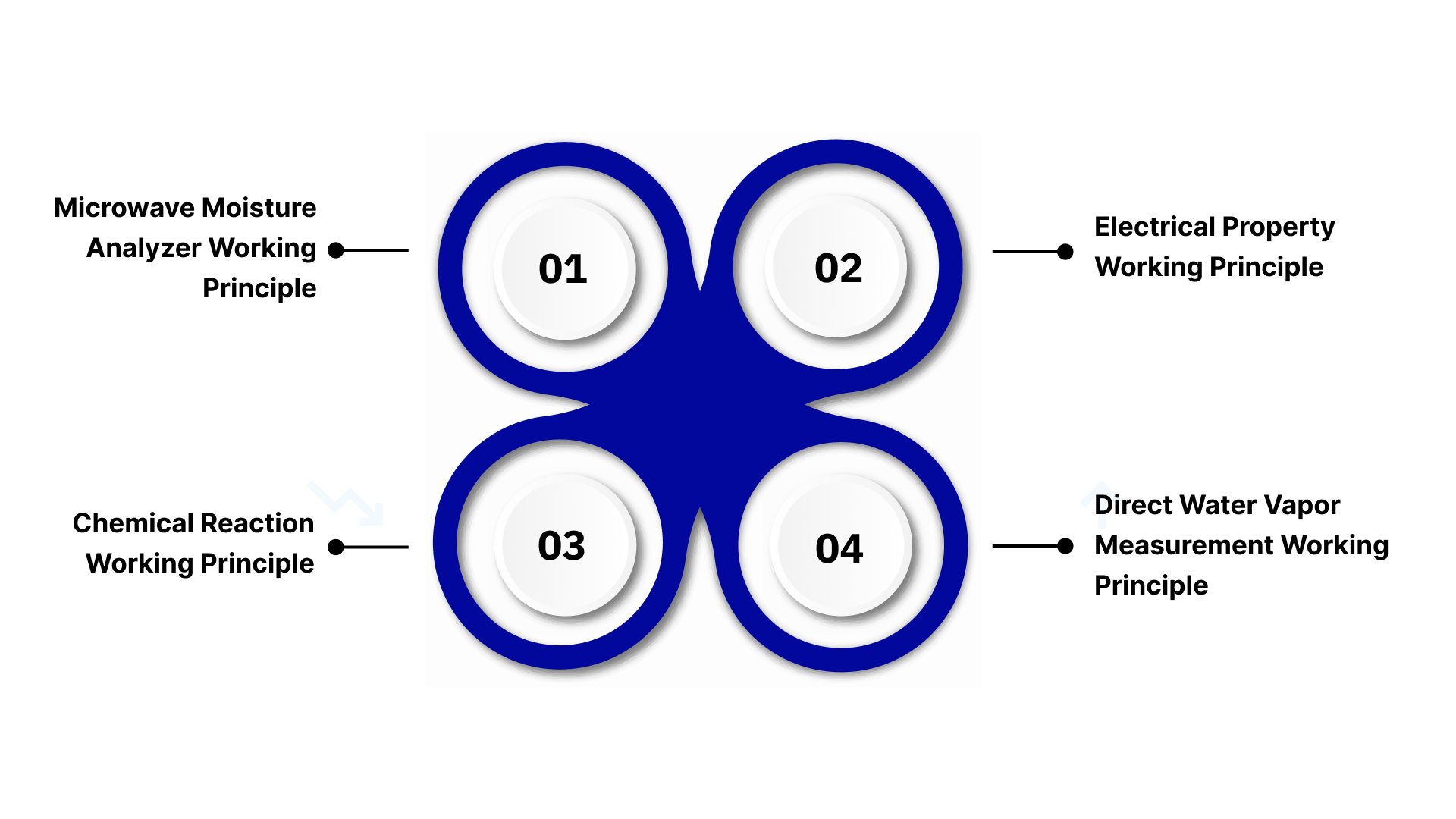
Moisture analyzers rely on different physical or chemical mechanisms to detect moisture. While the output may appear similar, each working principle measures a different effect and behaves differently depending on material, temperature, and environment.
1. Microwave Moisture Analyzer Working Principle
Microwave moisture analyzers expose the sample to microwave energy, which selectively excites water molecules. As the water absorbs energy, it heats rapidly and evaporates from within the material. Moisture content is then determined based on the resulting weight loss or the interaction between the microwave field and the sample.
Because water responds much more strongly to microwaves than most dry solids, this principle allows for fast drying and deeper penetration. However, the response is highly dependent on material composition, density, and geometry, which means results can vary significantly unless the method is tightly controlled.
2. Electrical Property (Capacitive or Resistive) Working Principle
Electrical moisture analyzers determine moisture content by measuring changes in a material’s electrical properties. As moisture increases, the dielectric constant or electrical conductivity of the material changes, and this change is correlated to moisture level.
This principle does not require drying or chemical reactions, but it depends heavily on calibration specific to the material being measured. Temperature, composition, and structural changes can all influence the electrical response, limiting how transferable or stable the measurement is across applications.
3. Chemical Reaction Working Principle (Karl Fischer)
Karl Fischer moisture analyzers measure moisture through a chemical reaction between water and a reagent containing iodine and sulfur dioxide. The amount of reagent consumed is directly proportional to the amount of water present in the sample.
This principle is highly sensitive and well suited for trace moisture analysis. It is primarily used in laboratory settings where sample handling and reagent control can be carefully managed. The method is precise but not continuous and requires ongoing consumables and maintenance.
4. Direct Water Vapor Measurement Working Principle
Direct moisture analyzers measure water vapor concentration directly in a gas or steam stream. Instead of drying a sample or inferring moisture from secondary properties, the analyzer detects water vapor itself and reports moisture as an absolute value.
Because this principle does not rely on weight loss, optical paths, or chemical reactions, it supports continuous, in-situ measurement. It is commonly used in process environments where real-time moisture data is needed under high temperature or harsh operating conditions.
Why Different Moisture Analyzer Principles Produce Different Results
Moisture analyzers often report results in the same units, but the values are not always directly comparable. That’s because each working principle measures a different physical or chemical effect, not moisture itself as a universal property. As operating conditions move away from controlled environments, these differences become more visible.
Different physical signals are being measured
Loss-on-drying measures mass change, electrical methods measure material response, chemical methods measure reaction volume, and direct analyzers measure water vapor. These signals are not equivalent, even if they are converted into the same moisture unit.Temperature affects principles differently
Heating-based methods are sensitive to overheating and non-water mass loss, while electrical and RH-based methods are strongly influenced by temperature itself, not just moisture.Material composition changes the response
Volatile compounds, binders, fillers, or changing density can alter weight-loss and electrical measurements without a true change in moisture.Time and exposure matter
Drying rate, heating profile, and exposure duration influence when a method declares “dry,” which affects the reported result.Process vs lab conditions amplify disagreement
In clean, controlled lab tests, different principles may agree reasonably well. In hot, dirty, or continuous processes, divergence is common and expected.Disagreement does not mean failure
Two analyzers can disagree while both are functioning correctly. The difference reflects the working principle, not necessarily an instrument fault.
Because of this, moisture results should always be interpreted based on how the measurement is produced, not just the number shown on the display.
How to Interpret Moisture Data Based on the Working Principle
Once the working principle is understood, moisture data becomes easier to interpret and harder to misuse. The same numeric change can mean very different things depending on how the analyzer produces the measurement.
Drying-based methods (LOD, IR, halogen, microwave)
Changes reflect mass loss over time. Results are sensitive to heating rate, endpoint definition, and whether non-water components are driven off during drying.Electrical property methods
Changes reflect shifts in material response, not moisture alone. Temperature, density, and composition can influence the signal as much as actual water content.Chemical reaction methods
Results reflect total water reacted during the test. Precision is high, but results depend on controlled handling and are not representative of dynamic processes.Direct water vapor measurement
Changes reflect actual water vapor concentration at the measurement point. Results respond directly to process conditions without a drying or inference step.
Understanding this prevents overconfidence in a number that may be behaving exactly as the principle dictates, even when it no longer aligns with process reality.
Common Misunderstandings About Moisture Analyzer Principles
Many moisture measurement problems stem from incorrect assumptions about how analyzers work.
“All moisture analyzers measure the same thing”
They don’t. Each principle measures a different physical or chemical effect and translates it into a moisture value.“Calibration fixes principle limitations”
Calibration corrects offsets and scaling under specific conditions. It does not remove assumptions built into the working principle.“Higher accuracy specs mean better results”
Resolution and repeatability do not compensate for principles that degrade or drift under real operating conditions.“Agreement in the lab guarantees agreement in the process”
Lab conditions mask many effects that dominate in high-temperature, continuous, or contaminated environments.
Choosing a Moisture Analyzer Principle for Industrial Use
When moisture measurement moves out of the lab and into the process, the working principle becomes the dominant factor in long-term reliability.
Batch vs continuous measurement needs
Drying and chemical methods are inherently batch-based. Process environments often require continuous measurement.Temperature and environment severity
High heat, particulates, vibration, and condensation stress indirect methods far more than direct measurement approaches.Maintenance tolerance
Some principles require frequent recalibration, cleaning, or consumables to remain reliable.Data defensibility over time
Long-term stability and explainable behavior often matter more than short-term precision.
The right principle is the one that continues to represent actual moisture under real conditions, not just during initial testing.
Conclusion
Moisture analyzers do not work on a single universal principle. Each method detects moisture through a specific physical or chemical mechanism, and that choice determines how the measurement behaves as conditions change. Most disagreements, drift, and confusion around moisture data can be traced back to misunderstanding how the analyzer produces the number. Once the working principle is clear, the strengths and limits of the measurement become much easier to manage.
If moisture measurement is being used in high-temperature or harsh industrial environments, a practical next step is to review whether the current working principle still aligns with how and where the measurement is used.
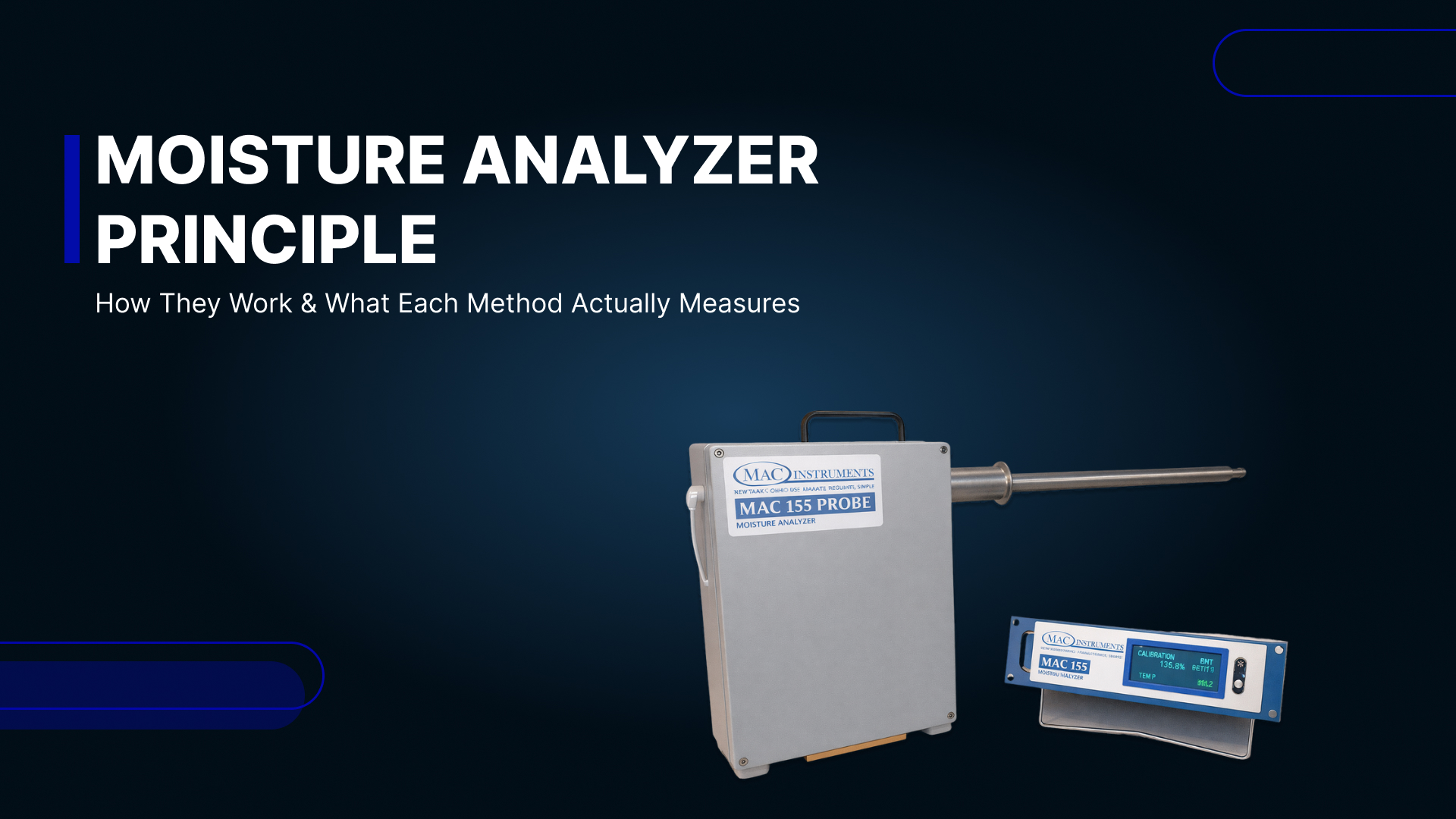
MAC Instruments provides in-situ moisture analyzers based on direct absolute moisture measurement, designed for continuous operation where drying-based and inference-driven methods struggle to remain stable.
In applications where long-term reliability and defensible moisture data matter, choosing a principle built for real process conditions can significantly reduce ongoing uncertainty and maintenance burden. Request a qoute for moisture analyzers.
Frequently Asked Questions (FAQs)
1. What is the working principle of a moisture analyzer?
A moisture analyzer works by detecting moisture through a defined physical or chemical mechanism, such as weight loss during drying, electrical property changes, chemical reaction, or direct measurement of water vapor. The principle determines what is actually being measured and how the result behaves.
2. Why do different moisture analyzers give different moisture readings?
Because they rely on different working principles, they measure different physical effects. Even when results are shown in the same units, differences in temperature, material composition, and environment can cause valid analyzers to report different values.
3. Is loss-on-drying the same as infrared or halogen moisture analysis?
Yes. Infrared and halogen moisture analyzers are variations of the loss-on-drying principle. They differ mainly in how the sample is heated, not in how moisture is determined.
4. Do all moisture analyzers require heating the sample?
No. Drying-based methods require heating, but electrical, chemical, and direct water vapor measurement methods do not rely on sample drying.
5. Why can moisture readings drift over time even after calibration?
Calibration corrects measurement offset under specific conditions, but it does not change the underlying working principle. Drift often occurs due to temperature effects, material changes, fouling, or degradation of the sensing method itself.