Choosing a moisture meter in an operating plant rarely fails on day one. It fails months later, when temperatures creep up, fouling builds, calibration slips, or the data stops lining up with reality. By then, the process is tuned around bad numbers, maintenance is chasing symptoms, and confidence in the measurement is already gone. The risk isn’t just downtime; it’s not knowing when the data stopped being trustworthy.
This article breaks down how experienced engineers evaluate moisture meters beyond datasheets. It focuses on failure modes, tradeoffs, integration realities, and audit pressure that surface after installation. It'll help you pressure-test your selection logic and avoid hidden operational risk.
Summary
Most moisture meters fail after startup, not at commissioning.
Measurement principle, temperature survivability, and calibration method drive long-term risk more than accuracy specs.
If moisture data feeds control, energy, or compliance, in-situ, continuous measurement reduces blind spots and audit exposure.
The right choice is the one that stays stable, supportable, and defensible years into operation—not the one that looks best on paper.
What Actually Qualifies as a Moisture Meter in Industrial Service
In an operating plant, a moisture meter is a permanently installed, in-situ instrument expected to run continuously in the process, not something pulled out for verification or used under controlled conditions. Once installed, it becomes part of the process infrastructure, not a test tool.
That distinction matters because most moisture measurement problems don’t start as accuracy issues. They show up as drift, fouling, or instability after prolonged exposure to heat, particulates, vibration, or corrosive gases. In many cases the instrument keeps outputting a signal long after the measurement itself has stopped reflecting the process.
At that point, moisture data is no longer just “instrumentation.” It is feeding control loops, alarms, energy decisions, and sometimes compliance reports through the PLC or DCS. When the measurement becomes unreliable, the risk spreads beyond the sensor into operations, yield, and audit defensibility.
The real evaluation question isn’t whether a device can measure moisture under ideal conditions. It’s whether the measurement can be trusted to remain stable, supportable, and defensible after years in a hot, dirty process with minimal intervention.
How to Choose a Moisture Meter: Requirement → Technology Mapping
The most reliable way to select a moisture meter is to start with process requirements and work forward to the measurement approach that can realistically sustain them. The table below maps common industrial requirements to the technologies that tend to hold up, or fail, once the process is running continuously.
Requirement-to-Technology Mapping
Process Requirement | What This Means in Practice | Technology Implication |
|---|---|---|
Sustained high temperatures | Continuous exposure, not short excursions | Requires instruments designed to measure stably at elevated temperatures, not just survive them |
Variable process conditions | Load changes, air in-leakage, fuel changes | Direct absolute moisture measurement avoids model drift |
Dirty or particulate-laden gas | Ash, fines, condensables, fouling risk | Minimize exposed components and fragile dependencies |
Continuous control or optimization | Moisture feeds loops, alarms, or tuning | In-situ, real-time measurement required |
Compliance or reporting use | Data may be audited months or years later | Calibration must be traceable and practical in service |
Limited maintenance windows | Instrument must run unattended for long periods | Low-maintenance, solid-state designs preferred |
PLC/DCS integration | Signal used directly by control systems | Stable outputs that don’t require excessive filtering |
Long asset life expectations | Instrument expected to last years, not cycles | Avoid disposable probes and consumable-heavy designs |
Takeaway from this table:
Start by marking which requirements are non-negotiable for your process
Eliminate technologies that cannot meet those requirements continuously
Evaluate remaining options based on maintenance realism, not best-case specs
In most plants, the decision narrows quickly once high temperature, continuous operation, and audit defensibility are treated as first-order requirements rather than edge cases.
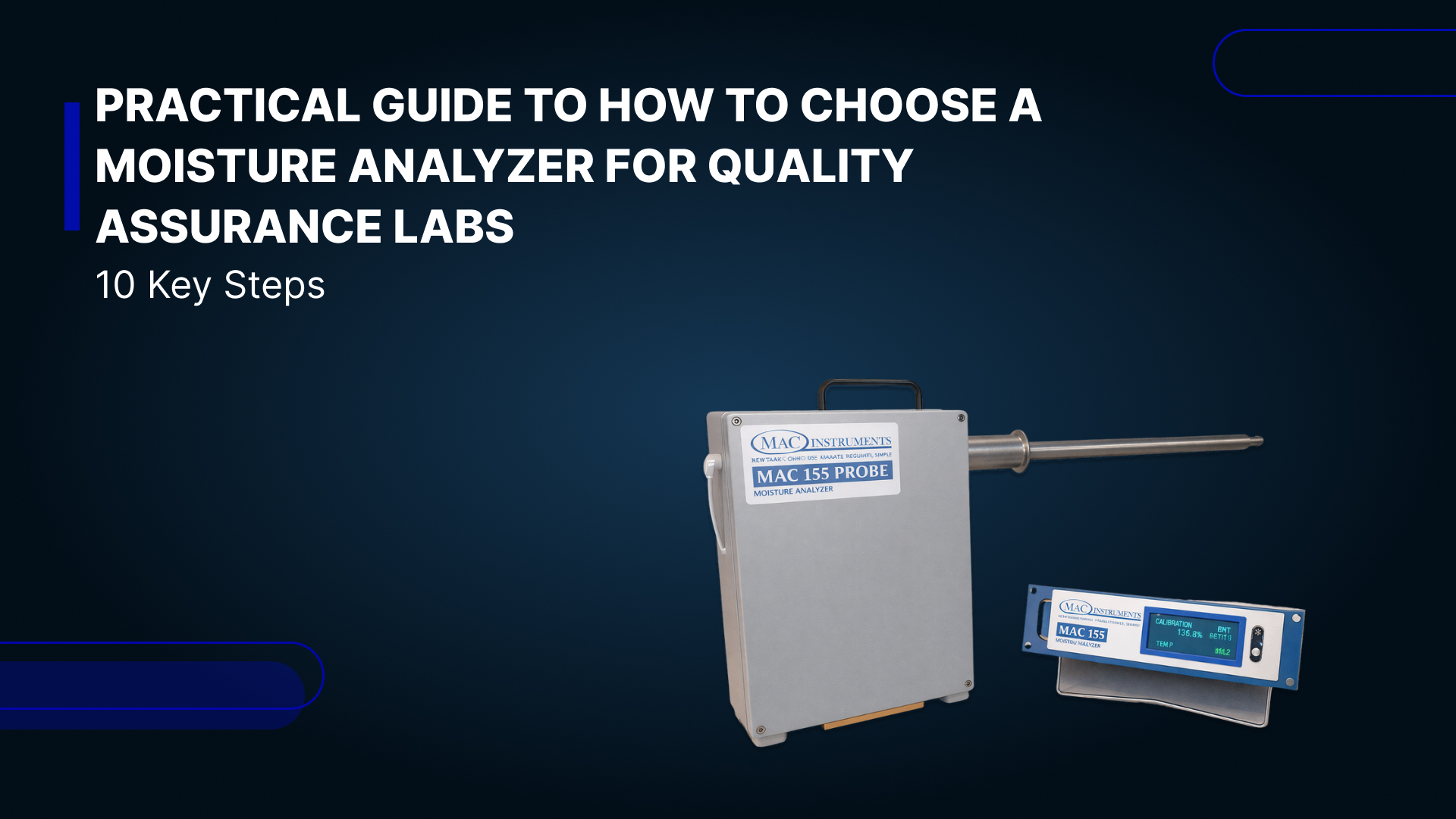
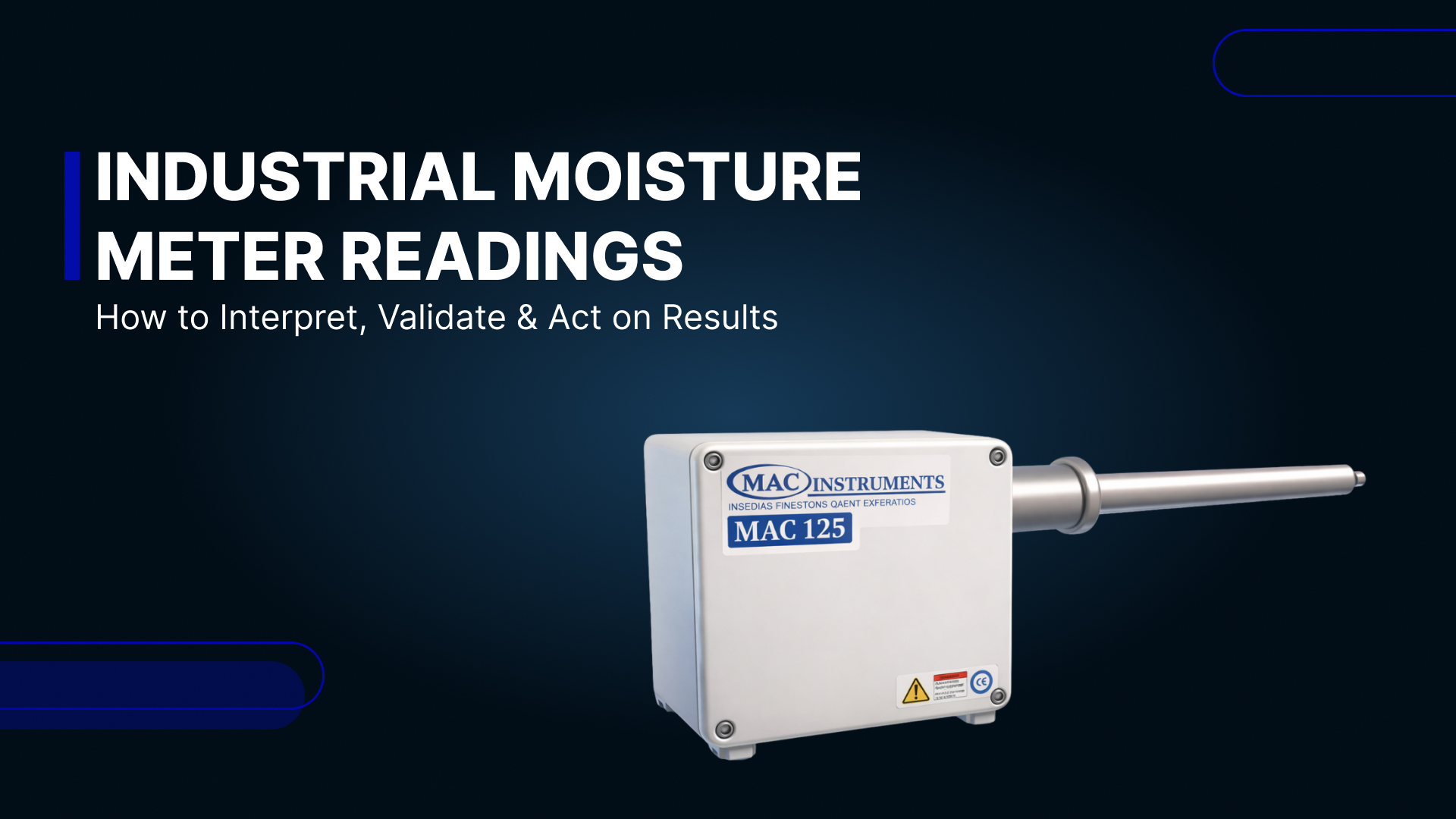
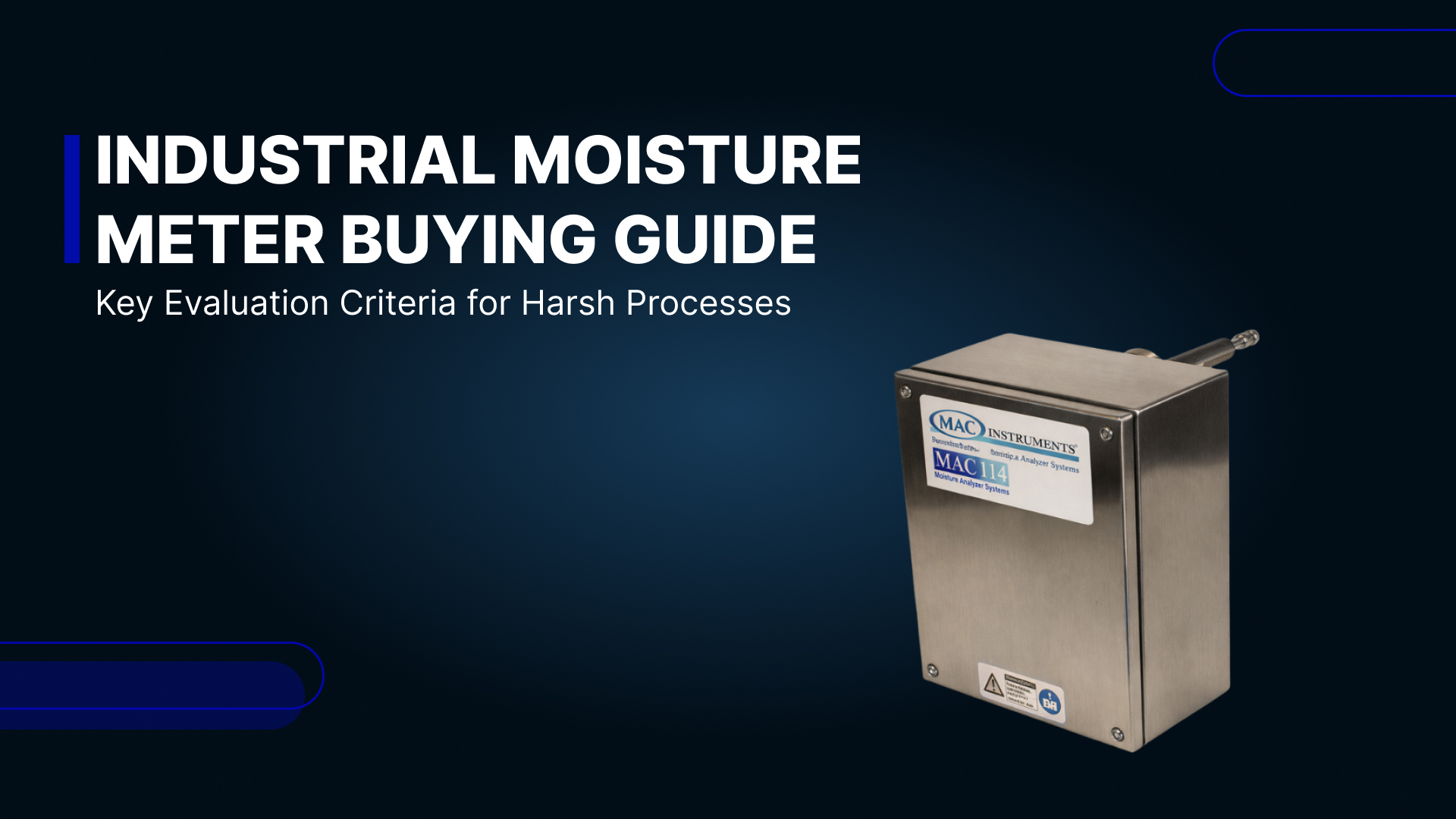
For high-temperature, dirty, steam-laden, or regulated applications, MAC Instruments is typically considered when other moisture measurement approaches become unstable or maintenance-heavy.
MAC analyzers are designed for direct absolute moisture measurement, continuous in-situ operation, elevated temperatures (up to 1200°F, with higher-temperature options), and practical field calibration, making them a fit for ovens, kilns, dryers, furnaces, stacks, and steam processes where long-term stability and defensible data matter.
Once a moisture meter is selected, these factors determine whether the measurement remains reliable in service.
Critical Factors to Evaluate While Buying a Moisture Meter
Once a moisture meter is in service, real operating conditions determine whether the data remains reliable. Heat, fouling, and process variability often expose weaknesses that affect control stability, maintenance effort, and confidence in the measurement.
A few practical factors drive that long-term reliability and risk. They are outlined below.
Measurement Principle: Absolute vs. Inferred
Absolute moisture measurement detects water vapor directly in the process stream, rather than calculating moisture from relative humidity, temperature models, or secondary gas assumptions.
Why this matters in practice
Inferred measurements depend on stable relationships between temperature, pressure, and gas composition. In high-temperature or stack environments, those relationships rarely hold, so the inferred value can drift even when the instrument appears healthy.
Relative humidity also varies with temperature, even when actual moisture does not. In continuously changing industrial processes, this makes RH-based models unstable and difficult to validate over time.
Failure mode engineers encounter
The signal stays online, but the moisture value no longer represents the process. Controls get tuned to a moving target, and compliance data becomes harder to defend because the measurement depends on assumptions that are no longer true.
Decision impact
If moisture data feeds control logic, energy decisions, or emissions reporting, the measurement principle must tolerate changing conditions without re-modeling or constant validation.
Operating Temperature & Environment
Industrial moisture measurement lives or dies by environmental compatibility. MAC instruments are designed for continuous operation at elevated temperatures, with published capability up to 1200°F (650°C) and optional configurations for applications up to 2400°F (1300°C).
At elevated temperatures, the limitations of relative humidity become more pronounced. Above approximately 212°F, relative humidity values become increasingly nonlinear and misleading because saturation pressure rises rapidly with temperature. Under these conditions, RH can appear very low even when absolute moisture content is high, making it a poor indicator for process control or compliance.
Why temperature ratings are not just survival specs
Many instruments can tolerate brief exposure to heat. Far fewer maintain measurement stability after prolonged thermal stress. Elevated temperatures accelerate component aging, drive sensor drift, and amplify the effects of corrosion and vibration.
Real-world implications
When a device is operated near or beyond its intended envelope:
Drift increases even if the sensor does not fail outright
Calibration intervals shrink
Maintenance becomes reactive
Operators lose confidence in the data before alarms ever trip
Decision impact
Engineers should evaluate not just maximum temperature ratings, but whether the instrument is designed to measure accurately and repeatably at those temperatures for years, not weeks.
Continuous In-situ vs. Spot or Portable Measurement
Continuous in-situ measurement provides real-time moisture data directly from the process, while portable or spot measurements provide isolated snapshots under non-steady conditions.
Tradeoffs engineers actually manage
Spot measurements are useful for troubleshooting and verification but miss transient events, startup behavior, and drift between checks.
Continuous measurement exposes instability early, supports closed-loop control, and creates an auditable data record—but only if the instrument is stable and maintainable.
Integration reality
In-situ analyzers become part of the control architecture, feeding PLCs or DCS systems for alarms, trending, and optimization. If the measurement is unreliable, the entire control strategy inherits that uncertainty.
Decision impact
The question isn’t cost versus convenience. It’s whether the process can tolerate blind spots between manual checks, or whether moisture variability needs to be visible at all times.
When moisture data supports reporting or audits, the bar for defensibility rises significantly.
Compliance, Audit Defensibility & Reporting Needs
In many plants, moisture data is no longer just a process variable. It becomes part of the compliance record, which changes how the measurement is evaluated, maintained, and defended.
Calibration Traceability
Calibration traceability is the ability to demonstrate how a moisture measurement was verified, when it was verified, and whether that verification can be reproduced.
What auditors actually look for
Auditors care less about nominal accuracy claims and more about whether calibration can be performed, documented, and repeated without removing the instrument from service. Field-calibratable instruments reduce gaps in data and eliminate periods where measurements are assumed rather than verified.
Risk in lab-only calibration models
When calibration requires removal or factory return, plants often extend intervals or rely on assumptions to keep operations running. That creates documentation gaps and weakens confidence in historical data during audits.
Decision impact
If moisture data supports compliance reporting, calibration must be practical enough to happen on schedule and traceable enough to stand up to external review.
Output Signals & Data Systems
Moisture measurements only add value if they integrate cleanly into existing control and reporting infrastructure.
What matters in practice
Stable analog outputs suitable for PLC and DCS systems
Signals that remain steady under process disturbances, not just steady-state conditions
Compatibility with trending, alarm logic, and historical data storage
Common failure mode
An instrument that technically “measures” moisture but produces noisy or unstable signals forces engineers to filter, average, or manually interpret the data. That introduces delay, masks real events, and complicates audits.
Decision impact
Engineers should evaluate how the signal behaves under upset conditions and whether it can be used directly for control and reporting without excessive conditioning.
Regulatory Context
For stack and emissions-related applications, moisture measurement directly affects reported values and compliance posture.
Why defensibility matters
Regulatory reviews focus on whether the measurement method is appropriate for the application and whether the data can be justified after the fact. In-situ measurement approaches designed for high-temperature stack environments reduce uncertainty caused by sampling losses, condensation, or process variability.
Decision impact
When moisture data feeds regulated calculations, the measurement approach must be able to withstand scrutiny long after the report is submitted.
Even a stable measurement can create problems if it does not integrate cleanly into plant systems.
Integration and Operational Reality
Even technically sound instruments can become operational liabilities if integration and service realities are overlooked.
Electrical & Software Interfaces
Moisture analyzers typically become permanent nodes in the control system.
What engineers evaluate
Whether the instrument is self-powered or loop-powered
Signal compatibility with existing I/O cards
Behavior during power interruptions or restarts
Operational risk
Poorly matched interfaces can lead to nuisance alarms, signal dropouts, or unexpected behavior during startups and shutdowns.
Maintenance Access & Serviceability
Serviceability often determines whether maintenance is proactive or reactive.
Design factors that matter
Access to sensing elements without major disassembly
Ability to inspect or service the instrument while installed
Minimal reliance on consumables or frequent cleaning
Impact on uptime
When routine checks require significant downtime or special handling, they tend to be delayed. Over time, that increases the likelihood of unnoticed drift or failure.
Spare Parts & Lifecycle Planning
Long-term ownership costs are shaped by how an instrument is supported over its life.
What experienced teams plan for
Availability of replacement components
Whether wear items are modular or integral
Avoidance of disposable probes that drive recurring replacement cycles
Decision impact
Lifecycle planning affects not just maintenance budgets, but also confidence that the measurement can be supported consistently over many years of operation.
Comparing Common Moisture Measurement Technologies
At a high level, most moisture measurement approaches can be grouped into a few categories. The practical differences between them only become clear once they are exposed to continuous operation, variable process conditions, and maintenance constraints.
Handheld and Portable Meters
Handheld moisture meters are designed for spot checks and troubleshooting, not continuous process control.
Where they fit
Verification checks
Commissioning support
One-time investigations
Limitations in plant service
Measurements reflect a single moment, not process variability
Results depend heavily on where and when the reading is taken
No integration with control systems or data historians
Decision implication
Handheld devices are useful tools, but they cannot replace continuous moisture measurement where control stability, energy use, or compliance depend on the data.
Laboratory and Extractive Analyzers
Lab-based or extractive systems can provide controlled measurements, but they introduce separation between the process and the measurement.
Operational tradeoffs
Sample handling adds complexity and maintenance
Transport losses, condensation, or leaks can bias results
Delays between process change and reported value reduce control usefulness
Failure modes engineers encounter
When sampling systems degrade, the analyzer may still function while the sample no longer represents the process. This disconnect is difficult to detect and harder to defend during reviews.
Decision implication
If sample integrity cannot be guaranteed over time, measurement confidence erodes even if the analyzer itself remains functional.
In-situ Industrial Moisture Analyzers
In-situ analyzers measure moisture directly in the process environment without removing or conditioning the sample.
Why this matters in real operation
Eliminates sampling losses and transport delays
Tracks process changes as they occur
Reduces auxiliary systems that require maintenance
Design considerations
In-situ measurement only works if the instrument is designed for the temperature, particulate loading, and chemical exposure of the application. When properly matched, it provides the most direct and defensible representation of process moisture.
Decision implication
For applications where moisture data influences control decisions or compliance reporting, minimizing the distance between the process and the measurement reduces uncertainty and long-term risk.
The appropriate technology depends less on how moisture can be measured and more on how reliably that measurement can be sustained once the process is running continuously.
Conclusion
Selecting a moisture meter is ultimately about ownership over time. The right choice is the one that continues to deliver stable, supportable, and defensible data after years of exposure to heat, fouling, process variability, and operational constraints.
When moisture measurement influences control performance, energy use, or compliance reporting, design tradeoffs that look minor at purchase tend to surface as real risk later.
For plants operating in high-temperature, harsh, or regulated environments, MAC Instruments is purpose-built around those long-term realities. If your next step is to validate fit for a specific application, such as a stack, oven, dryer, furnace, or steam process, it helps to review requirements carefully. Comparing them against MAC’s in-situ, absolute moisture measurement approach can reduce downstream operational and audit risk.
If you are evaluating moisture measurement for a demanding industrial application, consider discussing your process conditions in detail. MAC Instruments can help determine whether their analyzers align with your long-term reliability and compliance requirements. Request a quote today!
Frequently Asked Questions
How do I choose the right moisture meter for an industrial process?
Start by defining non-negotiable process requirements: operating temperature, gas cleanliness, process variability, maintenance access, and whether the data feeds control or compliance. Technologies that cannot sustain those conditions continuously should be eliminated early, regardless of accuracy claims.
What is the biggest reason moisture meters fail in real plants?
Most failures are not immediate sensor failures but gradual drift caused by sustained heat, fouling, or unstable inferred measurement models. The instrument often continues outputting a signal after the measurement itself has lost credibility.
Is relative humidity suitable for high-temperature or stack applications?
Relative humidity–based or inferred measurements become unreliable as temperature and process conditions change. In high-temperature or stack environments, changes in pressure, gas composition, or load can invalidate the underlying assumptions without obvious indication.
When is continuous in-situ moisture measurement necessary?
Continuous in-situ measurement is necessary when moisture data influences control loops, energy usage, yield, or regulatory reporting. Spot or portable measurements introduce blind spots that can mask drift and transient conditions.
How does calibration method affect audit defensibility?
Auditors focus on whether calibration can be performed, documented, and repeated under operating conditions. If calibration requires removing the instrument or long outages, intervals are often extended in practice, weakening data defensibility.
What should I look for in moisture meter integration with PLC or DCS systems?
Beyond basic signal compatibility, the key is signal stability under process upsets. Measurements that require heavy filtering or manual interpretation reduce control effectiveness and complicate troubleshooting and audits.
Why shouldn’t I rely on relative humidity at elevated temperatures?
Relative humidity describes how close a gas is to saturation at a given temperature, not how much moisture it actually contains. Above roughly 212°F, the relationship between RH and actual moisture content becomes highly nonlinear. In high-temperature processes, this makes RH-based measurements unstable and difficult to defend, even when the instrument itself appears to be functioning normally.