Introduction
Most stack emissions compliance programs account for flow rates, dilution corrections, and instrument calibration — but moisture content is where calculations quietly go wrong. Stack gases contain 5-20% moisture by volume, and EPA regulations require NOx and SO₂ to be reported on a dry basis. That means moisture measurement isn't optional; it's built directly into the compliance math.
The stakes are higher than they might appear. A 2% error in moisture measurement can produce a 10-15% error in reported emissions — enough to push a facility out of compliance or trigger an enforcement review.
This guide breaks down the technical relationship between stack moisture and emissions calculations, explains how measurement errors compound through EPA formulas, and covers what accurate moisture analysis looks like in practice.
Key Takeaways
- Stack gases contain 5–20% moisture by volume, directly distorting NOx and SO₂ concentration readings if left uncorrected
- EPA mandates dry-basis reporting, yet most analyzers read wet-basis — making moisture correction formulas non-negotiable
- Moisture errors multiply through calculations—a 2% moisture error can produce 10–15% reporting error
- Continuous moisture measurement via EPA Method 4 or in-situ analyzers prevents permit violations and avoids costly recalculations
What Is Stack Moisture and Why Does It Matter for Emissions?
Stack moisture is water vapor (H₂O) present in combustion exhaust gases, ranging from 5–20% by volume depending on fuel type, combustion efficiency, and process conditions. An error in that moisture value flows directly into NOx and SO₂ emissions calculations — producing reporting errors that can trigger permit violations or force costly recalculations.
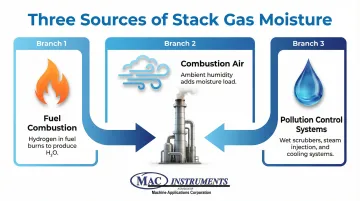
Three Pathways for Moisture Entry
Water vapor enters stack gas through:
- Combustion of hydrogen in fuel — When hydrogen-containing fuels burn, they produce H₂O as a primary byproduct
- Moisture in combustion air — Ambient humidity contributes to the total moisture load
- Water injection for pollution control — Wet scrubbers, steam injection for NOx control, or cooling systems add significant moisture
The Regulatory Imperative
EPA regulations (40 CFR Part 60, 40 CFR Part 75) require all pollutant concentrations to be reported on a dry volume basis to standardize comparisons across different processes and fuel types. This "apples-to-apples" approach prevents facilities from diluting emissions with water vapor to artificially lower reported concentrations.
The measurement challenge: Most continuous emissions monitoring systems (CEMS) measure pollutants on a wet basis — as measured in moisture-laden gas — requiring mathematical correction using accurate moisture data. Under 40 CFR Part 75, facilities calculating NOx emission rates in lb/mmBtu must either use a fuel-specific default moisture value or install and operate a continuous moisture monitoring system.
For reference method testing, EPA Method 4 expresses moisture content as Bws — the proportion of water vapor by volume — and this value feeds directly into emissions rate calculations for NOx, SO₂, and other pollutants. Because the moisture fraction appears in both the concentration correction and the volumetric flow calculation, an inaccurate Bws propagates error through two separate terms in the final reported rate.
How Moisture Impacts NOx and SO₂ Measurements
Moisture affects emissions measurements through two distinct mechanisms: spectroscopic interference and concentration basis dilution.
Spectroscopic Interference
Water vapor absorbs infrared radiation at wavelengths near those used to measure NOx and SO₂ in Non-Dispersive Infrared (NDIR) analyzers. Research confirms that at a water vapor concentration of 22 g/m³, uncorrected NDIR analyzers exhibit:
- 30% positive bias for NO₂ at 6.21 µm wavelength
- 20% positive bias for SO₂ at 7.45 µm wavelength
- 5% positive bias for NO at 5.25 µm wavelength
This interference creates artificially high readings that can trigger false compliance violations if not properly corrected.
The Concentration Dilution Problem
When moisture is present, the same mass of pollutant is diluted across a larger total gas volume. Wet-basis concentrations (ppmv wet) are always lower than dry-basis concentrations (ppmv dry) because water vapor occupies volume without contributing to the pollutant mass.
The fundamental relationship:
Cdry = Cwet / (1 - Bws)
This formula shows how moisture fraction (Bws) appears in the denominator and amplifies any measurement error.
Why Small Moisture Errors Compound
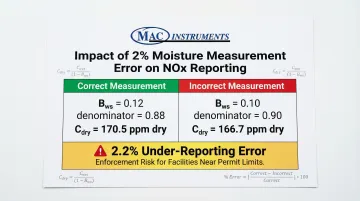
Consider a stack with 10% moisture (Bws = 0.10). If moisture is incorrectly measured as 8% (Bws = 0.08):
- Correct denominator: 1 - 0.10 = 0.90
- Incorrect denominator: 1 - 0.08 = 0.92
- Error created: (0.92 - 0.90) / 0.90 = 2.2%
This 2% moisture measurement error creates a 2.2% error in final emissions—and this multiplies through all downstream calculations including flow rate corrections.
Temperature Dependency
Measurement error doesn't stop at the formula — saturated gas streams and streams containing water droplets introduce additional positive bias that compounds the calculation errors described above.
EPA Method 4 requires simultaneous temperature measurement to verify saturation assumptions. In saturated streams, the method mandates:
- Comparing measured moisture against theoretical saturation limits from psychrometric charts
- Reporting the lower value to prevent over-reporting
In practice: Power generation facilities have deployed MAC Instruments' MAC155 moisture analyzers to prevent moisture measurement drift in their CEMS. Continuous, accurate moisture monitoring is essential for maintaining compliance with 40 CFR Part 75 (Continuous Emission Monitoring) and Part 60 (Standards of Performance for New Stationary Sources).
The Mathematics Behind Moisture-Corrected Emissions
Understanding the formulas reveals why moisture measurement accuracy is non-negotiable.
Core Dry Basis Conversion
The EPA formula for dry basis conversion is:
Cdry = Cwet / (1 - Bws)
Where:
- Cdry = pollutant concentration on dry basis (ppmv dry)
- Cwet = pollutant concentration on wet basis (ppmv wet)
- Bws = moisture fraction by volume (dimensionless)
- (1 - Bws) = dry gas fraction
Emissions Rate Calculation
The emissions rate formula incorporates moisture twice:
E = Cdry × Qsd × K
Where:
- E = emissions rate (lb/hr)
- Cdry = dry basis concentration (requires moisture correction)
- Qsd = dry standard volumetric flow rate (requires moisture correction)
- K = conversion constant
Stack Gas Flow Rate Correction
The dry standard flow rate itself requires moisture correction:
Qsd = Qact × (Pstd/Pact) × (Tact/Tstd) × (1 - Bws)
Moisture appears in both the concentration term and the flow rate term — meaning a measurement error propagates through two separate variables before reaching the final reported emissions rate.
Worked Example
Given:
- Wet-basis NOx concentration: 150 ppm
- Actual moisture content: 12% (Bws = 0.12)
- Measured moisture (error): 10% (Bws = 0.10)
Correct calculation: Cdry = 150 / (1 - 0.12) = 150 / 0.88 = 170.5 ppm dry
Incorrect calculation (with 2% moisture error): Cdry = 150 / (1 - 0.10) = 150 / 0.90 = 166.7 ppm dry
Reporting error: (170.5 - 166.7) / 170.5 = 2.2% under-reporting
For facilities within 5% of their permitted emission limit, a 2.2% under-reporting error is enough to trigger an exceedance — and potential enforcement action — that the data never flagged.
Why Regulators Require Dry Basis
That precision requirement is exactly what drove EPA to mandate dry-basis reporting. Standardizing to a moisture-free reference point eliminates variability caused by differences in fuel type, combustion conditions, and process design. A coal-fired plant producing 15% stack moisture and a natural gas plant producing 8% moisture can only be compared fairly when both report on a dry basis.
Moisture Measurement Methods for Emissions Compliance
Two primary approaches exist for measuring stack gas moisture: periodic reference methods and continuous monitoring systems.
EPA Method 4 Reference Method
EPA Method 4 is the EPA's established gravimetric reference method for moisture determination, providing NIST-traceable accuracy that serves as the benchmark for all other approaches:
Sampling procedure:
- Extractive sampling through heated probe (approximately 120°C / 248°F)
- Moisture condensation in four impingers connected in series
- First two impingers contain water, third is empty, fourth contains silica gel
- Silica gel captures residual moisture for gravimetric analysis
Requirements:
- Minimum sample volume: 0.60 standard cubic meters (21 scf)
- Maximum sampling rate: 0.021 m³/min (0.75 cfm)
- Simultaneous temperature measurement for saturation verification
Advantages: High-precision, NIST-traceable results accepted as the regulatory reference standard
Limitations: Requires manual sampling, lab analysis, and offers only periodic snapshots rather than continuous data
Continuous Moisture Monitoring Alternatives
Modern continuous analyzers provide real-time moisture data for CEMS applications:
Technology options:
- Capacitive sensors measure water vapor pressure directly
- High-temperature humidity probes measure moisture in-situ at up to 1200°F (650°C), with some models rated to 2400°F
- FTIR systems validated under Method 301 or Method 320
- Dual oxygen analyzers derive moisture by measuring O₂ on both wet and dry basis
When selecting a continuous analyzer for CEMS compliance, the specs that matter most are accuracy, response time, and how easily calibration fits into your QA schedule. MAC Instruments' MAC155, for example, achieves ±1% accuracy with a 60-second response time and supports daily two-point in-situ calibration checks — useful for facilities needing frequent verification without pulling the instrument offline.
Comparison Matrix
| Feature | EPA Method 4 | Continuous Analyzers |
|---|---|---|
| Measurement Type | Periodic reference | Real-time continuous |
| Principle | Gravimetric (condensation) | Capacitive, spectroscopic, or O₂ differential |
| Accuracy | High (reference standard) | ±1% with proper calibration |
| Sample Volume | Min 0.60 scm required | N/A (in-situ or extractive) |
| Calibration | Lab-based | Daily automated checks available |
| Use Case | RATA, audits, default validation | Ongoing compliance, process control |
| Maintenance | Manual sampling required | Automated with QA procedures |
Use Method 4 for periodic verification — annual default validation requires nine runs — while relying on continuous analyzers for real-time corrections and day-to-day compliance monitoring. Continuous monitors require regular calibration checks and QA procedures per EPA Performance Specification 18 (PS-18).
Consequences of Inaccurate Moisture Measurement
Moisture measurement errors carry real financial and legal consequences — not just data quality problems.
Regulatory Compliance Risks
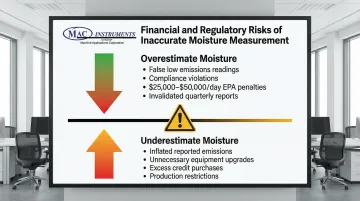
Underestimating moisture inflates your reported emissions. That can trigger:
- Unnecessary equipment upgrades costing millions
- Operational restrictions that limit production capacity
- Excess emission credit purchases
Overestimating moisture suppresses reported emissions below actual levels, exposing facilities to:
- Compliance violations and enforcement actions
- EPA penalties of $25,000–$50,000 per day of violation
- Invalidated quarterly compliance reports requiring expensive re-testing
Data Invalidation Periods
Under 40 CFR Part 75, a moisture monitoring system that fails a Quality Assurance test or malfunctions is classified as "out-of-control." The monitoring record for that period is invalidated.
During out-of-control periods, facilities must apply substitute data procedures. These typically use conservative (high) default values that artificially inflate reported emissions and consume more allowances than actual operations would require.
Financial Impacts
A 1% overestimation of moisture-corrected emissions in a 1200-MWe power plant can result in a generation loss equivalent of 12 MWe. At $35/MWh, this equates to an annual financial penalty of nearly $3.5 million in lost revenue or excess compliance costs.
Operational Consequences
Poor moisture data undermines process optimization at every level. Without reliable emissions calculations, operators lose the ability to accurately evaluate:
- Combustion efficiency and fuel consumption
- Pollution control equipment performance
- The emissions impact of fuel switching decisions
Each blind spot feeds the next, making it progressively harder to identify where performance is degrading.
Conclusion
Stack moisture is a critical multiplier in every NOx and SO₂ emissions calculation, appearing in both concentration corrections and volumetric flow calculations. The mathematics leave little margin: moisture fraction sits in the denominator of the dry-basis conversion formula, so small measurement errors propagate directly—and non-linearly—into final reported emissions rates.
Accurate moisture measurement isn't optional—it directly determines whether reported emissions hold up to regulatory scrutiny. Facilities that treat stack moisture as a secondary concern risk understating or overstating emissions, triggering compliance violations, or making process adjustments based on flawed data.
Two approaches anchor a reliable moisture monitoring program:
- EPA Method 4 — periodic manual sampling using condensation-based gravimetric techniques for regulatory baseline verification
- Continuous analyzers (such as the MAC155) — real-time monitoring with built-in calibration, suited for facilities requiring ongoing process control alongside compliance reporting
Either way, moisture measurement deserves the same care as the pollutant concentration measurements it directly affects.
Frequently Asked Questions
Why is moisture content important for NOx and SO₂ emissions calculations?
EPA requires dry-basis reporting to enable fair comparisons across facilities, but moisture dilutes pollutant concentrations in the measured gas stream. The correction formula Cdry = Cwet / (1 - Bws) makes moisture a direct multiplier of final emissions rates — errors in moisture measurement propagate through every downstream calculation.
What is the difference between wet basis and dry basis emissions reporting?
Wet basis is the concentration measured directly in moisture-laden stack gas, while dry basis is the concentration with moisture mathematically removed. Dry basis eliminates variability from different moisture contents across processes, fuels, and operating conditions, allowing consistent, fair enforcement of emission limits.
How does EPA Method 4 measure stack gas moisture?
Method 4 uses extractive sampling through a heated probe (120°C) to prevent condensation. Moisture condenses in chilled impingers and is measured volumetrically, while silica gel captures residual moisture for gravimetric analysis. Minimum sample volume is 0.60 scm.
What happens if moisture measurement is inaccurate in emissions testing?
Moisture errors multiply through calculations because Bws appears in denominators for both concentration and flow corrections. A 2% moisture measurement error can cause 10-15% emissions reporting error, potentially leading to false compliance violations or undetected exceedances, with penalties reaching $25,000-$50,000 per day.
Can moisture measurement be done continuously or only during compliance tests?
EPA Method 4 provides periodic reference measurements for audits and default validation, but continuous moisture analyzers are approved for CEMS applications under Performance Specification 18. These provide real-time data for ongoing compliance monitoring and must undergo daily calibration drift checks.
How does stack gas temperature affect moisture measurement accuracy?
Saturated gas streams or condensing conditions can bias moisture measurements high by including entrained liquid droplets. EPA Method 4 requires simultaneous temperature measurement to establish theoretical saturation limits, then reports the lower of measured versus theoretical values to prevent over-reporting.